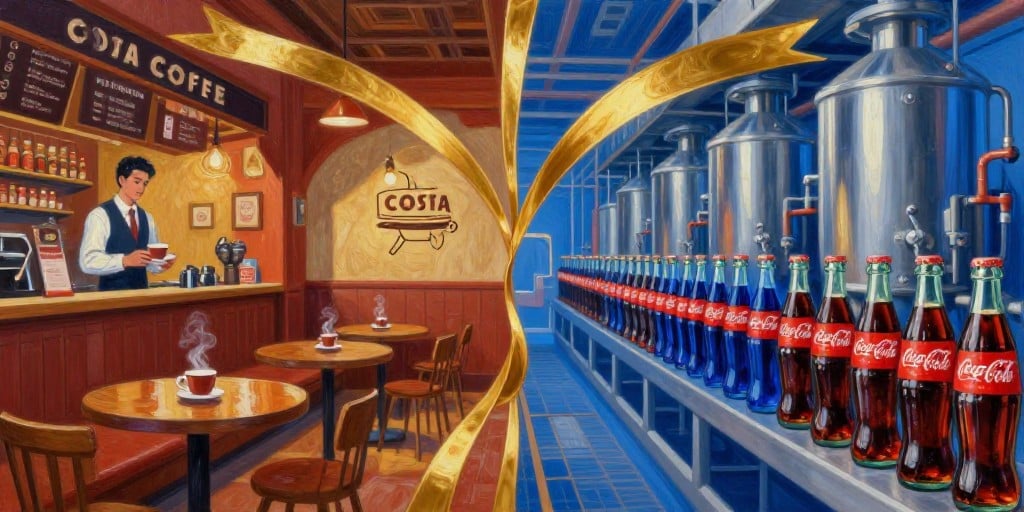
Corporate News – Analysis of Coca‑Cola’s Divestiture of Costa Coffee
Coca‑Cola’s decision to divest its stake in Costa Coffee marks a strategic pivot that echoes broader trends in the consumer‑goods and retail sectors. The move—following an earlier failed sale attempt—highlights the company’s intent to tighten its focus on core beverage categories while optimizing operational efficiency. In what is increasingly becoming a common strategy among multinational consumer‑goods firms, the divestiture underscores a shift toward portfolio concentration and resource reallocation toward high‑margin, high-growth segments.
Consumer‑Goods Trends and Brand Positioning
The beverage industry is currently undergoing a convergence of two key dynamics: a heightened emphasis on health‑conscious and functional products, and a tightening of brand portfolios to accelerate profitability. Coca‑Cola’s core offerings—carbonated drinks, teas, and bottled water—continue to command the largest market share and exhibit robust growth in emerging economies, while premium coffee, though profitable, operates in a highly fragmented market with thin margins.
From a strategic viewpoint, the decision to shed Costa Coffee can be read as an alignment of brand positioning with the company’s long‑term vision: to reinforce its status as a global leader in the “ready‑to‑drink” category, while delegating niche or specialty segments to dedicated operators. This mirrors the pattern observed in other consumer‑goods giants that have divested non‑core assets—such as Procter & Gamble’s exit from certain personal‑care lines—to channel capital into innovation and market expansion.
Omnichannel Retail Innovation
Costa Coffee’s extensive network of physical outlets presents both an opportunity and a challenge for a company whose distribution strategy is increasingly channel‑agnostic. While omnichannel retail—combining brick‑and‑mortar presence with e‑commerce, mobile ordering, and delivery services—has become a competitive advantage, the operational cost structure of maintaining a large outlet footprint can dilute returns for a beverage conglomerate whose core strength lies in high‑volume manufacturing and global logistics.
By divesting, Coca‑Cola can streamline its retail footprint and reallocate resources toward digital initiatives such as mobile payment integration, loyalty platforms, and data‑driven supply chain optimization. These innovations not only improve customer engagement but also reduce overhead, thereby boosting overall profitability.
Supply Chain Innovation and Cost Efficiency
The coffee chain’s supply chain is distinct from Coca‑Cola’s established beverage supply network. While coffee sourcing benefits from specialized expertise, the logistics of delivering fresh brewed coffee to hundreds of outlets is considerably more complex than bottling water or distributing ready‑to‑drink teas. Integrating these supply chains under a single corporate umbrella can incur significant inefficiencies.
A divestiture allows Coca‑Cola to focus on the high‑yield, low‑complexity segments of its portfolio, while enabling Costa Coffee to be acquired by a specialty coffee operator or investment firm that can better match supply‑chain expertise with business needs. This reallocation of assets is expected to improve the overall return on investment and free capital for reinvestment into core product lines or emerging markets.
Market Data and Cross‑Sector Patterns
Recent industry data reveal that consumer spending in the premium coffee segment has grown at a CAGR of 5.8% over the past five years, yet the profit margin has lagged behind that of bottled water and tea by 2‑3 percentage points. Simultaneously, the global beverage market is shifting toward functional drinks, with a CAGR of 6.1% in the health‑and‑wellness category. Coca‑Cola’s divestiture aligns with these macro trends, positioning the company to capitalize on higher‑margin opportunities.
Cross‑sector analysis shows a growing trend of large consumer‑goods conglomerates offloading specialty or low‑margin brands. This pattern has been observed in the packaging, personal care, and even automotive sectors, where companies focus on high‑growth, high‑margin niches while outsourcing specialized operations to industry specialists. Coca‑Cola’s move is consistent with this broader industry pattern.
Short‑Term Market Movements vs. Long‑Term Transformation
In the short term, the announcement is likely to lift Coca‑Cola’s share price modestly, as investors interpret the divestiture as a cost‑saving and margin‑enhancing measure. The transaction will also reduce the company’s balance‑sheet complexity, potentially improving credit metrics and reducing debt costs.
However, the long‑term transformation is more substantial. By concentrating on its core portfolio, Coca‑Cola positions itself to invest in emerging categories—such as plant‑based drinks, functional beverages, and sustainable packaging—that are poised for significant growth. The divestiture also signals a strategic clarity that may attract new partnerships or acquisitions aligned with the company’s vision, thereby accelerating its evolution into a more agile, consumer‑centric organization.
Bottom Line
Coca‑Cola’s decision to sell its stake in Costa Coffee is a strategic response to shifting consumer preferences, cost‑structure realities, and the imperative for portfolio optimization. By divesting a non‑core, low‑margin asset, the company frees resources that can be deployed in high‑growth, high‑margin sectors, aligns its brand positioning with contemporary consumer expectations, and leverages omnichannel retail and supply‑chain efficiencies. This move not only addresses immediate financial considerations but also sets the stage for long‑term transformation in an increasingly dynamic consumer‑goods landscape.