
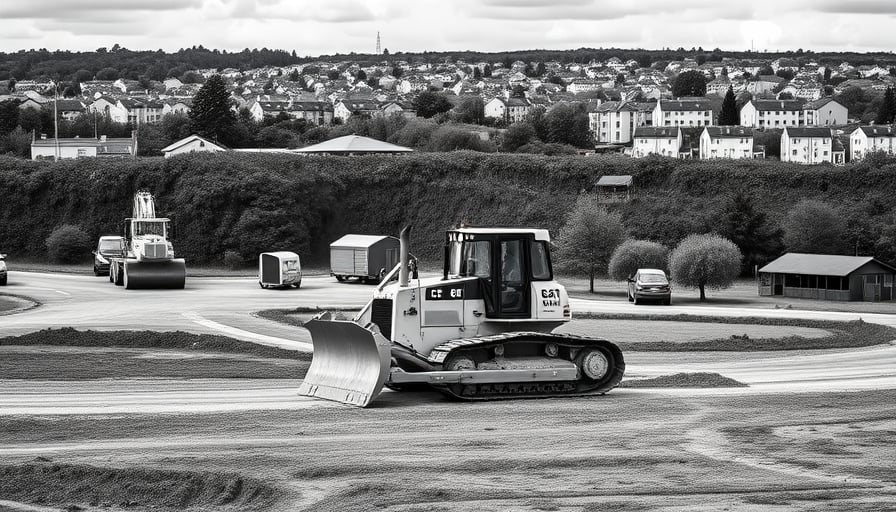
Caterpillar’s Strategic Emphasis on Industrial AI and Autonomy
Caterpillar Inc. has announced a series of developments that underscore its focus on industrial artificial intelligence and autonomy. The company introduced the Cat AI Assistant, a client‑facing platform that enables customers to interact with its equipment and digital services, aiming to improve worksite productivity. In a related move, Caterpillar will showcase its next‑generation industrial AI and autonomous technologies at the upcoming CES event, highlighting how these innovations are reshaping construction, mining and forestry operations.
Analysts have taken a positive view of the company’s technology push. Wolfe Research recently raised its price target for the stock, reflecting confidence in Caterpillar’s growth prospects, while Zacks analysts noted that the firm’s robust backlog, revenue expansion and heightened demand for data‑center capabilities are shaping a favorable outlook for 2026.
Overall, Caterpillar’s latest announcements reinforce its commitment to advancing digital solutions for heavy‑machinery customers, and market observers appear to view these initiatives as a potential catalyst for continued performance gains.
Contextualizing the Shift to Digital‑First Heavy‑Machinery
The construction, mining, and forestry sectors have traditionally relied on mechanical reliability and operational efficiency. However, a convergence of data‑analytics maturity, edge‑computing advancements, and the proliferation of sensor networks is accelerating the adoption of AI‑driven decision support and autonomous control. In this landscape, Caterpillar’s Cat AI Assistant represents a strategic pivot from purely hardware provision to a comprehensive digital‑platform offering. By integrating real‑time telemetry, predictive maintenance, and workflow optimization into a single interface, the company is positioning itself as a systems integrator rather than just a component supplier.
Market Dynamics and Competitive Positioning
Key industry players such as Komatsu, Volvo Construction Equipment, and John Deere are also investing heavily in AI and autonomous technology, creating a competitive field where differentiation hinges on data‑ownership, platform scalability, and ecosystem partnerships. Caterpillar’s early commitment to AI, coupled with its extensive global service network and established customer base, affords it a first‑mover advantage in capturing high‑value digital services contracts. Furthermore, the company’s existing investments in the Connected Infrastructure ecosystem provide a robust foundation for rapid deployment of new AI capabilities.
Economic Drivers and Cross‑Sector Implications
The demand for data‑center capabilities is rising as industrial firms transition to “Industry 4.0” models. This shift fuels growth in edge‑computing hardware, software licensing, and subscription‑based services—areas where Caterpillar’s Cat AI Assistant can generate recurring revenue. Additionally, the global push for sustainability is encouraging the adoption of autonomous machinery to reduce fuel consumption and emissions. By offering AI solutions that optimize asset utilization, Caterpillar can help operators meet regulatory targets and ESG goals, further strengthening its value proposition.
Analyst Sentiment and Forecast
Wolfe Research’s upward revision of the price target reflects an assessment that Caterpillar’s AI strategy will unlock significant upside in operating margins, driven by higher service revenue per unit and improved asset utilization. Zacks analysts highlight the company’s robust backlog—a testament to committed future revenue—as well as the growing appetite for data‑center services in the heavy‑machinery market. Together, these factors suggest a solid outlook for 2026, with the potential for Caterpillar to deliver both top‑line growth and margin expansion.
Conclusion
Caterpillar’s recent announcements signal a clear shift toward a digital‑centric business model. By integrating AI and autonomy into its product lineup and leveraging a global service ecosystem, the company is well‑positioned to capture emerging opportunities in construction, mining, and forestry. As analysts remain upbeat and market observers acknowledge the strategic significance of these moves, Caterpillar’s trajectory appears poised to deliver sustained performance gains in the coming years.