
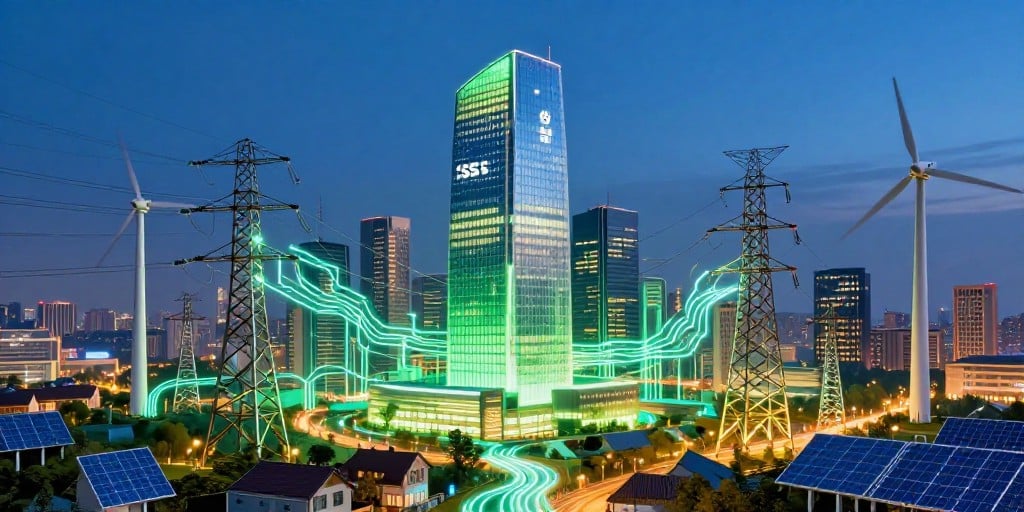
Corporate Developments and Their Implications for the UK Power System
The United Kingdom’s regulatory regime recorded two significant ownership notifications concerning SSE PLC on 29 July 2026. The filings, submitted by The Capital Group Companies, Inc. and BlackRock, Inc., detail the investors’ increased voting interests that now exceed the statutory thresholds for public disclosure. While the announcements themselves contain no comment from SSE or any immediate market‑impact statements, the heightened concentration of institutional ownership has ramifications that extend beyond corporate governance and into the technical and economic fabric of the country’s electricity sector.
1. Ownership Concentration and Market‑Stability Dynamics
From an engineering‑finance perspective, the influx of large, sophisticated capital into a major transmission and distribution operator can influence the company’s risk appetite and capital‑allocation priorities. Institutional stakeholders typically bring disciplined investment horizons and a focus on long‑term value creation. Their presence may:
| Investor | Voting Interest | Potential Influence | Impact on Grid Operations |
|---|---|---|---|
| The Capital Group | > 5 % voting rights | Strategic oversight on asset upgrades | Accelerated deployment of grid‑modernization projects |
| BlackRock | > 5 % voting rights | Portfolio‑level risk management | Enhanced focus on resilience and ESG compliance |
The dual rise in voting power can reinforce SSE’s capacity to secure financing for critical infrastructure investments—particularly those required to maintain grid stability amid growing renewable penetration.
2. Renewable Integration and Grid Stability Challenges
The UK’s power generation mix is undergoing a rapid shift toward intermittent renewable sources such as offshore wind and solar PV. This transition imposes stringent demands on the transmission and distribution networks:
- Variability Management: Renewable output fluctuates on timescales of minutes, necessitating sophisticated balancing mechanisms. The increased capital support from institutional investors can facilitate the deployment of advanced energy‑storage systems and real‑time monitoring platforms.
- Grid Congestion: Concentrated wind output in the North Sea can overload existing interconnectors. Enhanced funding may expedite the reinforcement of high‑capacity cables and the installation of flexible AC transmission systems (FACTS).
- Resilience to Extreme Events: Climate‑related extremes (heatwaves, storms) test the robustness of both overhead and underground assets. A stronger equity base can support the transition to underground cabling in critical corridors, reducing outage frequency and duration.
3. Infrastructure Investment Requirements
Maintaining grid reliability while integrating renewables requires sustained capital outlays. Current estimates for the UK’s 2035 network upgrade roadmap suggest:
| Asset Category | Planned Upgrade | Estimated Cost (£ bn) |
|---|---|---|
| Transmission Lines | 400 km of 400 kV upgrades | 2.0 |
| Substation Modernization | 350 new substations | 1.5 |
| Advanced Distribution | Smart meters + microgrids | 0.8 |
| Energy Storage | 5 GWh of battery storage | 1.0 |
Institutional ownership can aid in bridging financing gaps through blended funding structures, such as green bonds or infrastructure investment trusts (InvITs). Moreover, stronger equity positions improve credit ratings, reducing borrowing costs for large‑scale projects.
4. Regulatory Frameworks and Rate Structures
The regulatory environment in the UK—dominated by the Office of Gas and Electricity Markets (Ofgem)—sets the parameters for how investment returns are translated into consumer prices. Key elements include:
- Energy Price Review (EPR): Ofgem assesses the “fair share” of investment that can be recovered through tariffs. Institutional investors’ demand for higher returns may influence Ofgem’s assessment of acceptable rates.
- Smart Metering and Distribution Network Operator (DNO) Charges: The DNO’s revenue structure must balance network investment costs with affordability. Greater investment can shift the burden toward capacity charges, potentially mitigating wholesale price volatility.
- Carbon Pricing and ESG Compliance: Investors with sustainability mandates may push SSE to accelerate low‑carbon projects, affecting the cost of capital and, by extension, consumer tariffs.
The interplay between these regulatory levers and investor expectations will shape the trajectory of electricity pricing, especially as the network transitions toward a lower‑carbon paradigm.
5. Economic Impacts on Consumers and the Broader Economy
From an engineering‑economic viewpoint, the cost of grid upgrades is passed on to end‑users through two primary mechanisms:
- Capacity Charges – A direct correlation between network investment and consumer bills. Institutional support can moderate the pace of cost escalation.
- Energy Prices – Indirectly affected by wholesale market dynamics. Enhanced grid flexibility can smooth price swings, benefiting households and businesses.
Moreover, robust investment in grid resilience can yield broader economic benefits: reduced unplanned outages lower productivity losses; improved renewable integration attracts further clean‑energy projects, creating jobs and fostering innovation.
6. Conclusion
The simultaneous ownership notifications from The Capital Group and BlackRock signify a strengthening of institutional influence within SSE PLC. While the disclosures themselves do not alter operational parameters immediately, they underscore a growing alignment between capital markets and the technical imperatives of the UK power system. The infusion of disciplined, long‑term capital can accelerate essential upgrades, improve grid stability in the face of renewable variability, and help navigate the complex regulatory landscape that governs electricity pricing. Ultimately, these developments reinforce the intertwined nature of corporate governance, engineering excellence, and economic stewardship in achieving a reliable, low‑carbon electricity future.