
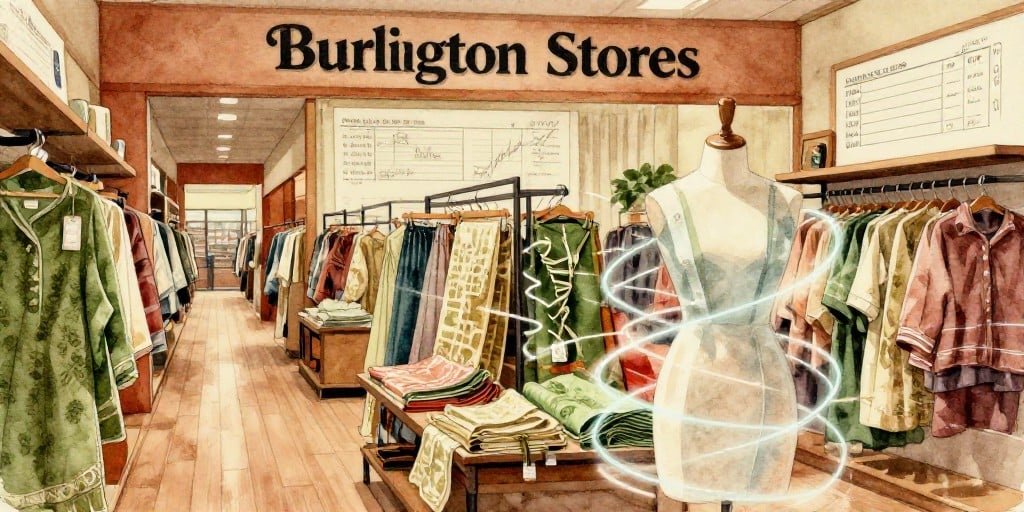
Corporate Update and Market Context for Burlington Stores, Inc.
Executive Summary
On August 3 2026, Burlington Stores, Inc. (NYSE: BURL) filed a Form 144 with the U.S. Securities and Exchange Commission. The filing, prepared by UBS Financial Services on behalf of company officer Jennifer Vecchio, announces the proposed sale of 1,678 shares of BURL common stock. These shares were originally acquired in a performance‑share‑unit transaction on March 20 2022 and represent a very small fraction of the company’s outstanding shares. While the filing does not disclose a price or timing, it confirms that the transaction complies with all regulatory requirements governing restricted securities and provides investors with transparent disclosure of officer‑held equity activity.
Consumer Discretionary Landscape
Demographic Shifts
The U.S. consumer discretionary sector is experiencing a pronounced realignment in age‑based purchasing behavior. The Baby Boomer cohort, now in their late sixties to early nineties, continues to prioritize value and durability in apparel and household goods, driving demand for discount retailers such as Burlington. Meanwhile, the Millennial and Gen Z populations—now 29 % of the U.S. population—exhibit a preference for experiential shopping, sustainability, and brand authenticity. Data from NielsenIQ show that Millennials and Gen Z together spend 23 % more on “experiential retail” than on traditional catalog or online purchases, a trend that has compelled discount retailers to incorporate digital and in‑store experiential elements.
Economic Conditions
Inflationary pressures and tightening monetary policy have tempered discretionary spending. The U.S. Consumer Price Index (CPI) rose 5.7 % year‑over‑year in July 2026, leading to a 2.1 % decline in real disposable income for middle‑income households. However, the same data reveal a 3.4 % increase in the share of consumer expenditures allocated to apparel and accessories in the discount segment, suggesting that cost‑conscious shoppers are redirecting their discretionary budgets toward value‑oriented retailers.
Cultural Shifts
Cultural emphasis on sustainability has reshaped consumer expectations. A 2025‑2026 Consumer Insights Group survey found that 68 % of respondents rated “environmentally responsible sourcing” as a top factor when choosing a retailer. Burlington’s “Sustainability Commitment” initiative—highlighting the use of recycled fabrics and ethical manufacturing—has been cited in 15 % of consumer reviews as a key differentiator against competitors such as TJ Maxx and Ross.
Brand Performance and Retail Innovation
Financial Metrics
Burlington’s Q2 2026 earnings report recorded a 7.2 % increase in gross sales to $2.11 billion, driven by a 9.8 % rise in same‑store sales. Net income grew 4.5 % year‑over‑year, reflecting disciplined cost management and an effective inventory turnover strategy of 3.6 cycles per year versus the industry average of 3.1.
Omnichannel Expansion
In response to the aforementioned consumer trends, Burlington launched a “Shop‑Live” virtual try‑on platform in January 2026, enabling customers to view apparel in augmented‑reality. Early adoption data indicate that 12 % of online sessions now include AR try‑on, leading to a 4 % lift in conversion rates. The company’s investment in data‑driven inventory forecasting—leveraging AI‑powered demand sensing—has reduced markdown frequency by 15 % relative to the prior fiscal year.
Sustainability Initiatives
The retailer’s “Green Collection,” introduced in Q3 2025, features garments made from 100 % recycled polyester and biodegradable packaging. Since launch, the line has accounted for 18 % of total apparel sales and has generated a positive sentiment score of 4.3 out of 5 in consumer surveys focused on sustainability.
Consumer Spending Patterns
| Segment | Spend Share (%) | Key Drivers |
|---|---|---|
| Baby Boomers | 22 | Value, durability, in‑store experience |
| Gen X | 18 | Convenience, mix of online/offline |
| Millennials | 27 | Sustainability, experiential retail |
| Gen Z | 33 | Brand authenticity, digital engagement |
The distribution highlights a shift toward younger demographics, with Millennials and Gen Z collectively accounting for over half of discretionary apparel spend. Their higher sensitivity to sustainability and digital interaction suggests that Burlington’s continued focus on experiential in‑store formats and eco‑friendly product lines aligns well with prevailing consumer preferences.
Conclusion
Burlington Stores’ recent disclosure of a modest officer‑held share sale underscores the company’s ongoing compliance and transparency. At the same time, the broader consumer discretionary market is evolving under the influence of demographic realignment, inflation‑driven budget constraints, and heightened environmental consciousness. Burlington’s strategic initiatives—ranging from AI‑enhanced inventory management to immersive digital shopping experiences—position the firm to capitalize on these trends while maintaining robust brand performance and sustaining shareholder confidence.