
Corporate Update – BHP Group Ltd. on 8 July 2026
BHP Group Ltd. experienced a mixed day in the Australian market on 8 July 2026, as the S&P/ASX 200 slipped slightly, reflecting broader pressure on base‑metal and energy shares. The miner’s share price moved little against the backdrop of a falling index, while other major miners such as Fortescue and Rio Tinto recorded small declines.
Key Events
| Event | Summary | Market Implications |
|---|---|---|
| Escondida Expansion Approval | BHP announced it has secured its first environmental approval for a significant expansion of the Escondida copper mine in Chile. The approval covers early‑stage work on sulfide leaching and power upgrades and is the initial step toward a planned investment of roughly $15 billion across the site. | The approval signals BHP’s commitment to increasing copper output, aligning with its long‑term objective of doubling production by the mid‑2030s. It also reflects the growing demand for copper, driven by global electrification and renewable energy deployment. |
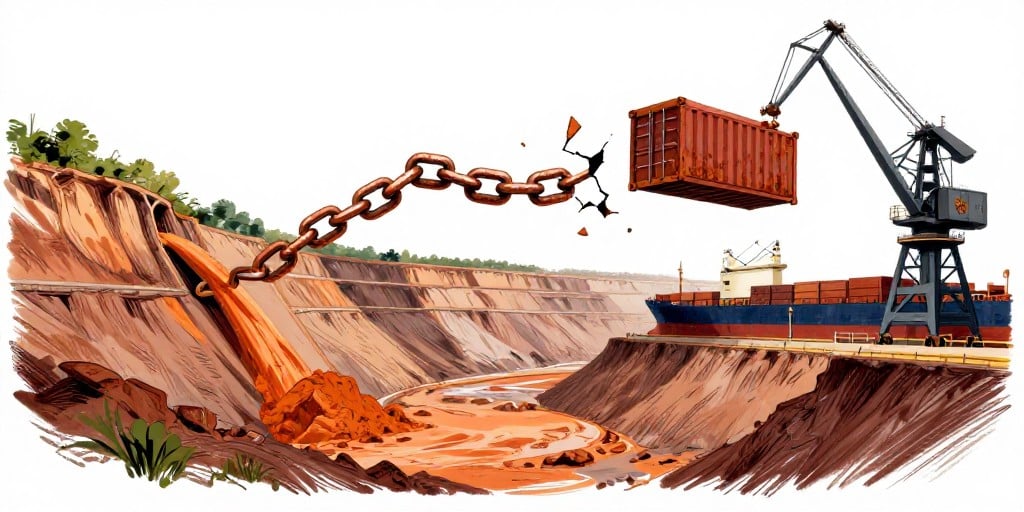
| Port Hedland Terminal Strike | Workers from the Combined Ports Unions are scheduled to strike on 16 July, affecting BHP operations at its Port Hedland terminal. The action follows six months of negotiations and could impact supply from the world’s largest iron‑ore export port, a key conduit for BHP’s iron‑ore traffic to China and other markets. | The potential disruption could temporarily reduce BHP’s iron‑ore throughput, affecting revenue streams. The company has reiterated its focus on reaching a fair agreement while maintaining operational continuity. |
| Market Context | The S&P/ASX 200 slipped slightly, reflecting broader pressure on base‑metal and energy shares. | BHP’s share price movement was largely flat, suggesting limited short‑term reaction to the day’s events, but the market environment remains testing the resilience of mining stocks. |
Strategic Analysis
Diversified Asset Portfolio BHP’s simultaneous focus on copper expansion and iron‑ore logistics underscores its strategy to diversify revenue sources across metals with complementary demand drivers. Copper, central to the global transition to clean energy, offers growth potential, while iron ore remains a stable commodity with strong demand from China’s infrastructure sector.
Risk Management at Flagship Assets The Port Hedland strike highlights the importance of labor relations in maintaining supply chain continuity. BHP’s proactive stance—seeking a fair agreement while safeguarding operations—illustrates its commitment to mitigating operational risks that could otherwise erode earnings.
Capital Allocation Efficiency The $15 billion investment at Escondida is a calculated move to secure long‑term supply of copper. By initiating early‑stage work on sulfide leaching, BHP is positioning itself to capitalize on technological advancements that improve yield and reduce environmental impact, thereby enhancing its competitive positioning in a market increasingly focused on ESG metrics.
Macroeconomic and Commodity Dynamics The day’s market decline reflects global uncertainty over interest rates and supply‑chain disruptions. Base‑metal stocks, including BHP, are sensitive to such macro signals. Nonetheless, BHP’s diversified portfolio and forward‑looking projects provide a buffer against short‑term volatility.
Cross‑Sector Linkages The expansion at Escondida dovetails with broader trends in the renewable energy and electric‑vehicle sectors, both of which rely heavily on copper. Similarly, the Port Hedland terminal remains a critical node in the global steel supply chain, linking mining with manufacturing and construction industries.
Bottom Line
BHP Group Ltd. continues to navigate a challenging market environment while pursuing growth in copper production and maintaining operational resilience at its core assets. The company’s strategic investments, coupled with a disciplined approach to risk management and capital allocation, position it to capture opportunities across multiple commodity markets.