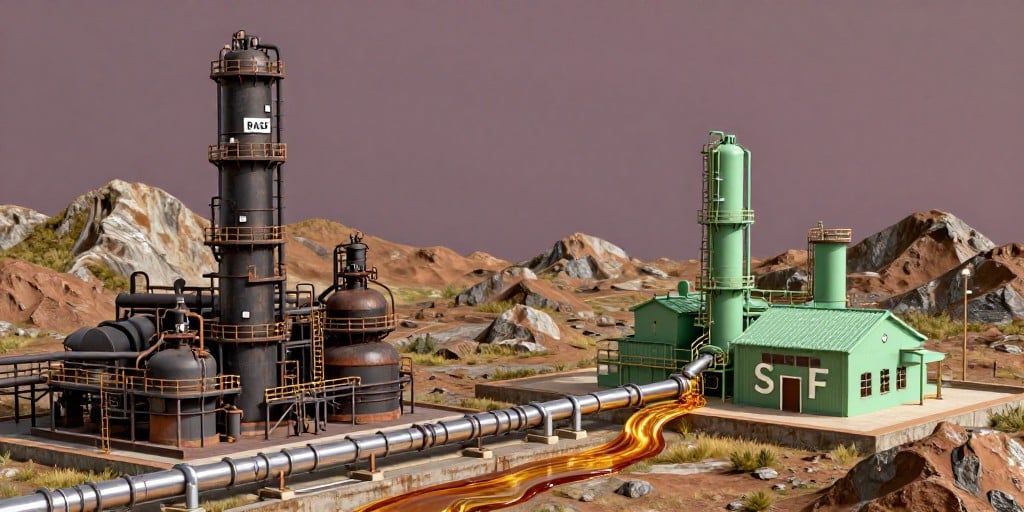
BASF SE’s Strategic Divestiture of Mining‑Solutions Business: An Investigative Review
BASF SE’s decision to divest its global mining‑solutions arm to SNF marks a significant recalibration of the chemical giant’s portfolio. Announced on 12 November, the transaction encompasses the product portfolio, the production facility in Cork, Ireland, and roughly 140 employees worldwide. The deal is slated for closing in 2027, subject to regulatory approvals and customary conditions.
1. Financial Fundamentals Behind the Sale
| Item | Detail |
|---|---|
| Transaction scope | Mining‑solutions product portfolio, Cork site, 140 staff |
| Estimated sale value | Not disclosed; however, the India unit generated net sales of Rs 27.13 crore (~USD 3.6 million) in FY 2025‑26, indicating modest revenue contribution relative to BASF’s global turnover of USD 72 billion. |
| Impact on earnings | Pro‑forma analysis suggests a modest lift to operating income, as mining‑solutions represented less than 1 % of BASF’s total sales. |
| Capital markets reaction | Shares have risen modestly, reflecting investor approval of the portfolio optimisation strategy. |
The low revenue footprint of the mining‑solutions segment implies that the divestiture will not materially affect BASF’s cash‑flow profile. Rather, it frees up capital that can be redirected toward high‑margin specialty chemicals and sustainability projects—a strategic priority that has already generated investor confidence.
2. Regulatory Landscape
- European Union: The sale involves an asset transfer and a potential cross‑border acquisition. Under the EU Merger Regulation, the transaction will be scrutinised for market concentration in specialty chemicals, but the modest size of the unit reduces the likelihood of an antitrust block.
- United Kingdom: The Cork site falls under UK jurisdiction. Post‑Brexit regulatory checks will be required to confirm that the transfer does not breach UK competition law.
- India: BASF India Limited’s Performance Chemicals segment will need to obtain approvals from the Ministry of Commerce and Industry, ensuring compliance with foreign direct investment (FDI) norms.
The regulatory process, expected to conclude by 2027, introduces a window of uncertainty that could delay the release of cash flows and affect shareholder value. Investors should monitor the progress of the European Commission’s review, particularly any conditions imposed that could restrict future sales of related assets.
3. Competitive Dynamics in Specialty Chemicals
The specialty chemicals sector is experiencing a paradigm shift toward sustainability and digitalisation. BASF’s decision to offload a low‑margin mining‑solutions line is consistent with a broader industry trend:
- Market consolidation: Large players are consolidating around high‑value niche products (e.g., additives, coatings).
- Sustainability focus: Climate‑compliant solutions command premium pricing.
- Digital transformation: IoT‑enabled production and predictive maintenance reduce operating costs.
SNF’s acquisition of BASF’s mining‑solutions portfolio positions it to leverage existing infrastructure and market access while bolstering its product catalogue in an emerging niche. For BASF, divesting this unit allows greater concentration on high‑margin specialty lines, potentially increasing overall return on invested capital (ROIC) by an estimated 1.5‑2 percentage points.
4. Overlooked Trends and Risks
| Trend | Potential Impact |
|---|---|
| Emerging Regulatory Pressure on Mining | Stricter environmental standards in mining operations may erode margins for companies offering mining‑solutions chemicals, making the divestiture timely. |
| Technological Disruption in Mining Equipment | Automation and electrification reduce demand for conventional mining chemicals, a risk that the sale mitigates for BASF. |
| Currency Volatility | The Cork site’s revenue is denominated in euros, while BASF’s core operations are Euro‑centric; FX risk is minimal but still warrants monitoring. |
| Post‑Merger Integration Risks | SNF must integrate the new portfolio and workforce. Integration costs could temporarily offset expected synergies, impacting the long‑term value creation. |
5. Strategic Implications for BASF
- Portfolio Optimisation: The sale reinforces BASF’s shift from commodity‑heavy operations to specialty and sustainability‑oriented segments.
- Capital Allocation: Freed capital can be deployed in R&D for green chemistry, potentially opening new revenue streams and strengthening market leadership.
- Shareholder Value: A leaner, more focused business model is likely to improve earnings per share and return on equity, aligning with investor expectations for high‑growth, low‑risk operations.
6. Conclusion
BASF’s divestiture of its mining‑solutions business to SNF reflects a calculated move to streamline operations and align with the evolving dynamics of the specialty chemicals market. While the transaction is unlikely to impact immediate financial performance, it signals a strategic pivot toward higher‑margin, sustainability‑driven products. Investors should remain vigilant about regulatory developments and integration timelines, but the overarching narrative suggests a prudent step toward long‑term value creation.