
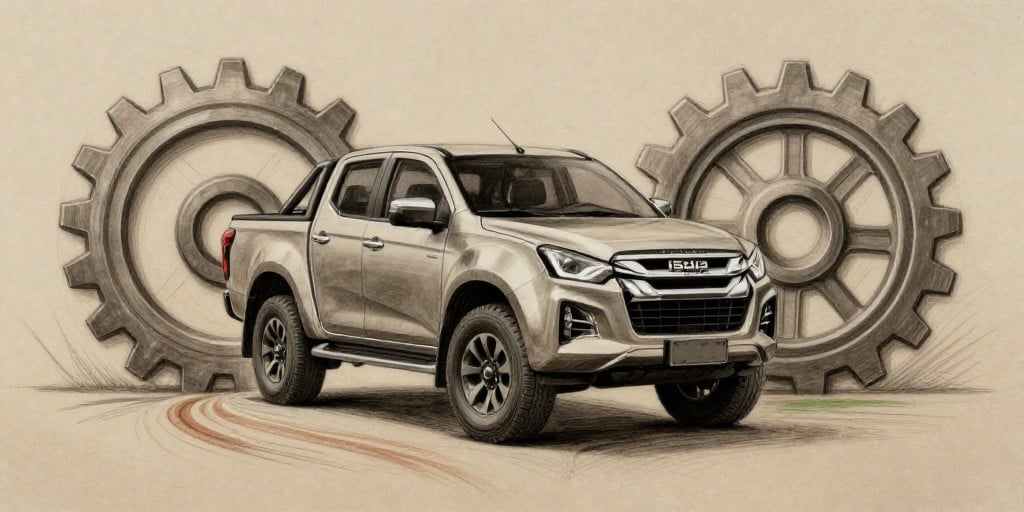
Corporate Analysis of Aisin Corp’s Role in the Updated Isuzu D‑Max Pickup
Aisin Corp, a prominent supplier of automotive components, has been prominently featured in a recent industry report concerning the latest generation of the Isuzu D‑Max pickup. The report highlights the significant power‑train overhaul, chassis refinement, and interior modernization that collectively enhance the vehicle’s competitiveness in the light‑commercial and utility segments.
Power‑train Enhancements and Transmission Upgrade
The new D‑Max now employs a 2.2‑litre diesel engine that delivers horsepower figures comparable to the previous generation while expanding the torque curve for improved low‑speed performance. Aisin’s eight‑speed automatic transmission—upgraded from the earlier six‑speed variant—has been integrated with the engine. This partnership yields smoother gear changes, better drivability, and a more efficient use of fuel, attributes that are particularly valuable to fleet operators who prioritize operational reliability and cost control.
From an industrial perspective, Aisin’s transmission technology is a key differentiator in the commercial vehicle market. The eight‑speed unit’s higher gear ratio density allows for finer torque management and can reduce wear on drivetrain components, thereby extending service intervals. Such reliability gains align with the sector’s emphasis on long‑term ownership costs, a factor that often drives procurement decisions in fleet management.
Platform and Chassis Refinement
While the overarching platform remains robust—suitable for both light commercial and utility applications—the chassis and bodywork have undergone a refresh. The updated layout preserves the D‑Max’s proven durability while accommodating the new power‑train architecture. The integration of Aisin’s gearbox within this framework exemplifies the modular approach that is becoming increasingly common across automotive suppliers. By providing a plug‑and‑play component that can be adapted to various engine configurations, Aisin positions itself to serve a broader range of manufacturers beyond Isuzu, thereby diversifying its revenue streams.
Interior Modernization and Safety Features
The vehicle’s interior has been updated with a revised dashboard and a standard seven‑color display, enhancing user interface and accessibility. A key feature is the addition of an infrared camera‑based driver‑monitoring system, which contributes to advanced driver assistance systems (ADAS). The inclusion of lane‑departure alerts further strengthens the safety profile of the vehicle. These developments reflect the broader industry trend toward integrating digital connectivity and safety technologies even in traditionally utilitarian models. By providing these capabilities, Aisin helps Isuzu maintain competitiveness against rivals that are rapidly incorporating similar features into their own light‑commercial offerings.
Market Positioning and Strategic Implications
Price remains a critical lever in the D‑Max’s segment. The updated powertrain and transmission are expected to bolster the vehicle’s appeal among fleet operators and individual buyers alike, who increasingly demand both performance and economy. Aisin’s contribution—particularly the reliable and service‑friendly eight‑speed transmission—serves to differentiate the D‑Max from competing models that still rely on older, less efficient transmission systems.
Strategically, the partnership underscores a broader economic trend: automotive suppliers are increasingly acting as co‑designers, embedding value‑added technology that can directly influence a vehicle’s total cost of ownership (TCO). By providing components that lower maintenance costs and improve fuel efficiency, suppliers like Aisin can secure long‑term contracts with OEMs and capture a share of the after‑sales market. This shift aligns with the automotive industry’s move toward circular business models, where component longevity and repairability become integral to corporate profitability.
Cross‑Sector Connections
The dynamics observed in the D‑Max case resonate beyond the automotive sector. Industries such as logistics, construction, and even maritime transport are similarly gravitating toward modular, high‑efficiency powertrains coupled with advanced driver‑support systems. The emphasis on reduced operating costs and improved reliability is a common thread across these sectors. Aisin’s success with the D‑Max demonstrates how supplier innovation can catalyze performance gains that are transferable to other commercial vehicle domains, reinforcing its status as a critical partner in the evolution of modern, versatile commercial transport.
In conclusion, Aisin Corp’s involvement in the latest iteration of the Isuzu D‑Max exemplifies how strategic supplier partnerships can enhance a vehicle’s market positioning through technological advancement and cost‑efficient design. The integration of an advanced eight‑speed transmission, coupled with chassis and interior refinements, positions the D‑Max as a compelling option for both fleet operators and individual buyers, while simultaneously strengthening Aisin’s foothold in the competitive automotive component landscape.