
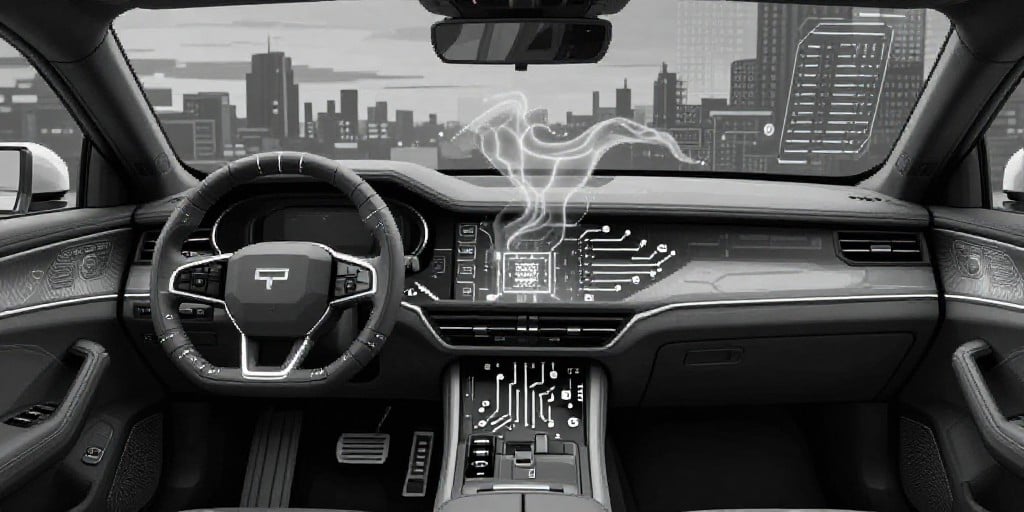
The Ascendant Role of Artificial Intelligence in the Automotive Value Chain
The automotive sector is undergoing a profound transformation as artificial intelligence (AI) moves from a peripheral technology to the core of vehicle architecture. Traditional manufacturers, long reliant on mechanically oriented production processes, are now confronting a paradigm shift that prioritises software‑driven solutions. This shift is reshaping the entire value chain, from design and manufacturing to aftermarket services, and is placing significant pressure on legacy players—particularly German premium brands such as Volkswagen and Porsche—to accelerate their digital transition.
From Mechanics to Code: A Fundamental Shift
For decades, the competitive advantage of German automakers has stemmed from precision engineering, high‑quality manufacturing, and a robust supply‑chain network. Their production lines have historically been designed for incremental hardware upgrades and component‑centric innovation. In contrast, AI‑driven platforms require rapid iteration, data integration, and the ability to deploy updates over the air. Consequently, the traditional “hardware‑first” model is increasingly misaligned with market demands for software flexibility, connectivity, and autonomous capabilities.
German Premium Brands: Navigating Fragmentation and Delayed Innovation
Volkswagen and Porsche, both hallmarks of German automotive excellence, face a dual challenge:
Fragmented Development Ecosystems Their architecture is often built on a mosaic of suppliers and legacy components. Each component—sensors, powertrains, infotainment—has its own development cycle, leading to longer lead times and higher integration costs.
Hardware‑Centric Upgrade Path Hardware updates are typically tied to the production cycle, meaning that any software innovation must be bundled with a new vehicle generation. This approach reduces responsiveness to rapid technological changes and limits the ability to offer iterative feature updates.
These constraints are exacerbated by the stringent regulatory environment in the European market, where safety and emissions standards necessitate rigorous validation cycles that can further delay the deployment of AI‑based features.
BYD’s Integrated AI Strategy: A Benchmark for Rapid Deployment
By contrast, Chinese electric‑vehicle manufacturer BYD has implemented a vertically integrated AI strategy that demonstrates the benefits of a unified, software‑centric approach:
In‑House AI Chips BYD designs its own silicon for on‑board inference, reducing dependence on external suppliers and enabling tighter performance‑power trade‑offs.
Centralised Control Architecture The company employs a single, modular architecture that consolidates vehicle functions—perception, planning, actuation—into a unified software stack. This reduces complexity and facilitates rapid feature roll‑outs.
Accelerated Time to Market By eliminating the need for multi‑vendor coordination, BYD shortens the development cycle, allowing new AI features to be deployed through over‑the‑air updates.
The BYD model exemplifies how a streamlined architecture can create a competitive edge in an industry where speed, flexibility, and integration are paramount.
Economic Implications and Market Volatility
The transition to AI‑centric models introduces several economic dynamics that are likely to increase volatility in the sector:
Capital Allocation Shifts Companies that can pivot quickly to software development may attract greater investor capital, while those locked into legacy hardware may face diminishing returns.
Supply‑Chain Disruption The demand for specialized AI chips and integrated platforms could strain existing supplier networks, leading to price volatility and supply constraints.
Regulatory Evolution As safety standards evolve to incorporate AI validation, compliance costs will rise, potentially widening the performance gap between agile firms and traditional players.
These factors suggest that the automotive market is poised for significant restructuring. Firms that can successfully reorient their value chains toward AI will be better positioned to capture emerging opportunities, while those unable to adapt may experience eroded margins and market share.
Investment Outlook
Investors should monitor the following indicators when evaluating exposure to the automotive sector:
| Indicator | Rationale |
|---|---|
| Software Development Pipeline | A robust pipeline indicates readiness for rapid feature updates. |
| Supply‑Chain Integration | Centralised control reduces fragmentation and costs. |
| Capital Expenditure on AI R&D | Higher investment reflects commitment to future capabilities. |
| Regulatory Compliance Track Record | Demonstrates ability to meet evolving safety standards. |
Given the volatility and the high stakes associated with digital transformation, opportunities may arise for firms that can successfully transition toward AI‑centric models. Conversely, companies that remain entrenched in mechanically driven production risk falling behind in a rapidly evolving marketplace.