
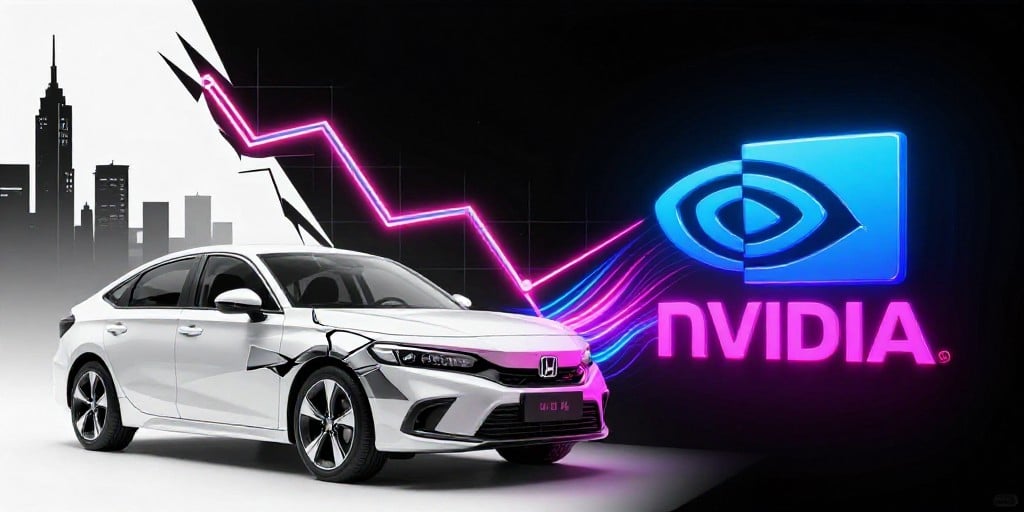
Honda Motor Co. Ltd. Announces 2026 Production Cut in China
Honda Motor Co. Ltd. has formally declared a substantial reduction in vehicle production within China for the 2026 fiscal year, with the company planning to cut output by roughly forty percent. This decision is rooted in persistently weak demand and intensified competition from domestic electric‑vehicle (EV) manufacturers. As a result, Honda is scaling back its manufacturing operations in the region, a move that is poised to generate significant repercussions for suppliers and factory utilization across China.
Market Dynamics and Competitive Landscape
China remains the world’s largest automotive market, yet it is undergoing a rapid transformation driven by stringent emissions regulations, aggressive government incentives for EVs, and a surge in local EV producers such as BYD, NIO, and Xpeng. Honda’s decision reflects a strategic response to these evolving dynamics. While the company has historically leveraged its reputation for reliability and hybrid technology, the current environment favors high‑volume, low‑cost EV production that many domestic competitors dominate.
The planned decrease aligns with a broader industry trend in which traditional internal‑combustion engine (ICE) manufacturers are reallocating resources toward electrification and autonomous technologies. Analysts estimate that the shift could reduce Honda’s China production capacity by approximately 1.2 million units in 2026, a move that will ripple through the supply chain. Local suppliers of conventional drivetrain components, such as gearboxes and fuel‑system parts, may experience a contraction in orders, prompting them to pivot toward EV‑related components or diversify into other markets.
Economic Implications
From an economic perspective, the production cut may influence employment levels in Honda’s Chinese facilities and ancillary manufacturing sites. While the company’s announcement did not specify workforce reductions, a reduction in output typically correlates with a scaling back of labor requirements. Moreover, the contraction in factory utilization could affect local economies that are increasingly dependent on automotive manufacturing.
On the macro level, Honda’s adjustment underscores the volatility within the automotive sector as it confronts a transition to low‑carbon mobility solutions. The shift in production strategy may prompt other global automakers to reassess their China footprints, potentially accelerating a reshaping of the industrial landscape toward more flexible, modular production capabilities that can accommodate rapid changes in demand.
Technological Collaboration: Astemo Americas Joins NVIDIA’s DRIVE Hyperion Ecosystem
In parallel with production realignments, Honda’s joint venture, Astemo Americas, has joined NVIDIA’s DRIVE Hyperion ecosystem as a Tier‑1 partner. The collaboration focuses on developing dual NVIDIA DRIVE AGX Thor electronic control units (ECUs) for automotive original equipment manufacturers (OEMs). The initiative is designed to advance the transition from partially autonomous to fully autonomous, software‑defined vehicle platforms.
Astemo’s participation in the DRIVE Hyperion ecosystem exemplifies Honda’s broader commitment to electrification and autonomous driving technologies. By integrating NVIDIA’s cutting‑edge AI and machine‑learning capabilities, Astemo aims to deliver high‑performance, low‑latency ECUs that can process massive amounts of sensor data in real time—an essential requirement for Level 4 or Level 5 autonomy.
The partnership also signifies a strategic pivot toward software‑defined vehicles, a trend that is reshaping the automotive industry. Software‑centric platforms allow OEMs to update vehicle capabilities remotely, reducing long‑term maintenance costs and enabling rapid deployment of new features. By aligning with NVIDIA, Astemo and Honda position themselves to compete in an ecosystem that increasingly values software integration, data analytics, and connectivity.
Cross‑Sector Insights and Broader Economic Trends
Honda’s dual maneuvers—reducing traditional production while bolstering autonomous technology—mirror broader economic and industrial shifts. The automotive sector is undergoing a convergence with technology, data, and energy industries. The decline in ICE production is complemented by investments in AI, machine learning, and battery technology, all of which are critical to the transition toward electrified, autonomous mobility.
Furthermore, the strategic realignment in China may influence supply chain strategies across multiple sectors. Suppliers that traditionally focused on ICE components are now compelled to explore EV battery modules, electric drivetrains, and advanced electronics. This cross‑sector shift is likely to catalyze innovation in material science, semiconductor manufacturing, and logistics, fostering a more resilient and flexible industrial base.
In sum, Honda’s announced production cut and its engagement with NVIDIA’s DRIVE Hyperion ecosystem reflect an adaptive response to market realities while simultaneously reinforcing the company’s position within the evolving landscape of electrified, autonomous vehicles. The implications extend beyond Honda, signaling a broader industry recalibration toward software‑defined, electrified mobility solutions that transcend traditional automotive boundaries.