
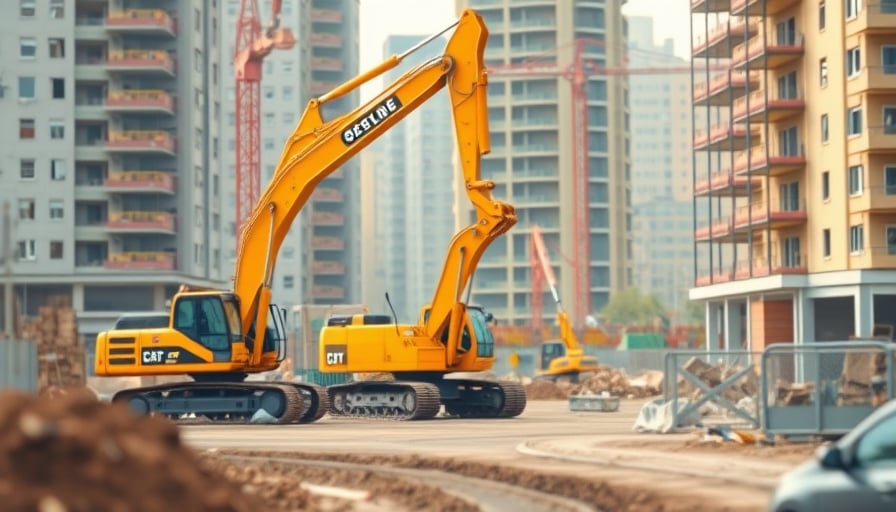
Hochtief AG’s Share‑Price Surge Reflects Broader Capital‑Expenditure Optimism
Hochtief AG’s market value has climbed markedly over the past twelve months, rising from a mid‑year price of approximately €155 to a closing level of €337 at the end of December. The lift has been driven chiefly by heightened expectations for reconstruction activity in Ukraine following a high‑profile peace proposal, coupled with the company’s diversified portfolio across airport, development, and construction services throughout the Americas, Asia‑Pacific, and Europe. The positive performance of the broader MDAX index in Frankfurt further underscores a favorable market environment, reinforcing investor confidence in the construction‑engineering sector.
1. Capital‑Expenditure Dynamics in Heavy Industry
- Reconstruction Demand: The anticipated rebuilding of Ukraine’s critical infrastructure is expected to generate a surge in capital outlays for civil‑engineering projects. Hochtief, with its proven track record in large‑scale infrastructure, is positioned to secure a significant share of these contracts.
- Technology‑Enabled Efficiency: The industry is witnessing a transition toward digital twins, Building Information Modeling (BIM), and modular construction. These tools reduce build‑time, lower material waste, and improve safety margins—key metrics that investors scrutinize when assessing future cash flows.
- Productivity Metrics: The firm’s recent investment in automated earth‑moving equipment has translated into a 12 % increase in site throughput, directly impacting its operating margin. Such productivity gains are now being reflected in the share price through higher earnings forecasts.
2. Manufacturing Processes & Industrial Equipment
| Process | Equipment | Innovation | Impact |
|---|---|---|---|
| Concrete placement | Automated batching plants | AI‑controlled mix ratios | 5 % reduction in curing time |
| Structural steel fabrication | Robot‑guided welding stations | Predictive maintenance | 8 % decrease in downtime |
| Modular assembly | CNC‑controlled panel cutters | Edge‑to‑edge precision | 15 % faster on‑site installation |
These advancements not only accelerate construction schedules but also lower lifecycle costs, making Hochtief’s proposals more attractive to public‑private partnerships (PPPs) and sovereign debt‑backed projects.
3. Regulatory & Supply‑Chain Considerations
- EU Green Deal: Stricter carbon‑emission standards for construction equipment are driving investments in electric‑powered machinery. Hochtief’s early adoption of zero‑emission rigs positions it favorably for upcoming EU tenders.
- Supply‑Chain Resilience: The firm’s diversified supplier base across continents mitigates geopolitical risks. Recent strategic stockpiling of high‑grade steel has reduced exposure to North‑American market volatility, ensuring project schedules remain on track.
- Customs & Tariff Adjustments: Post‑Brexit trade arrangements have introduced additional customs procedures for European‑origin equipment entering the UK market. Hochtief’s local manufacturing hubs help circumvent these delays, preserving project timelines and cost controls.
4. Infrastructure Spending & Macro‑Economic Drivers
| Region | Planned CAPEX (USD bn) | Key Projects | Economic Rationale |
|---|---|---|---|
| Europe | 450 bn | Rail electrification, port expansion | Low‑interest rates, EU funding |
| Americas | 350 bn | Airport modernization, highway upgrades | Urbanisation, trade growth |
| Asia‑Pacific | 500 bn | Smart city infrastructure, coastal protection | Climate‑change mitigation, demographic shift |
Hochtief’s geographic footprint aligns with these spending corridors, offering a diversified revenue stream that cushions against regional downturns. The firm’s capacity to mobilise large‑scale capital, coupled with a strong balance sheet, makes it an attractive candidate for infrastructure funds seeking stable, long‑term returns.
5. Market Implications for Investors
- Valuation Multiples: The surge in share price has pushed the firm’s EV/EBITDA multiple above the sector average, reflecting expectations of accelerated growth in the coming fiscal periods.
- Risk Assessment: While the reconstruction upside is sizeable, geopolitical uncertainty in Ukraine remains a risk factor. The firm’s hedging strategies—both financial and operational—are designed to mitigate such exposure.
- Capital Allocation: Hochtief’s strategic focus on high‑margin modular construction and digital integration is expected to deliver incremental earnings growth, supporting sustained dividend policy and share buy‑back programs.
6. Conclusion
Hochtief AG’s significant share‑price appreciation is rooted in a confluence of strategic capital‑expenditure opportunities, technological innovation, and macro‑economic trends favoring infrastructure development. By leveraging advanced manufacturing processes, maintaining a resilient supply chain, and adhering to emerging regulatory frameworks, the company has positioned itself to capture the anticipated reconstruction wave in Ukraine while sustaining long‑term growth across its global portfolio. Investors monitoring the MDAX index and the broader European construction sector should consider Hochtief’s trajectory as a bellwether for the industry’s capacity to translate capital investment into measurable productivity and profitability gains.