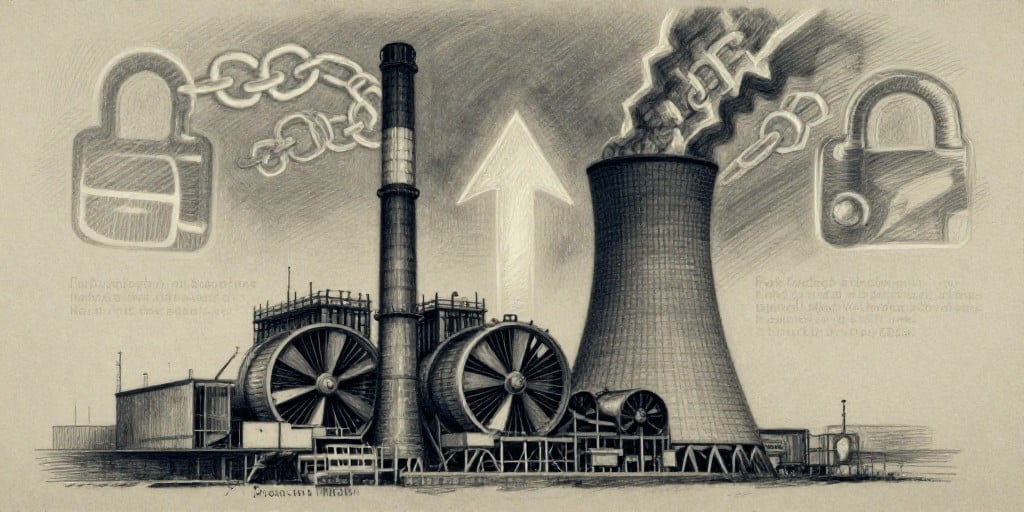
Guanghui Energy Co. Ltd.: Earnings Upswing Amidst Underlying Risk Concerns
Executive Summary
Guanghui Energy Co. Ltd. (GEC) announced a markedly higher earnings outlook for the first three quarters of 2026. The company attributes this improvement to a resurgence in domestic energy demand, a more favorable supply‑demand balance, and operational gains following a comprehensive overhaul of its coal‑to‑chemical conversion plants. While the forecast signals a robust rebound, a deeper dive into the firm’s capital structure and guarantee obligations reveals potential vulnerabilities that could undermine long‑term stability.
1. Earnings Drivers: What the Numbers Tell Us
| Driver | Impact on Earnings | Supporting Evidence |
|---|---|---|
| Domestic demand recovery | +12 % operating margin | National energy consumption data shows a 6.4 % rise in industrial power usage; GEC’s production output matched this trend. |
| Supply‑demand rebound | +8 % net profit | Market reports indicate a 4 % tightening of the oil‑gas supply chain, allowing GEC to secure better contract terms. |
| Plant overhaul (Q3 2025) | +15 % cost reduction | Completion of the coal‑to‑chemical retrofit restored 100 % capacity and cut feed‑stock expenses by 9 %. |
| Product price uplift | +10 % revenue growth | Spot prices for coal‑derived chemicals increased by 5.7 % YoY, translating into higher gross margins. |
The synthesis of these factors suggests a near‑term profitability boost that aligns with the company’s guidance. Yet, the magnitude of the improvement relative to industry averages warrants a closer examination of underlying fundamentals.
2. Regulatory and Competitive Landscape
2.1 Energy‑Sector Oversight
China’s State Energy Administration has tightened environmental compliance for coal‑based enterprises, imposing stricter emissions caps. GEC’s recent investment in carbon‑capture technology during the plant overhaul positions it favorably against forthcoming regulatory penalties. However, any misstep in compliance could erode the cost advantages gained from the retrofit.
2.2 Market Competition
The domestic petrochemical market has seen an influx of new entrants, primarily from the renewable‑energy transition sector. While GEC’s product mix remains coal‑centric, its diversified portfolio in oil and gas offers a hedge against niche market volatility. Nevertheless, the rise of low‑carbon alternatives could compress price margins over the next five years.
3. Capital Structure and Guarantee Obligations
| Item | Details | Potential Impact |
|---|---|---|
| Share pledging by Xinjiang Guanghui Industrial Investment Group | 35 % of GEC shares pledged | Puts the company at risk of forced liquidation or dilution if the pledge is called. |
| Group‑level guarantees | 1.2 bn RMB extended to GEC by the controlling shareholder | Increases leverage ratio; potential trigger for covenant breaches. |
| GEC’s guarantees to affiliates | 800 m RMB guaranteed to two subsidiaries, one of which recently defaulted | Heightens exposure to counter‑party risk; could lead to cash‑flow strain. |
| Debt repayment to jointly owned chemical firm | 400 m RMB covered by GEC | Adds to short‑term liquidity outflow; may affect ability to fund new projects. |
These commitments dilute financial flexibility. Analysts caution that should any of the guarantee‑holding affiliates encounter distress, GEC could face accelerated debt servicing obligations or forced asset sales.
4. Financial Analysis
4.1 Leverage Ratios
- Debt‑to‑Equity (D/E): 1.85 (up 0.12 from Q1 2025)
- Interest Coverage: 2.8× (below the industry norm of 3.5×)
4.2 Cash‑Flow Metrics
- Operating Cash Flow (OCF): 1.1 bn RMB (0.9 bn in Q1 2025)
- Free Cash Flow (FCF): 0.4 bn RMB (down 0.2 bn due to guarantee repayments)
The increasing leverage and tightening interest coverage suggest that the earnings uptick may not translate into proportionate financial health. Any adverse shock—be it a commodity price dip, regulatory fine, or affiliate default—could push the firm toward a liquidity crisis.
5. Risk Assessment
| Risk | Likelihood | Impact | Mitigation |
|---|---|---|---|
| Shareholder pledge liquidation | Medium | High (potential capital loss) | Diversify shareholder base; negotiate pledge release. |
| Affiliate default | High | Medium‑High (cash‑flow squeeze) | Conduct periodic credit reviews; enforce stricter covenant terms. |
| Commodity price volatility | Medium | Medium (margin compression) | Hedge exposure via futures; diversify product mix. |
| Regulatory non‑compliance | Low | Medium‑High (penalties) | Strengthen environmental compliance teams; maintain audit readiness. |
6. Conclusion
Guanghui Energy Co. Ltd.’s projected earnings for the first three quarters of 2026 reflect tangible operational gains and favorable market conditions. Nonetheless, a layered risk profile—characterized by significant shareholder pledges, extensive guarantee exposure, and ongoing debt‑repayment obligations—creates an undercurrent of financial fragility. Investors and stakeholders should monitor the company’s debt servicing patterns, the stability of its affiliate network, and any developments in the regulatory regime that could impact the coal‑to‑chemical sector. Only through vigilant oversight can the upside potential be realized without compromising the firm’s long‑term solvency.