
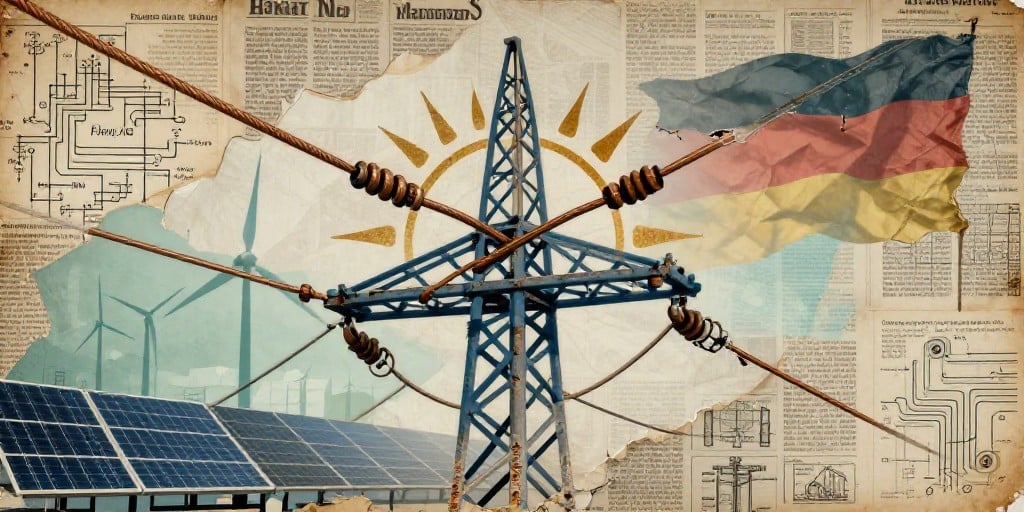
Corporate News: Power System Dynamics and Market Impacts in Germany
The German benchmark index (DAX) closed on a modest decline, largely reflecting turbulence in the utilities and energy sectors. Among the most affected were the shares of E.ON SE, a leading utility that had been under scrutiny for its strategy around grid modernization and renewable integration. While the market reaction is driven by short‑term investor sentiment, the underlying technical challenges and regulatory environment present a more substantial story for the future of Germany’s power system.
Grid Stability in a Renewable‑Heavy Landscape
Germany’s energy transition, known as the Energiewende, has dramatically increased the penetration of wind and solar generation. These resources introduce intermittency and low inertia into the grid, raising the risk of frequency excursions and voltage instability. Modern power electronics, such as inverters with synthetic inertia and grid‑forming capabilities, are being deployed to mitigate these risks. However, widespread integration requires coordinated control across thousands of distributed generation assets—a task that demands sophisticated SCADA systems and advanced forecasting algorithms.
The decline in E.ON’s valuation can be partly attributed to concerns that the company’s current grid investment plans may fall short of the requirements for maintaining stability at a 90 % renewable share. The grid code mandates that utilities invest in flexibility resources—energy storage, demand response, and flexible transmission—to ensure reliable frequency control. Failure to meet these obligations could lead to penalties and loss of market share to more agile competitors.
Renewable Energy Integration Challenges
1. Capacity Factor Variability
Wind turbines operating in the German North Sea typically achieve capacity factors around 45 %. Solar PV in southern Germany averages 17‑18 %. The resulting variability imposes a need for balancing services that can absorb surplus generation and compensate for deficits. The German market’s Balancing Mechanism (BM) has been updated to incentivize rapid response from distributed energy resources, but the uptake remains uneven across regions.
2. Grid Congestion and Sub‑station Upgrades
The rapid build‑up of offshore wind farms has stressed existing transmission corridors. Sub‑station reinforcement and the deployment of high‑voltage direct current (HVDC) links are essential to transport power from the North Sea to load centers without significant losses. Regulatory frameworks now allow for grid ownership sharing between utilities and developers, but the contractual complexity can delay project timelines.
3. Regulatory Alignment and Policy Certainty
Recent policy drafts proposing a “phase‑out” of certain subsidies for wind turbines older than eight years have introduced uncertainty. While aimed at reducing long‑term costs, this move could threaten the economic viability of ongoing projects and, consequently, the workforce that relies on them. Clear, long‑term regulatory guidance is crucial for securing investment and maintaining domestic manufacturing for solar panels and wind blades.
Infrastructure Investment Requirements
The German federal government’s Infrastructure Investment Plan (2025‑2035) earmarks €500 billion for the power grid, targeting:
- Smart Grid Deployment: Advanced metering infrastructure, distribution automation, and AI‑based fault detection.
- Flexibility Resources: Large‑scale battery storage (≥5 GW total capacity), pumped‑storage expansion, and vehicle‑to‑grid (V2G) pilot projects.
- Grid Expansion: HVDC links, underground cabling in urban areas, and interconnection upgrades to neighboring countries.
E.ON’s capital allocation strategy has been criticized for lagging behind these benchmarks. The company’s 2024 Annual Report disclosed that only 12 % of its planned spend was earmarked for flexibility, compared to the 18 % target set by the regulator. This shortfall could influence future market positioning and risk ratings.
Regulatory Frameworks and Rate Structures
Germany’s Tariff Regulation Authority (BNetzA) oversees utility tariffs, balancing investment recovery with consumer protection. Key points affecting utilities:
Investment Recovery Mechanisms: The “Tariff Formula” allows utilities to recover costs via a combination of regulated and market‑sensitive rates. The formula is being revised to incorporate “Flexibility Premiums”, rewarding utilities that provide ancillary services.
Net Metering and Feed‑In Tariffs: While feed‑in tariffs have been reduced to reflect market conditions, net‑metering policies remain generous, encouraging rooftop solar adoption. However, the “Capacity Market” is being introduced to ensure long‑term capacity adequacy without over‑charging consumers.
Cross‑Border Coordination: The EU’s Market Coupling initiative necessitates harmonized bidding strategies across Germany, France, and the Netherlands, impacting how utilities bid into the balancing market and the associated revenue streams.
Economic Impacts on Utility Modernization
Cost Transfer to Consumers: Increased investment in grid infrastructure often translates into higher regulated tariffs. Recent studies estimate that a 5 % increase in grid costs could raise electricity prices by 3–4 %. Policymakers must balance this with the social cost of carbon savings generated by higher renewable penetration.
Job Creation vs. Workforce Restructuring: While the renewable‑energy sector generated a record number of jobs in 2025, future policy shifts could compress employment. Transition plans, including retraining for grid operators and maintenance technicians, are essential to avoid labor market disruptions.
Competitive Dynamics: Utilities that invest aggressively in smart grid technologies may capture new revenue streams from ancillary services and distributed energy management. Conversely, firms with sluggish investment timelines risk losing market share to more nimble, technology‑centric competitors.
Engineering Insights into Power System Dynamics
Frequency Stability: Inertia ( H ) of conventional synchronous generators is reduced as wind turbines replace them. Synthetic inertia via inverter controls can emulate ( H ), but requires real‑time coordination. The Governor Droop characteristic is modified to maintain frequency response.
Voltage Regulation: Distributed reactive power compensation (e.g., STATCOMs, SVCs) is essential to mitigate voltage drops caused by remote wind farms. Advanced Optimal Power Flow (OPF) models are employed to schedule reactive support across the network.
Contingency Analysis: The N‑1 criterion—ensuring the grid can withstand any single component loss—becomes computationally intensive as the number of renewable nodes increases. Tools such as Probabilistic Contingency Analysis (PCA) are being adopted to evaluate multiple simultaneous losses.
Conclusion
The day’s trading activity underscores how investor sentiment reflects deeper technical and regulatory challenges. While short‑term market fluctuations may obscure long‑term trends, the underlying necessity for robust grid stability, renewable integration, and strategic infrastructure investment remains clear. Utilities like E.ON must align their investment strategies with evolving regulatory frameworks and market incentives to maintain resilience, support the energy transition, and ultimately safeguard consumer costs in a rapidly changing power landscape.