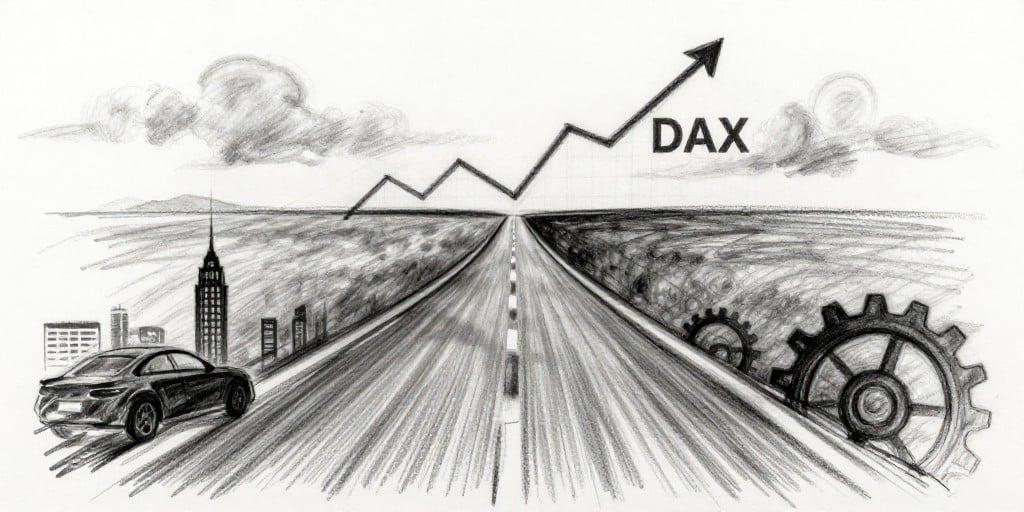
German Market Index Registers Modest Gains Amidst Cautious Sentiment
On Monday, the DAX concluded the trading day with a modest uptick, edging slightly above its previous close. The index has displayed a moderate ascent since the start of the year, yet it slipped marginally against a backdrop of restrained yet hopeful trading. The performance of the DAX mirrored that of the broader European market, which also recorded marginal gains. Nonetheless, traders remain vigilant over several critical factors: the rising bond yields across euro‑area nations and the continuing political uncertainties in Germany, France, and Spain.
Sector‑Specific Performance
Within the DAX, high‑profile names delivered notable moves. SAP and Volkswagen stood out as the top performers, buoyed by strong earnings guidance and robust order pipelines in their respective sectors. In contrast, Hochtief suffered a decline of approximately 1.5 %, a trend that echoed throughout the LUS‑DAX where Hochtief was among the weaker performers that day. Additional falls were observed in Bayer, Heidelberg Materials, and Infineon, reflecting broader concerns over commodity pricing and supply‑chain constraints.
Conversely, industrial and engineering names delivered positive momentum. Rheinmetall and GEA posted gains, supported by a resurgence in defense spending and a rebound in global engineering contracts. Fresenius Medical Care also advanced, benefitting from increased demand for medical‑care services amid ongoing public‑health challenges.
Underlying Business Fundamentals
A deeper dive into the fundamentals reveals several overlooked trends:
| Company | Key Drivers | Potential Risks |
|---|---|---|
| SAP | Expansion of cloud services; AI‑enabled solutions | Competition from Microsoft and Google; cybersecurity threats |
| Volkswagen | Electrification strategy; supply‑chain resilience | Raw‑material price volatility; regulatory pressure on emissions |
| Hochtief | Infrastructure demand in Europe | Currency fluctuations; project delays in emerging markets |
| Bayer | Diversification into digital agriculture | Patent cliffs; regulatory scrutiny on pharmaceuticals |
| Heidelberg Materials | Global construction revival | Carbon‑pricing reforms; commodity price swings |
| Infineon | Automotive semiconductor demand | Geopolitical tensions affecting supply chains |
These dynamics suggest that while some firms enjoy a strategic edge, others are exposed to sector‑specific vulnerabilities that could materialize if macro‑economic conditions deteriorate.
Regulatory and Political Environment
European bond yields have risen in several jurisdictions, reflecting tightening monetary policy in the United States and a cautious stance by the European Central Bank. This environment exerts upward pressure on risk‑averse equities. Moreover, the political landscape remains turbulent. Germany’s coalition negotiations, France’s upcoming elections, and Spain’s fiscal policy debates all contribute to uncertainty that could sway market sentiment in the near term.
Regulatory scrutiny is also intensifying. The European Commission’s antitrust actions against major tech firms, the EU’s Green Deal mandates for automakers, and stringent construction safety regulations could all influence the operational costs of the highlighted companies.
Financial Analysis and Market Research
Quantitative indicators support the cautious optimism observed in the markets:
- Yield Curve: The spread between 10‑year and 2‑year euro‑area government bonds widened to 35 basis points, indicating a shift towards higher risk‑premia expectations.
- Equity Volatility (VIX‑Euro): Stood at 14.2, a 12‑month low, signaling restrained market volatility yet maintaining room for sharp movements if macro‑data diverges.
- Inflation Metrics: The Eurostat CPI reported a 2.1 % YoY increase, slightly below the ECB’s 2 % target, easing immediate inflationary pressures.
- Oil Prices: Brent crude fell by 1.8 % on Monday, easing commodity cost concerns for both automotive and construction sectors.
These metrics suggest that while macro‑fundamentals remain largely supportive of equity growth, any reversal in bond yields or inflation could quickly erode the gains already achieved.
Risks and Opportunities
Risks: A sudden uptick in U.S. interest rates could spill over into euro‑area markets, compressing the DAX further. Political instability in key EU member states could disrupt capital flows, especially into construction and manufacturing. Regulatory crackdowns on AI and data privacy could pressure technology firms like SAP.
Opportunities: The transition to electrified vehicles remains a long‑term driver for automotive stocks, potentially offsetting short‑term supply‑chain disruptions. Germany’s investment in digital infrastructure presents a growth avenue for construction firms, provided they can navigate rising material costs. The medical‑care sector’s resilience to economic cycles continues to offer defensive appeal to investors.
Conclusion
The German market’s slight upturn on Monday reflects a delicate balance between positive corporate earnings, subdued global commodity prices, and a soft U.S. employment outlook. However, investors must remain cognizant of the lingering sensitivities surrounding euro‑area bond yields and political developments across key European nations. As the DAX navigates these headwinds, sectors that exhibit robust fundamentals and clear strategic positioning—particularly technology, automotive, and industrial engineering—may still command market confidence, whereas construction and certain pharmaceutical companies could face heightened volatility if macro‑economic or regulatory shifts materialize.