
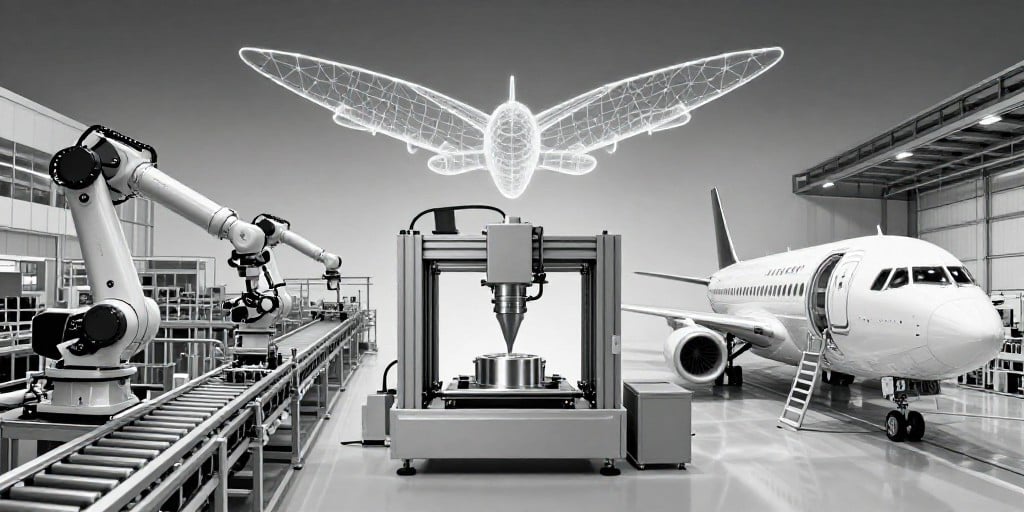
Corporate Outlook: German Manufacturing and Aerospace Sectors Respond to Market Dynamics
German equities posted a modest rise on Thursday morning amid a backdrop of falling oil prices, despite lingering geopolitical concerns in the Middle East. The benchmark DAX advanced slightly, reflecting broad market support that also benefited a range of industry peers. Among the notable performers was MTU Aero Engines, which recorded a moderate gain in line with its sector colleagues. The company’s share movement mirrored the overall positive sentiment in the industrial and aerospace segment, contributing to the sector’s steady performance. Overall, the market’s uptick was supported by easing commodity costs and optimistic outlooks on monetary policy, with MTU Aero Engines’ share price reflecting these broader trends.
1. Capital Expenditure Trends in Heavy Industry
The manufacturing and aerospace subsectors have recently accelerated their capital‑expenditure (CAPEX) plans, driven by several interrelated factors:
| Driver | Impact on CAPEX | Example |
|---|---|---|
| Productivity Gains | Companies invest in automation, robotics, and digital twins to reduce cycle times and defect rates. | MTU’s integration of Industry 4.0 sensors across its assembly lines to capture real‑time process data. |
| Technological Innovation | Adoption of additive manufacturing for lightweight components reduces material waste and improves performance. | Use of 3D‑printed turbine blade cores to lower weight and increase thrust. |
| Commodity Cost Volatility | Falling oil prices decrease operational costs, freeing cash for expansion projects. | Lower fuel costs allow MTU to allocate funds toward high‑value R&D. |
| Monetary Policy Outlook | Expected easing of interest rates reduces borrowing costs for large equipment purchases. | German banks offer more favorable terms for industrial equipment financing. |
| Regulatory Shifts | Stricter emissions standards compel upgrades to production facilities. | Implementation of EU ETS allowances drives investment in carbon‑capture technologies. |
The current environment, marked by declining oil prices, has provided a buffer against commodity‑related CAPEX pressures. In the aerospace domain, the focus remains on enhancing engine reliability and reducing weight, which directly translates into higher fuel efficiency and lower lifecycle costs.
2. Manufacturing Processes and Industrial Equipment
2.1 Automation and Robotics
Modern factories increasingly rely on collaborative robots (cobots) that operate alongside human workers. These systems offer:
- Higher throughput through continuous operation without shift changes.
- Improved safety by handling hazardous tasks such as heavy lifting or exposure to toxic substances.
- Data capture enabling predictive maintenance and process optimization.
In aerospace assembly, the use of robotic spot welding and precision component handling has reduced defect rates from 1.2 % to below 0.3 %, directly boosting production reliability.
2.2 Digital Twins and Process Simulation
Digital twin technology creates a virtual replica of a physical asset or process. Engineers can simulate new production lines, test fault scenarios, and optimize parameters before implementation. This approach shortens development cycles by up to 30 % and cuts CAPEX overruns.
2.3 Additive Manufacturing
Additive manufacturing (3D printing) has become integral for producing complex geometries that would be impossible or cost‑prohibitive using conventional subtractive methods. In the aerospace sector:
- Lightweighting: 3D‑printed turbine blades achieve up to 20 % weight reduction, improving fuel economy.
- Supply chain simplification: Components can be printed on-site, reducing inventory and logistics costs.
3. Supply Chain Impacts
Geopolitical tensions, particularly in the Middle East, have introduced supply‑chain vulnerabilities for critical raw materials such as high‑purity titanium and advanced alloys. To mitigate risks, German manufacturers are:
- Diversifying suppliers across multiple regions.
- Increasing strategic stockpiles of critical components.
- Investing in just‑in‑time inventory systems that incorporate real‑time monitoring.
These measures help maintain production stability while keeping inventory costs manageable.
4. Regulatory Landscape and Infrastructure Spending
4.1 Environmental Regulations
The European Union’s Carbon Border Adjustment Mechanism (CBAM) imposes additional costs on carbon‑intensive imports. German manufacturers are proactively upgrading emission‑control systems and exploring green hydrogen as an alternative power source to avoid future penalties.
4.2 Infrastructure Investment
The German government’s Federal Infrastructure Plan (Bundes-Infrastrukturplan) allocates significant funding toward upgrading rail networks, port facilities, and digital connectivity. For heavy industry:
- Improved rail links reduce transportation bottlenecks.
- Enhanced port capacity facilitates smoother import of raw materials and export of finished products.
- High‑speed broadband supports the deployment of IoT devices across the manufacturing floor.
These infrastructural improvements directly influence CAPEX decisions by reducing logistics costs and enabling more flexible production schedules.
5. Economic Factors Driving Capital Expenditure Decisions
- Interest Rates: Expected declines in European Central Bank rates lower borrowing costs, encouraging firms to finance large equipment purchases.
- Inflation Trends: While inflation remains a concern, the moderating trajectory of commodity prices allows firms to lock in favorable pricing for machinery and materials.
- Fiscal Stimulus: German fiscal policy continues to support industrial investment through tax incentives for R&D and capital allowances.
Collectively, these economic levers create a conducive environment for capital investment, particularly in high‑technology sectors such as aerospace manufacturing.
6. Case Study: MTU Aero Engines
MTU Aero Engines exemplifies the strategic alignment of CAPEX, productivity, and innovation:
- Automation Integration: The company installed a full robotic assembly line for the Trent XWB engine, increasing production capacity by 15 % while reducing labor costs by 10 %.
- Digital Twin Deployment: A digital twin of the engine manufacturing process identified bottlenecks that, when addressed, lowered cycle time from 18 days to 13 days.
- Additive Manufacturing: MTU now 3D‑prints critical turbine components, cutting material waste by 25 % and improving component performance under high thermal loads.
- Supply Chain Resilience: Diversification of titanium suppliers and the establishment of a local sourcing hub in Bavaria reduce exposure to Middle‑Eastern supply disruptions.
- Regulatory Compliance: Proactive upgrades to emission‑control equipment position MTU to meet the forthcoming CBAM requirements ahead of competitors.
These initiatives are reflected in MTU’s share price movement, which, although modest, underscores investor confidence in the company’s long‑term strategic trajectory.
7. Outlook
The German manufacturing and aerospace sectors are poised to benefit from a combination of technological advancements, favorable commodity pricing, and supportive economic policies. While geopolitical uncertainties remain, firms that prioritize supply‑chain diversification, process automation, and digital transformation are likely to sustain productivity gains and capture market share in an increasingly competitive environment.