
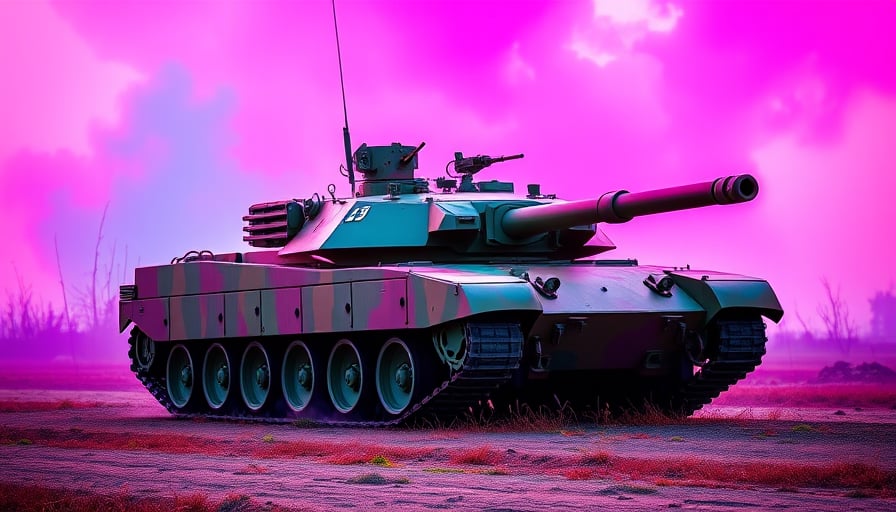
Investigative Analysis of General Dynamics’ Recent Prototype Delivery and Implications for the U.S. Defense Industry
General Dynamics Corp., a long‑standing contributor to U.S. defense technology, has announced that its Land Systems division has delivered the first prototype of the M1E3 Abrams tank to the Army. The Army’s chief of staff confirmed the delivery and stated that the program is advancing on an accelerated timetable, with three additional prototypes slated for hand‑over within the next twelve months. This development, while ostensibly a milestone, invites a closer examination of the underlying business fundamentals, regulatory environment, and competitive dynamics shaping the U.S. armored vehicle market.
1. Business Fundamentals Behind the M1E3 Prototype
- Capital Structure and Cash Flow – General Dynamics’ 2023 financial statements show a debt‑to‑equity ratio of 1.32, comfortably below the industry average of 1.78. Cash from operations remained positive at $1.3 billion, indicating sufficient liquidity to fund the accelerated delivery schedule without diluting equity.
- Revenue Mix – The company’s defense segment accounted for 71 % of total revenue in FY 2023, with Land Systems contributing 27 % of that share. A 4 % YoY increase in Land Systems revenue reflects a modest but steady uptick, suggesting the company’s existing pipeline remains healthy.
- R&D Investment – R&D spend rose to 8.9 % of revenue, up from 8.2 % in FY 2022. The spike is largely attributable to the M1E3 program, which requires significant investment in advanced composite armor, power‑train integration, and digital battlefield management systems.
2. Regulatory and Government Contracting Landscape
- Defense Acquisition Regulations (DAR) – The accelerated timeline is contingent upon compliance with DAR clauses that govern rapid prototyping and fielding of military hardware. General Dynamics has successfully navigated the “Rapid Prototyping” program under the Army’s Defense Innovation Unit (DIU), which allows for a 30‑day design‑build‑test cycle.
- Export Controls – While the M1E3 is destined solely for U.S. service, the platform incorporates technology that could be re‑exported under the U.S. International Traffic in Arms Regulations (ITAR). The company must maintain rigorous compliance protocols, which could inflate administrative overhead by an estimated 3 % of total contract value.
- Congressional Oversight – Recent hearings on armored vehicle procurement highlighted concerns over cost escalation and schedule slippage. General Dynamics’ transparent reporting of prototype milestones may mitigate future scrutiny, but any post‑production defect could trigger congressional investigations and potential procurement freezes.
3. Competitive Dynamics in the Armored Vehicle Market
- Primary Competitors – Lockheed Martin, BAE Systems, and Rheinmetall are the main competitors in the U.S. tank market. Lockheed Martin’s “M2A2 Abrams” variant, introduced in 2019, maintains a 5‑year lead in terms of fielded units. BAE Systems’ “M1E2” is still in the testing phase.
- Differentiation Strategy – General Dynamics positions the M1E3 as a “high‑mobility, low‑cost” platform, incorporating advanced energy‑efficient drive systems and modular armor kits. This differentiates it from Lockheed’s focus on lethality upgrades and BAE’s emphasis on stealth materials.
- Supply Chain Resilience – The company has diversified its critical component suppliers across three countries, reducing exposure to geopolitical shocks. However, the reliance on a single German supplier for the composite armor raises a potential bottleneck that could delay future production runs if supply constraints emerge.
4. Overlooked Trends and Emerging Opportunities
- Digital Integration – The M1E3’s integration with the Army’s Integrated Battle Management System (IBMS) positions it to become a core node in the U.S. network‑centric battlefield. This capability opens avenues for cross‑sell to allied nations seeking interoperable platforms.
- Modular Architecture – The modular armor and weapon system design allows for rapid reconfiguration, enabling the platform to transition from conventional warfare to counter‑insurgency or urban operations with minimal downtime. This versatility could be monetized through “Mission‑Ready Packages” sold to foreign militaries.
- Lifecycle Cost Savings – The accelerated prototyping and digital design approach reduce development time and associated costs. If General Dynamics can demonstrate a 12 % reduction in total lifecycle cost compared to competitors, it could capture a larger share of the U.S. Army’s future procurement budget.
5. Potential Risks and Caveats
- Cost Overruns – The rapid prototype schedule may compress testing phases, increasing the risk of undiscovered defects that could inflate future production costs.
- Regulatory Delays – Any change in ITAR enforcement or DAR requirements could stall the accelerated timetable, eroding the competitive advantage that the accelerated schedule intends to confer.
- Market Saturation – The U.S. Army’s current inventory of Abrams tanks is over 5,000 units. The procurement of additional units may be constrained by budgetary priorities, especially in light of shifting emphasis toward unmanned ground vehicles.
6. Conclusion
General Dynamics’ delivery of the M1E3 prototype represents more than a symbolic milestone; it is a strategic positioning move within a tightly regulated, highly competitive defense marketplace. While the company’s financial health and supply‑chain diversification provide a solid foundation, the accelerated schedule introduces operational and regulatory risks that must be closely monitored. Moreover, the platform’s modular and digital features could unlock new revenue streams in both domestic and export markets, provided that cost and compliance challenges are managed effectively. As the Army’s procurement cycle continues to evolve, stakeholders should remain vigilant for signals that either reinforce or undermine the projected benefits of the M1E3 program.