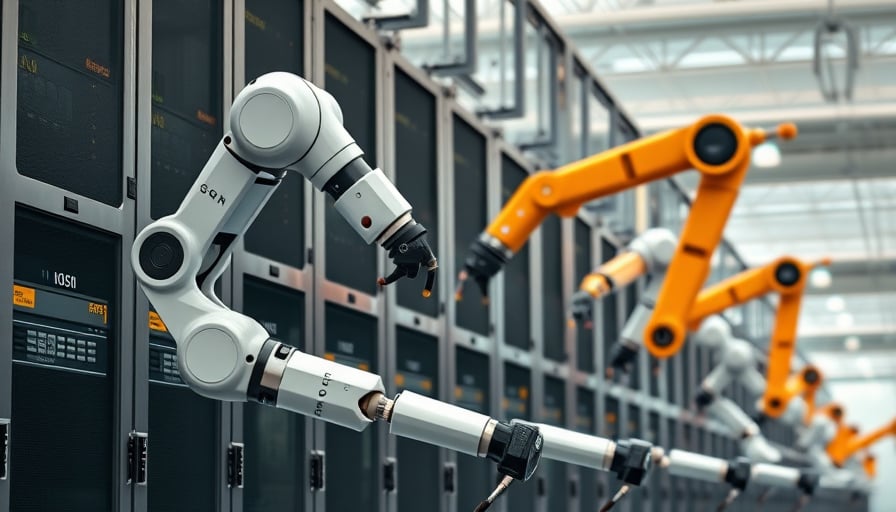
Foxconn Industrial Internet’s AI Server Upswing Signals a Shift in the Manufacturing Landscape
Foxconn Industrial Internet Co. Ltd (FCI) has projected a high‑double‑digit expansion in AI server rack shipments for the first quarter of 2026, with the possibility of nearly doubling that pace over the full calendar year. The announcement underscores a decisive shift in the company’s revenue mix: cloud and networking—including AI servers—now accounts for roughly forty per cent of sales, surpassing the smart‑consumer‑electronics segment for the first time.
1. A New Era of Production Capacity
- US‑Based Facility – FCI’s latest large‑scale manufacturing plant, slated to begin full operations in 2026, is designed to deliver around 2,000 server racks per week.
- Strategic Location – By positioning a production hub within the United States, Foxconn mitigates supply‑chain exposure, aligns with the U.S. government’s emphasis on domestic data‑center capabilities, and meets the bandwidth demands of leading cloud service providers.
2. Financial Momentum Fuels Expansion
- Profitability Gains – Net profit rose by approximately 25 % YoY, while revenue increased near 19 %.
- Dividend Confidence – The company raised its dividend payout to a record level, signalling robust cash flow and management confidence in continued earnings growth.
These figures suggest that FCI’s pivot toward high‑value AI infrastructure is not a speculative gamble but a financially anchored strategy.
3. Partnerships that Cement Ecosystem Positioning
- NVIDIA Collaboration – Joint development of AI platforms and liquid‑cooling solutions positions Foxconn as a critical component supplier for high‑density AI workloads.
- Skild AI Alliance – Integration of advanced robotics and AI software enhances Foxconn’s manufacturing automation, reducing lead times and improving quality control.
The convergence of hardware and software partnerships indicates Foxconn’s intent to offer end‑to‑end AI infrastructure solutions rather than remaining a passive assembler.
4. Challenging Conventional Wisdom about Manufacturing Giants
Historically, Foxconn has been synonymous with mass production of consumer electronics, notably smartphones and tablets. The current trajectory—focusing on AI servers, cloud networking, and advanced robotics—reverses the typical narrative of a legacy manufacturer merely “keeping up” with tech trends. Instead, Foxconn is actively shaping the next generation of data‑center architecture.
This strategic reorientation offers several insights for the broader industry:
| Conventional View | Foxconn’s New Position |
|---|---|
| “Large‑scale OEMs are relegated to low‑margin consumer goods.” | “Large‑scale OEMs can command premium margins by supplying critical components for AI infrastructure.” |
| “AI manufacturing requires specialized, high‑skill factories.” | “OEMs can leverage existing manufacturing expertise and scale to meet AI demands, provided they invest in new facilities and partnerships.” |
| “Cloud and networking services are the domain of software companies.” | “Hardware suppliers are essential partners in cloud and AI ecosystems, offering complementary value.” |
5. Broader Market Implications
- Supply‑Chain Resilience – Foxconn’s U.S. facility may serve as a model for other OEMs seeking to diversify away from China‑centric supply chains.
- Capital Allocation – The dividend hike and robust cash flow could attract capital to further research and development of AI‑centric manufacturing technologies.
- Competitive Landscape – Traditional competitors in the AI server space—such as Dell Technologies and Lenovo—will face increased pressure to match Foxconn’s scale and partnership depth.
6. Forward‑Looking Analysis
While macroeconomic volatility remains a concern, Foxconn’s strategic focus on AI and cloud services provides a compelling moat. The company’s ability to rapidly scale production, secure high‑profile partnerships, and maintain healthy financial metrics positions it well to ride the wave of growing demand for AI infrastructure.
For stakeholders—investors, partners, and policy makers—Foxconn’s evolution represents a case study in how legacy manufacturing giants can pivot successfully into high‑technology domains. Continued monitoring of its production milestones, partnership outcomes, and financial performance will be essential to gauge the long‑term impact on the AI server market and the broader technology ecosystem.