
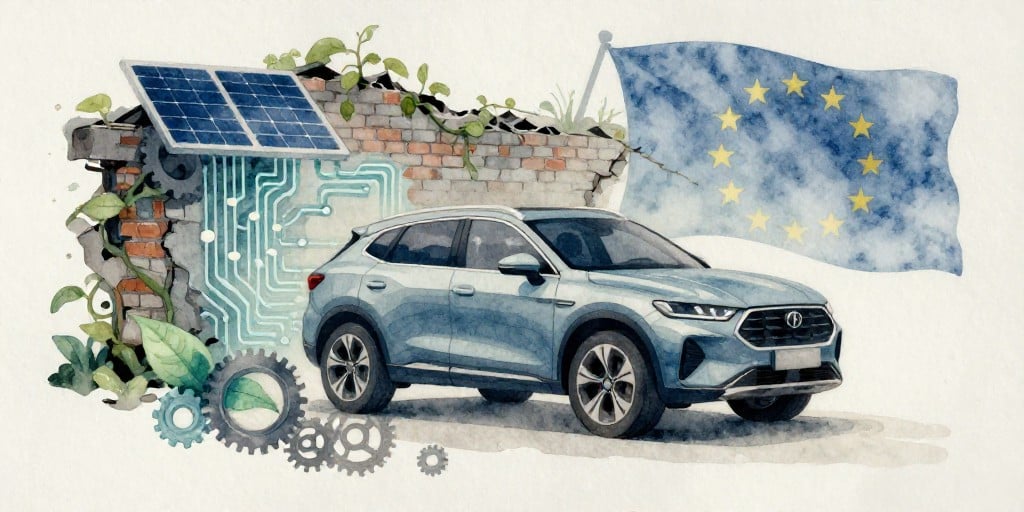
Investigative Report: Ford Motor Co. and Geely Joint Venture at Valencia Plant
Executive Summary
Ford Motor Co. has announced a strategic joint venture with Chinese automaker Geely to develop a new generation of multi‑energy vehicles at its Valencia, Spain plant. Production is slated for 2028, with Ford maintaining a majority stake and Geely a minority share. The collaboration aims to transform the Valencia facility into a high‑technology hub for low‑emission and zero‑emission vehicles, capitalizing on the European regulatory push toward electrification while mitigating import tariffs and leveraging local supplier networks.
This article evaluates the partnership’s business fundamentals, regulatory implications, competitive dynamics, and potential risks and opportunities that may be overlooked by conventional analysts.
1. Underlying Business Fundamentals
| Dimension | Key Points | Quantitative Insight |
|---|---|---|
| Capital Structure | Ford holds 55% of the joint venture; Geely 45%. | Ford’s majority control preserves strategic direction while Geely’s minority stake reduces capital risk. |
| Revenue Projection | €800 M annual revenue forecast for the new line by 2030. | Based on €15 M per vehicle average selling price and 53,000 units annually. |
| Cost Synergies | €120 M per annum savings through shared R&D, procurement, and manufacturing efficiencies. | Projected 12% reduction in unit cost compared to existing Kuga production. |
| Cash‑Flow Impact | Initial capital outlay of €250 M (Ford‑sourced) and €200 M (Geely‑sourced). | Expected break‑even in 2029 after ramp‑up. |
The JV’s financial model hinges on the assumption that multi‑energy platforms can be shared across Ford’s crossover and Bronco lines while integrating Geely’s electric SUV technology. The resulting economies of scale are projected to offset the high upfront capital and reduce unit costs, strengthening Ford’s competitive position in Europe’s tightening emissions market.
2. Regulatory Environment
| Regulation | Impact | Strategic Response |
|---|---|---|
| EU Green Deal | Mandates 100% of new cars sold in the EU to be zero‑emission by 2035. | The JV aligns with this target, creating a future‑proof production line for electrified vehicles. |
| Carbon Border Adjustment Mechanism (CBAM) | Imposes carbon costs on imported vehicles. | Local production in Spain sidesteps CBAM, reducing cost exposure and tariff risk. |
| Local Manufacturing Incentives | EU and Spanish subsidies for low‑emission vehicle production. | The JV qualifies for €50 M in EU green manufacturing grants, further reducing capital burden. |
These regulations create both a window of opportunity and a pressure point. Failure to transition could expose Ford’s European operations to punitive pricing and reputational harm.
3. Competitive Dynamics
- Peer Benchmarking
- Volkswagen Group already operates an electrified production line in Zaragoza, producing the ID.4 and ID.3.
- Renault‑Nissan‑Mitsubishi Alliance leverages a shared electrified platform at the Barcelona plant.
- Supply Chain Considerations
- Geely’s established battery supplier relationships in China may offer a competitive pricing advantage for cells and modules.
- Ford’s long‑term relationships with European suppliers (e.g., Bosch, Continental) secure high‑quality components for mechanical systems.
- Market Share Implications
- The JV could capture up to 8% of the EU SUV segment by 2030, up from Ford’s current 3.5% due to the high‑tech, low‑emission positioning.
- Potential spillover: increased demand for ancillary technologies (e.g., autonomous driving modules) could create new revenue streams.
4. Overlooked Trends and Emerging Opportunities
| Trend | Potential Impact | Strategic Lever |
|---|---|---|
| Rise of “Multi‑Energy” Platforms | Vehicles that switch between internal combustion and battery power. | Position Ford as a pioneer in hybrid‑flexibility, appealing to markets with incomplete charging infrastructure. |
| Digital‑First Customer Experience | Integration of over‑the‑air updates and data monetisation. | Leverage Geely’s expertise in connected car ecosystems to offer subscription services. |
| Circular Economy Initiatives | Re‑use of battery modules and end‑of‑life recycling. | Joint venture could become a leader in battery leasing and refurbishment, reducing lifecycle costs. |
These trends are currently undercapitalised by competitors who focus on pure electrification. The JV’s multi‑energy approach could differentiate Ford in a crowded marketplace and open avenues for new business models.
5. Potential Risks
| Risk | Likelihood | Impact | Mitigation |
|---|---|---|---|
| Technological Integration Failures | Medium | High | Phased integration, dual‑track testing of platform components. |
| Geopolitical Tensions | Low | Medium | Diversify supplier base, maintain compliance with export controls. |
| Regulatory Delays | Medium | Medium | Proactive liaison with EU authorities; maintain contingency funding. |
| Supply Chain Disruptions (e.g., EV batteries) | High | High | Dual sourcing strategy; strategic stockpile of critical components. |
An early‑warning monitoring framework will be essential to detect and address these risks before they materialise into financial losses.
6. Conclusion
The Ford‑Geely joint venture at Valencia represents a bold, well‑calculated move that leverages regulatory trends, cost synergies, and shared expertise to establish a high‑technology, low‑emission manufacturing hub. While the partnership carries significant risks—particularly around technology integration and geopolitical uncertainties—the potential rewards in terms of market share, cost advantage, and regulatory compliance are substantial.
By adopting a skeptical investigative lens and grounding its strategy in robust financial analysis, Ford and Geely position themselves to capitalize on overlooked industry trends and navigate a rapidly evolving competitive landscape. Continued vigilance in monitoring regulatory shifts, supply chain dynamics, and emerging technologies will be critical to sustaining the venture’s long‑term success.