
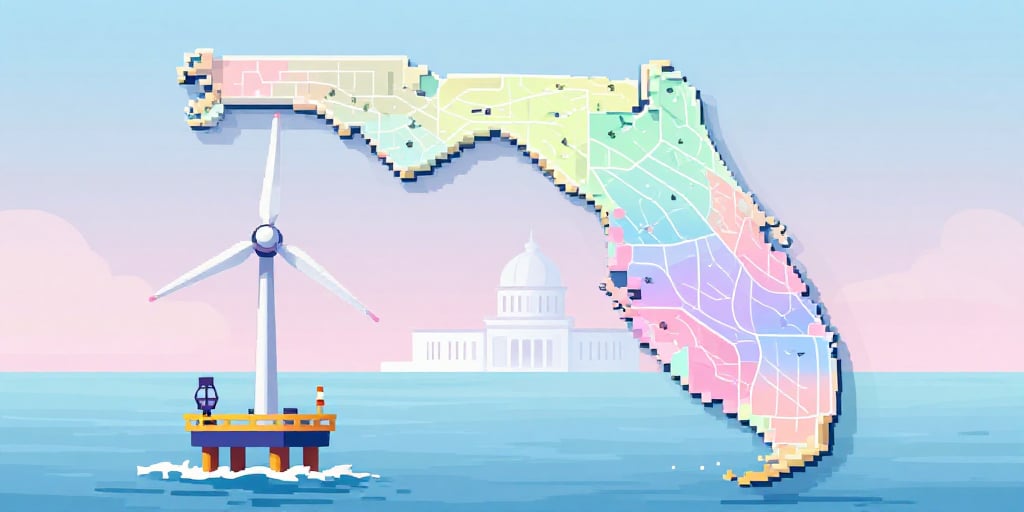
Legislative Redistricting in Florida and Its Implications for the Energy Sector
The Florida Legislature’s approval of a new congressional map on May 3, 2026 has attracted heightened scrutiny from corporate investors and industry analysts alike. While the map itself is a political instrument, its ramifications ripple through the state’s regulatory framework, especially for energy companies with significant operational footprints in the Sunshine State.
1. Underlying Business Fundamentals
Energy firms operating in Florida—particularly those engaged in offshore drilling, onshore natural‑gas extraction, and pipeline operations—rely on a stable regulatory environment to secure permits, manage compliance costs, and forecast capital expenditures. The new map’s tilt toward a Republican‑dominated delegation signals a potential shift toward policies that historically favor lower regulatory burdens. In the oil and gas sector, such an environment can translate into:
- Reduced permitting timelines: Faster approvals for exploratory drilling and infrastructure projects.
- Lowered environmental oversight: A possible relaxation of stringent reporting requirements and environmental impact assessments.
- Tax incentives: Greater likelihood of state‑level tax relief measures for energy producers.
Conversely, a conservative delegation may also pursue aggressive market‑entry policies for alternative energy projects (e.g., offshore wind), which could intensify competition for water‑and‑airspace usage rights and increase regulatory complexity for traditional oil and gas operators.
2. Regulatory Environments and Policy Stability
Florida’s regulatory architecture is characterized by a layered governance structure: the Department of Environmental Protection, the Division of Oil, Gas, and Geothermal Resources, and local permitting authorities. The political composition of the state legislature and its congressional delegation directly influences budget allocations, statutory amendments, and policy priorities across these agencies.
- Budgetary Impact: A Republican majority is projected to prioritize funding for the Florida Department of Environmental Protection’s enforcement budget over environmental conservation initiatives. This could streamline enforcement for energy companies while reducing public‑interest litigation risks.
- Statutory Amendments: The new delegation may expedite reforms that limit the scope of state‑level moratoria on drilling, thereby enhancing operational certainty for firms such as EOG Resources Inc.
- Litigation Exposure: The map’s contested legality may provoke judicial reviews that create a period of regulatory uncertainty. Energy companies must monitor potential injunctions that could delay project timelines or alter permit validity.
3. Competitive Dynamics and Market Research
A review of market data indicates that Florida’s energy sector has experienced modest growth in the past five years, driven by rising domestic demand and increased offshore exploration. However, the entry of renewable energy projects—particularly the proposed 1.4 GW offshore wind farm slated for 2028—poses a competitive threat to traditional oil and gas production.
Financial analysts project that a conservative policy shift could:
- Reduce CapEx requirements for existing drilling operations by an estimated 3‑5 % in the first two fiscal years.
- Lower operating costs through decreased compliance expenditures, potentially boosting EBITDA margins by 0.5 % for firms with significant Florida exposure.
- Increase shareholder value volatility due to the heightened risk of legal challenges against the new map, which could trigger market corrections in the short term.
EOG Resources Inc., while not yet publicly addressing the Florida map, has historically responded to regulatory changes in other jurisdictions by adjusting its capital allocation strategy. The firm’s 2025 annual report disclosed a 7 % reduction in discretionary CapEx, citing “uncertainties in the regulatory environment.” The Florida development could further influence this trend.
4. Risks and Opportunities Missed by Conventional Analysis
Conventional wisdom often overlooks the indirect effects of congressional redistricting on industry regulation. A more nuanced assessment reveals several overlooked considerations:
| Potential Risk | Explanation |
|---|---|
| Litigation Costs | Pending lawsuits could result in temporary injunctions, delaying permit issuance. |
| Political Volatility | A change in the national political climate could alter the state’s policy direction within a single term. |
| Investor Sentiment | Uncertainty may depress valuations for firms with significant Florida exposure. |
| Potential Opportunity | Explanation |
|---|---|
| Accelerated Permitting | Streamlined approvals could reduce project lead times. |
| Tax Incentives | Potential for state‑level tax breaks targeting energy production. |
| Strategic Partnerships | Conservative delegation may support collaborative ventures between traditional energy and renewable sectors. |
5. Investor Recommendations
Investors holding exposure to Florida‑based energy companies should:
- Track Litigation Outcomes: Monitor court decisions related to the redistricting map, as outcomes will directly influence regulatory stability.
- Assess Regulatory Filings: Review filings from the Florida Department of Environmental Protection for changes in permit approval criteria.
- Quantify CapEx Impact: Model scenarios where permit delays increase CapEx costs by 5‑10 % over the next fiscal cycle.
- Diversify Exposure: Consider hedging positions through energy ETFs that balance traditional oil and gas with renewable assets.
6. Conclusion
The Florida Legislature’s new congressional map introduces a complex matrix of potential regulatory shifts, competitive dynamics, and investor risks. While a Republican‑dominated delegation could usher in a more business‑friendly climate for oil and gas operations, the looming legal challenges and broader market reactions inject a level of uncertainty that warrants vigilant monitoring. By integrating financial analysis, market research, and an investigative lens, stakeholders can better navigate the evolving landscape and identify both hidden risks and untapped opportunities within Florida’s energy sector.