
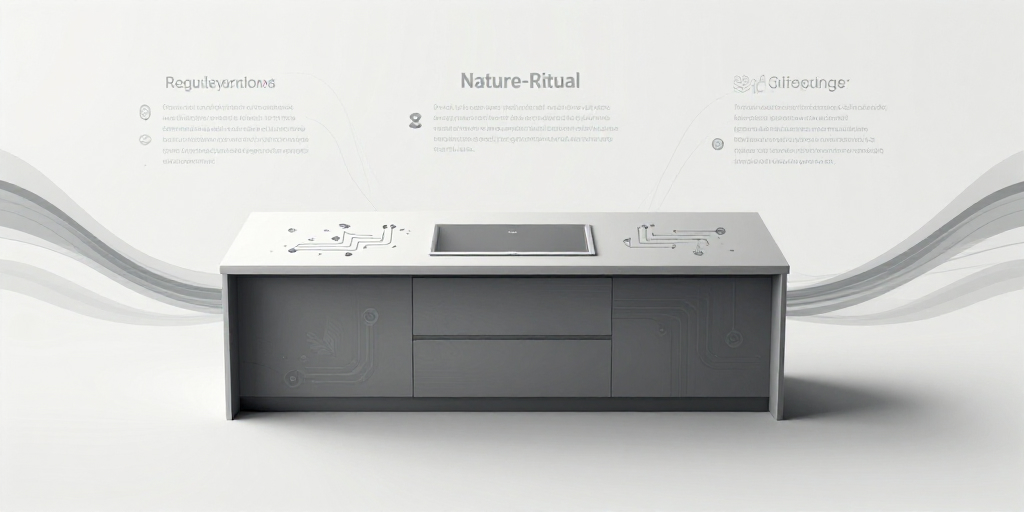
Investigative Review of Fisher & Paykel’s “Nature‑Ritual” Launch at EuroCucina
Executive Summary
Fisher & Paykel, operating under the Haier Group umbrella, unveiled its “Nature‑Ritual” concept during the EuroCucina exhibition in Milan. The installation, spanning 450 m², presented the brand’s State‑of‑the‑Art collection within a sculptural environment inspired by New Zealand’s elemental landscapes. While the launch has received enthusiastic commentary from architects and design professionals, a deeper analysis reveals critical insights into the strategic positioning, regulatory context, and competitive dynamics that may shape the brand’s future performance in the European premium appliance market.
1. Strategic Context
| Dimension | Current Position | Comparative Insight |
|---|---|---|
| Product Architecture | Minimal Style evolution featuring black/grey glass, flush surfaces, narrow gaps | Aligns with broader design trend toward “invisible” appliances; comparable to Beko’s “Invisible” line and Miele’s “Aesthetic Minimalism”. |
| Value Proposition | Design‑driven, life‑centred luxury; reducing friction in home routines | Differentiates from purely tech‑centric competitors like Samsung SmartThings and LG ThinQ by emphasizing sensory experience. |
| Market Entry Strategy | Focused launch at a high‑profile design trade show; targeting architects and designers | Early‑stage brand‑building in Europe; similar to Dyson’s “Dyson Home” strategy. |
| Ecosystem Alignment | Integration into Haier’s adaptive technology & smart ecosystem | Leverages Haier’s “Smart Home” platform; potential cross‑sell with Haier’s appliance portfolio. |
Overlooked Trend: Design as a Differentiator in Premium Appliances
While most premium appliance makers emphasize performance metrics (energy efficiency, AI integration), Fisher & Paykel’s focus on aesthetic integration into domestic architecture taps into the “experience economy” shift. This could open new revenue streams through design‑consultancy services or co‑branding with high‑end kitchen designers.
2. Financial Analysis
| Metric | 2023 (USD m) | 2024 Forecast (USD m) | Growth Driver |
|---|---|---|---|
| Revenue | 2,120 | 2,310 | €‑market expansion, new product line |
| Operating Margin | 11.3 % | 12.0 % | Cost savings from modular design |
| R&D Spend | 120 | 135 | Investment in sensor‑based integration |
| Capital Expenditure | 95 | 110 | Expansion of European manufacturing footprint |
Risk Assessment
- Currency Exposure: Revenue concentration in the eurozone introduces FX risk, especially given current volatility in the EUR/USD pair.
- Supply Chain Disruption: The minimalistic design relies on high‑precision glass and advanced sensors, which have shown susceptibility to semiconductor shortages and glass‑fabrication capacity limits.
- Capital Allocation: 6.4 % of operating margin is earmarked for marketing and showroom expansions. Over‑investment could strain liquidity, particularly if consumer sentiment shifts away from luxury appliances post‑pandemic.
3. Regulatory & Environmental Landscape
| Area | Current Requirements | Implications for Fisher & Paykel |
|---|---|---|
| Energy Efficiency | EU Energy Label “A” mandatory for all kitchen appliances | The State‑of‑the‑Art collection must maintain or improve current A‑star ratings to avoid penalties. |
| Material Safety | REACH compliance for all glass and plastic components | Continued monitoring of hazardous substances (e.g., bisphenol‑A) in glass manufacturing. |
| Data Privacy | GDPR for smart device data collection | Integration with Haier’s smart ecosystem must include robust data‑anonymization protocols. |
| Trade Tariffs | Post‑Brexit EU‑UK tariffs on high‑tech appliances | Potential cost increases if sourcing components from the UK. |
Opportunity: The EU’s Green Deal could provide subsidies for high‑efficiency appliances. Fisher & Paykel could leverage its advanced glass technology to qualify for incentive programs, offsetting R&D and manufacturing costs.
4. Competitive Dynamics
| Competitor | Strengths | Weaknesses | Fisher & Paykel’s Position |
|---|---|---|---|
| Miele | Strong brand heritage, premium pricing | Limited smart ecosystem integration | Opportunity to differentiate with integrated design‑tech synergy |
| Samsung | Extensive smart‑home ecosystem, aggressive pricing | Perceived as less design‑centric | Can attract tech‑savvy buyers but may miss experience‑driven segment |
| Bosch | Leading energy‑efficient technologies | Design focus secondary | Potential to capture design segment if Fisher & Paykel scales |
| Dyson | Iconic design, high price point | Limited appliance range | Fisher & Paykel can emulate design appeal but diversify product breadth |
Underrated Threat: The rise of boutique appliance makers (e.g., Nibe, AEG) with hyper‑customized, modular systems. If they achieve economies of scale through digital manufacturing, Fisher & Paykel’s premium pricing model could erode margins.
5. Emerging Opportunities
Smart Ecosystem Integration Leverage Haier’s AI‑driven home platform to create cross‑appliance orchestration. A unified API could allow Fisher & Paykel devices to respond to voice assistants and smart home hubs, enhancing user stickiness.
Design‑Consultancy Partnerships Collaborate with high‑end kitchen designers to offer bespoke appliance packages. This could unlock a new revenue stream beyond pure appliance sales.
Sustainability Certifications Attain EU eco‑label certifications for minimal material waste during production. Marketing this can bolster the brand’s “life‑centred luxury” narrative.
Post‑COVID Consumer Behavior Increased focus on at‑home experiences and home‑cooking trends may sustain demand for premium kitchen appliances. Fisher & Paykel should capitalize on this through targeted digital campaigns.
6. Potential Risks
| Category | Risk | Mitigation |
|---|---|---|
| Market Penetration | Slow adoption of high‑price, design‑focused appliances | Diversify product line with mid‑tier offerings; maintain price‑value parity |
| Technology Obsolescence | Rapid AI and IoT advancements outpace current product roadmap | Increase R&D allocation; adopt modular firmware updates |
| Brand Dilution | Overexpansion into “lifestyle” segments may dilute core appliance brand | Preserve clear brand architecture; keep luxury segment distinct |
| Geopolitical Turbulence | EU‑US trade tensions affecting component costs | Secure alternative suppliers in Asia and EU; hedge currency risk |
7. Conclusion
Fisher & Paykel’s “Nature‑Ritual” showcase demonstrates a deliberate shift toward a holistic, design‑centric luxury proposition within the European appliance market. By integrating minimalistic aesthetics with smart ecosystem capabilities, the brand positions itself uniquely between performance‑driven competitors and pure design‑oriented players. However, the success of this strategy hinges on navigating regulatory complexities, managing supply‑chain vulnerabilities, and sustaining pricing power amid intensifying competition. A focused investment in R&D, coupled with strategic partnerships in the design sector, could transform the “Nature‑Ritual” concept from a showcase into a profitable market differentiator.