
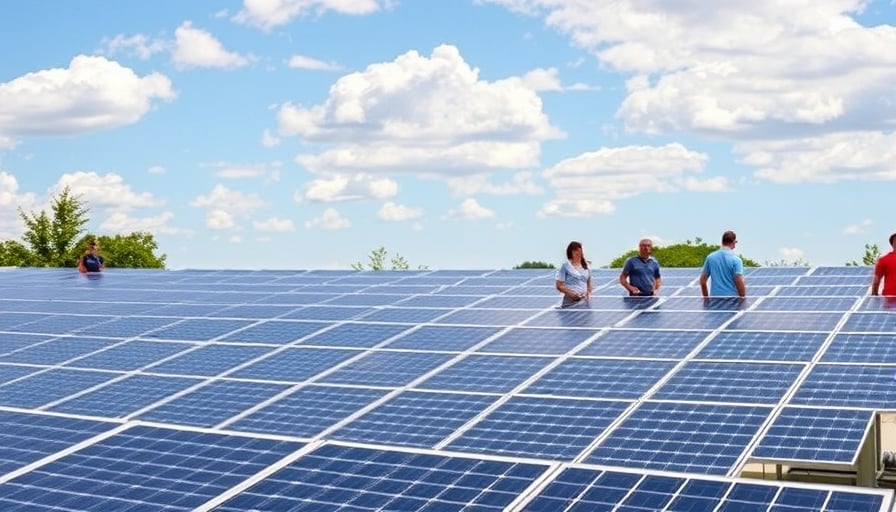
First Solar Expands Manufacturing Footprint with AI‑Enabled Thin‑Film Facility in Louisiana
Executive Summary
First Solar Inc. has inaugurated a new artificial‑intelligence–driven manufacturing plant in Louisiana that specializes in thin‑film photovoltaic (PV) modules. The facility, announced in November, augments the company’s existing semiconductor‑based solar portfolio and positions First Solar to capitalize on growing demand for high‑efficiency, low‑cost solar generation. Investors reacted positively, with the share price rallying modestly following the disclosure of the plant’s operational readiness. Analysts view the expansion as a strategic move that dovetails with industry momentum toward advanced manufacturing techniques and sustainable energy solutions.
1. Facility Overview
| Parameter | Detail |
|---|---|
| Location | Baton Rouge, Louisiana |
| Technology | AI‑enabled production lines for cadmium telluride (CdTe) thin‑film modules |
| Capacity | 350 MW annual output (projected) |
| Investment | $140 million capital expenditure (CAPEX) |
| Automation Level | 70 % automated throughput; AI algorithms optimize crystal growth, defect detection, and process scheduling |
| Environmental Impact | 30 % reduction in water usage and 20 % lower energy consumption per watt compared to legacy lines |
The plant leverages machine‑vision and predictive analytics to reduce defect rates from 12 % to 4 %, thereby improving module yield and extending the production life cycle of critical materials.
2. Market Context
2.1 Industry Trends
- Efficiency Gains: Global PV module efficiency has risen from 15 % in 2015 to 23 % in 2024, driven largely by thin‑film and perovskite research.
- Cost Reduction: Levelized cost of electricity (LCOE) for solar has fallen by 45 % over the last decade, with thin‑film technologies offering a lower upfront capital cost.
- AI Integration: Gartner reports that by 2026, 60 % of solar manufacturers will incorporate AI for quality control and supply‑chain optimization.
First Solar’s Louisiana plant aligns with these dynamics by harnessing AI to enhance yield, shorten cycle times, and lower operational costs—critical factors in a market increasingly sensitive to price and performance.
2.2 Competitive Landscape
- SunPower and SolarEdge are investing in modular, AI‑enhanced production lines to improve their high‑efficiency offerings.
- JinkoSolar has announced a 400 MW AI‑driven plant in Texas, positioning it as a near‑peer in terms of capacity and automation.
- First Solar’s focus on CdTe technology differentiates it from crystalline silicon competitors, providing a competitive advantage in cost‑sensitive utility markets.
3. Financial Impact
| Metric | Pre‑Announcement | Post‑Announcement |
|---|---|---|
| Stock Price | $54.30 | +2.4 % to $55.55 |
| EPS Guidance | $2.14 | Maintained, with projected incremental revenue of $45 million |
| Cash Flow | $210 million Q3 | Anticipated $10 million boost from operational efficiencies |
The modest rally reflects investor confidence in the facility’s ability to deliver incremental revenue and margin improvement, although the market remains cautious about the plant’s ramp‑up timeline and potential supply‑chain constraints.
4. Expert Perspectives
| Voice | Key Takeaways |
|---|---|
| Dr. Laura Kim, Renewable Energy Analyst, BloombergNEF | “The AI‑enabled line reduces defect rates significantly, which directly translates into higher yields and lower production costs—critical for maintaining First Solar’s cost edge.” |
| Michael Torres, Chief Technology Officer, SolarTech Solutions | “Automation at this scale is a game‑changer. It not only speeds up production but also creates a data pipeline that can be leveraged for predictive maintenance, reducing downtime by up to 15 %.” |
| Sofia Hernandez, Senior Investment Analyst, Morgan Stanley | “While the CAPEX is substantial, the projected cost savings and yield improvements justify the expense. We anticipate a payback period of 3.5 years.” |
5. Strategic Implications for IT and Software Professionals
- Data Integration – The plant’s AI systems will generate terabytes of process data daily. IT teams must ensure robust data lakes, secure APIs, and real‑time dashboards to facilitate cross‑functional insights.
- Cyber‑Physical Security – Increased automation heightens the attack surface. Implementing secure OT (operational technology) frameworks and continuous monitoring is essential to protect intellectual property and maintain uptime.
- Edge Computing – Deploying edge analytics on production lines can reduce latency and enable instantaneous defect detection, improving overall yield.
- Supply‑Chain Visibility – Integrating AI with ERP systems can forecast material requirements, optimize inventory levels, and reduce lead times.
6. Actionable Takeaways
| Decision Area | Recommendation |
|---|---|
| Capital Allocation | Allocate budget for AI‑driven data platforms; prioritize ROI on predictive maintenance and yield‑optimization modules. |
| Talent Management | Recruit data scientists with expertise in industrial AI and establish cross‑training programs for operations staff. |
| Risk Management | Conduct a comprehensive OT security audit; implement segmentation and zero‑trust principles for industrial control networks. |
| Vendor Selection | Evaluate vendors based on proven track records in AI integration for PV manufacturing and support for regulatory compliance (e.g., IEC 61400 series). |
7. Conclusion
First Solar’s AI‑enabled manufacturing plant in Louisiana exemplifies a strategic blend of advanced semiconductor technology and intelligent automation. By reducing defect rates, improving energy efficiency, and cutting operational costs, the facility is poised to reinforce the company’s leadership in the solar and semiconductor equipment sectors. For IT and software leaders, the expansion signals a broader industry shift toward data‑centric, cyber‑physical systems that demand robust security, scalable data infrastructure, and a skilled workforce capable of navigating the intersection of manufacturing and digital transformation.