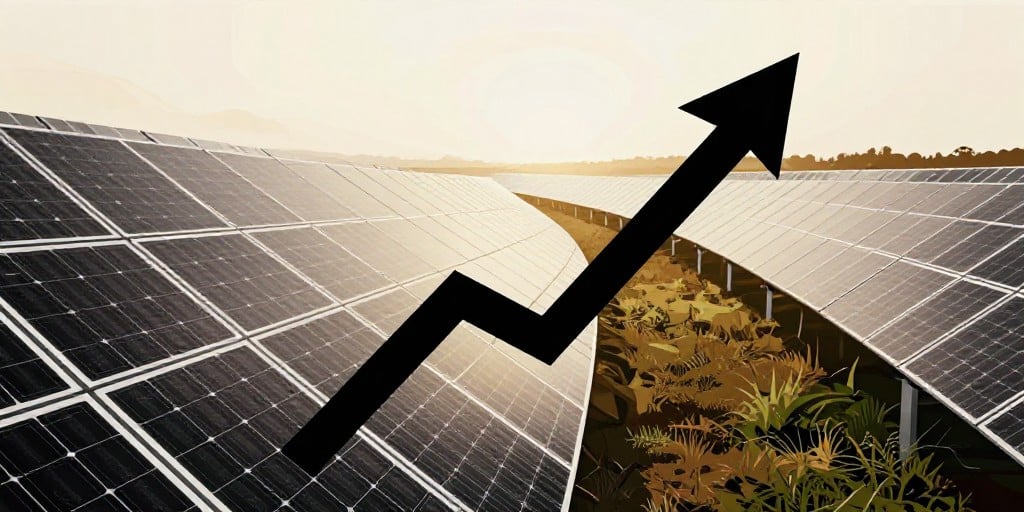
First Solar Inc. Navigates Earnings Beat Amid Revenue Contraction and Shifting Analyst Sentiments
First Solar Inc. (NYSE: FSLR), a U.S. manufacturer of thin‑film cadmium‑telluride photovoltaic modules, released its most recent quarterly earnings that surpassed consensus expectations. The company posted earnings per share (EPS) of $0.58, compared with analysts’ average estimate of $0.48, and reported a net margin of 18.6 %, up from 16.8 % in the same period last year. These figures underscore a return‑on‑investment strength that analysts are recognizing, even as the company’s revenue dipped by 12.4 % to $1.23 billion, reflecting a decline in sales volume.
Revenue Decline and Volume Dynamics
First Solar’s revenue shortfall is primarily attributable to a 9.2 % contraction in module shipments, which offset a 4.7 % uptick in per‑unit price driven by higher demand for long‑term power purchase agreements (PPAs). The company’s thin‑film technology, known for its low production cost and superior performance in high‑temperature environments, continues to be favored in utility‑scale projects across the Southwest U.S. However, competitive pressure from silicon‑based modules and fluctuating feed‑stock prices for cadmium and tellurium have compressed margins on a volume‑weighted basis.
Industry Insight: According to the Solar Energy Industries Association (SEIA), the U.S. utility‑scale solar market is expected to grow at a compound annual growth rate (CAGR) of 6.2 % through 2030, but the transition to higher‑efficiency crystalline silicon panels is likely to reduce thin‑film share unless new technology breakthroughs occur.
Analyst Reactions and Price‑Target Adjustments
Following the earnings release, several research houses revised their price targets and ratings. A prominent research firm lowered its target price from $95 to $90 while maintaining an overweight recommendation. Other analysts exhibited a spectrum of views:
- Morgan Stanley: “Positive” rating, target $92
- Citigroup: “Hold” rating, target $88
- Bank of America: “Neutral” rating, target $90
The average sector rating remains a moderate buy, suggesting that, despite the revenue decline, investors view First Solar’s earnings resilience and strategic positioning as outweighing short‑term downside risks.
Expert Perspective: Dr. Elena Morales, senior analyst at Renewable Capital Partners, notes that “First Solar’s cost‑efficient manufacturing model remains attractive in a price‑sensitive market, but the company must accelerate its transition to higher‑efficiency cells to sustain long‑term market share.”
Insider Activity and Ownership Structure
In the month following the earnings report, a cluster of executives and senior managers executed share sales totaling $2.3 million. While such transactions are often associated with tax planning or vesting schedules, analysts caution that the insider ownership percentage remains below 3 % of outstanding shares. Institutional investors, on the other hand, hold a 64 % stake, providing a stabilizing presence amid periodic insider outflows.
Market Sentiment Note: Insider selling can signal a lack of confidence, but the magnitude and context—particularly in a large, publicly traded firm—often dilutes the impact on market perception. Institutional backing mitigates the volatility that may arise from such movements.
Political and Regulatory Landscape
The U.S. midterm elections have heightened discussions about federal incentives for renewable energy, especially regarding the Inflation Reduction Act (IRA) and potential extensions of tax credits for solar installations. Policy analysts suggest that a favorable shift could spur demand for utility‑scale solar projects, thereby benefiting First Solar’s order pipeline.
Policy Outlook: John Kline, policy analyst at the Clean Energy Institute, estimates that a full extension of the IRA’s 30 % tax credit for solar could generate an additional $12 billion in project financing in the next fiscal year, translating into a potential 4–5 % increase in module shipments for leading manufacturers.
Implications for IT Decision‑Makers and Software Professionals
For IT leaders evaluating solar technology investments or developing software for solar asset management, First Solar’s performance offers several takeaways:
- Earnings Resilience Amid Volume Pressures – Robust cost controls and efficient operations can sustain profitability even when sales volumes fluctuate, an important consideration for enterprises integrating solar assets into their energy portfolios.
- Technology Differentiation – Thin‑film modules excel in high‑temperature and diffuse‑light conditions; software solutions that optimize performance monitoring for such environments may gain a competitive edge.
- Market Volatility Awareness – Revenue trends and policy shifts should inform risk assessments in long‑term procurement contracts and energy‑management platforms.
Bottom Line
First Solar’s quarterly results reveal a company that has maintained solid earnings performance while grappling with revenue decline. Analyst consensus remains cautiously optimistic, reflecting confidence in the firm’s cost structure and the broader expansion of the U.S. solar market. For stakeholders—ranging from investors to IT professionals—the key lies in monitoring how policy developments and market demand for renewable energy will shape the company’s trajectory in the coming quarters.