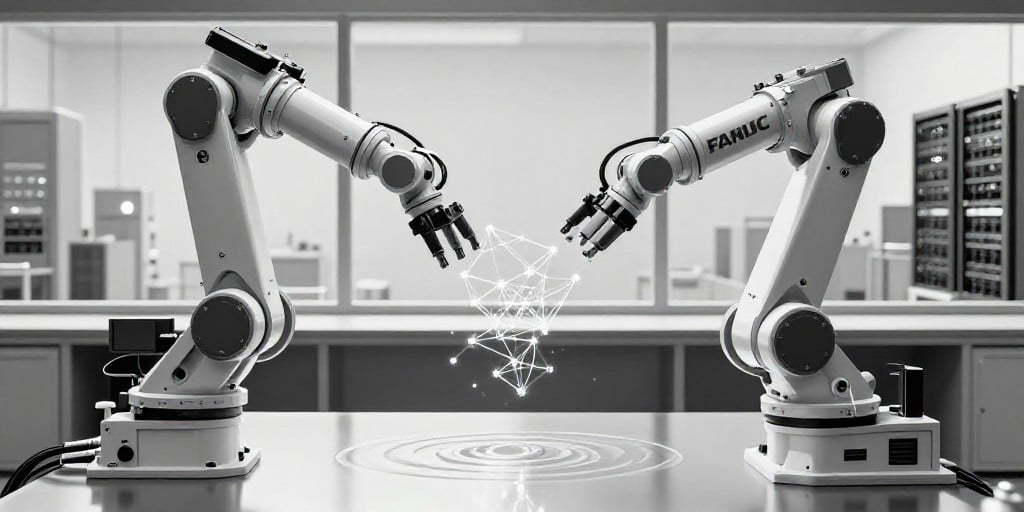
Corporate News – Investigative Briefing on FANUC Corp.’s Montreal AI Research Initiative
Overview
FANUC Corp., a global leader in industrial robotics and CNC systems, has announced the creation of a dedicated research laboratory in Montreal, Canada, focused on developing physical artificial intelligence (AI) for manufacturing. The facility aims to bridge the gap between academic research and real‑world industrial deployment by integrating large‑scale industrial data collection, iterative model refinement, and customer feedback loops. A complementary “Send us your parts” program invites German manufacturers to contribute physical components for in‑situ testing with FANUC robots.
Market Context
- Robotics & Automation Growth: The global industrial robotics market is projected to reach USD $51.4 billion by 2030, growing at a CAGR of 7.6% (Grand View Research, 2025). North America remains the largest region, yet Latin America and Asia‑Pacific are rapidly catching up.
- AI‑Driven Automation: Physical AI, which incorporates sensor data and tactile feedback into control loops, is a nascent sub‑segment expected to grow faster than conventional machine‑learning‑based automation. According to a 2024 McKinsey report, companies that adopt AI‑enabled robotics can achieve up to a 30% increase in throughput while reducing error rates by 25–35%.
- Competitive Landscape: Key competitors include KUKA, ABB, and Yaskawa, all investing in AI and digital twins. FANUC’s Montreal lab positions it to compete in the high‑end “smart factory” niche where customization and rapid deployment are prized.
Underlying Business Fundamentals
- Capital Allocation and ROI
- FANUC’s FY2024 operating income exceeded USD $3.1 billion, with an operating margin of 13.7%. The Montreal lab represents a strategic capital outlay of approximately USD $150 million, primarily allocated to R&D personnel, sensor infrastructure, and data analytics platforms.
- Risk: The return on this investment depends on the speed at which developed algorithms can be commercialized. A lag in market adoption could compress the payback period beyond the typical 4–5 year horizon for high‑tech R&D.
- Supply Chain Integration
- By sourcing parts directly from German manufacturers, FANUC reduces the time‑to‑market for new hardware configurations, mitigating bottlenecks in the silicon and sensor supply chain that have plagued the industry post‑COVID‑19.
- Opportunity: This “Send us your parts” model could evolve into a broader ecosystem of co‑innovation partners, potentially creating a recurring revenue stream through licensing of optimized AI models.
- Talent and Knowledge Capture
- Montreal boasts a vibrant AI research community, with institutions such as McGill University and the Université de Montréal. FANUC’s proximity to these centers allows access to a highly skilled talent pool and facilitates joint academic grants.
- Risk: Talent retention may prove challenging if competitors offer higher compensation or more flexible research environments, especially given the competitive Canadian AI talent market.
Regulatory Environment
- Data Privacy and Security
- The lab’s data collection activities fall under Canada’s Personal Information Protection and Electronic Documents Act (PIPEDA) and the European Union’s General Data Protection Regulation (GDPR) for any customer data originating from European partners. Strict data governance protocols are required to avoid costly breaches or fines.
- Safety Standards
- Physical AI systems must comply with ISO 10218 (robotics safety) and ISO/TS 15066 (collaborative robots). FANUC’s iterative testing with real parts must ensure compliance, otherwise regulatory approval could delay deployment.
Competitive Dynamics
- Differentiation Through Customization
- While many competitors rely on off‑the‑shelf AI modules, FANUC’s lab focuses on custom solutions tailored to each customer’s production line. This can command premium pricing but also increases the complexity of scaling.
- Open‑Source vs Proprietary
- The industry trend leans toward open‑source frameworks (e.g., ROS, OpenAI Gym). FANUC’s decision to offer proprietary tools may attract customers seeking integrated solutions but risks alienating developers who prefer open ecosystems.
- Potential Entrants
- Start‑ups specializing in AI‑augmented robotics are rapidly emerging. FANUC must maintain a technology lead or risk losing market share in the high‑margin smart factory segment.
Overlooked Trends
- Human‑Robot Collaboration (HRC) Synergies
- The Montreal lab’s focus on scene digitisation and collision‑free motion planning directly supports HRC deployments. Companies integrating human‑centric safety protocols can leverage FANUC’s data to improve ergonomics, potentially opening new regulatory incentive programs (e.g., tax credits for HRC adoption).
- Predictive Maintenance
- Real‑time data collected during part testing can feed into predictive maintenance models, reducing downtime and extending robot lifespan. This secondary use case could be monetised through service contracts.
- Digital Twins and Simulation
- By capturing physical interaction data, FANUC can enhance its digital twin capabilities, enabling virtual commissioning that cuts prototype costs by up to 40%.
Risks and Mitigation
| Risk | Impact | Mitigation |
|---|---|---|
| Technological Obsolescence | Rapid advances in AI may outpace lab outputs. | Continuous partnership with academic labs and participation in joint funding programs. |
| Regulatory Non‑compliance | Delays or fines. | Establish a dedicated compliance unit overseeing data handling and safety certifications. |
| Supply Chain Disruptions | Part shortages. | Diversify suppliers and maintain a buffer stock for critical components. |
| Market Adoption Lag | Lower ROI. | Pilot projects with flagship customers to create case studies and accelerate market penetration. |
Opportunities
- Service‑Based Business Model Leveraging the lab’s data analytics platform, FANUC could transition from pure product sales to Automation as a Service, offering subscription‑based AI model updates and performance monitoring.
- Global Partnerships The “Send us your parts” program can be expanded to Asia‑Pacific and South American manufacturers, fostering a global network of collaborative innovation.
- Policy Incentives Governments are increasingly funding AI research (e.g., Canada’s Strategic Innovation Fund, EU’s Horizon Europe). FANUC can secure additional funding streams by aligning lab projects with policy priorities.
Conclusion
FANUC’s Montreal laboratory represents a strategic pivot toward a data‑centric, customer‑centric AI model in industrial robotics. By marrying rigorous research with real‑world deployment, the company positions itself to capture high‑margin opportunities in the evolving smart‑factory landscape. Nonetheless, careful navigation of regulatory requirements, talent acquisition, and competitive dynamics is essential to ensure that the lab’s innovations translate into sustainable financial performance.