
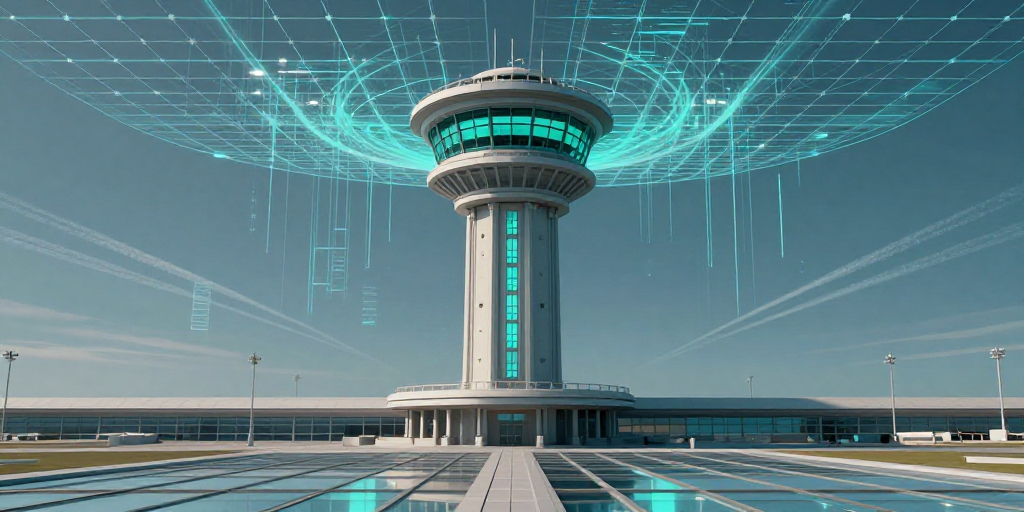
Federal Aviation Administration Seeks AI‑Powered Air Traffic Control Modernization
The Federal Aviation Administration (FAA) has launched a strategic initiative to upgrade the United States’ air traffic control (ATC) infrastructure, inviting a consortium of technology firms—including Palantir Technologies, Thales SA, and Air Space Intelligence—to develop an artificial‑intelligence (AI) platform. The goal is to enhance the national airspace system (NAS) by identifying congestion patterns, mitigating aircraft proximity risks, and improving overall operational safety.
Capital Investment Outlook
While the FAA’s initial funding has been secured through Congressional appropriations, industry analysts anticipate that subsequent rounds of capital expenditure will be required to bring the system to full operational capability. The magnitude of this investment will be comparable to large‑scale industrial upgrades—such as the installation of next‑generation digital control towers or the deployment of automated ground‑moving equipment in logistics hubs—where capital outlays are driven by projected productivity gains and risk mitigation.
Manufacturing and Engineering Implications
High‑Availability Processing Pipelines The AI platform will necessitate a distributed compute architecture capable of ingesting real‑time radar, ADS‑B, and flight‑plan data. Engineers will need to design fault‑tolerant, low‑latency pipelines, analogous to those employed in large‑scale sensor fusion for autonomous vehicles.
Robust Edge Computing Nodes Deploying edge nodes at major airports reduces data transmission times and increases resilience against network outages. The design parallels the use of edge processors in heavy‑industry automation, where latency constraints are critical for safety‑critical operations.
Advanced Sensor Integration The system must harmonize inputs from existing radar, multilateration, and satellite‑based surveillance systems. Integration strategies will mirror those used in modern port‑terminals, where legacy sensors coexist with new IoT devices to enhance situational awareness.
Redundancy and Fail‑Safe Architectures The FAA will require multi‑layer redundancy, including backup power supplies and parallel data pathways, to meet stringent safety certifications. These concepts are familiar from nuclear power plant control systems and aerospace avionics, where a single point of failure is unacceptable.
Productivity Metrics and ROI
Throughput Increase Early simulations predict a 15–20 % rise in aircraft throughput during peak periods, analogous to the throughput gains observed in semiconductor fabrication when AI is applied to yield optimization.
Delay Reduction AI‑driven conflict detection is expected to reduce average flight delays by 10 – 12 %, directly translating into fuel savings and improved airline profitability.
Operational Cost Savings Automation of routine traffic management tasks can free ATC personnel for higher‑level decision making, potentially lowering staffing costs by an estimated 8 %.
These productivity metrics are critical drivers for capital allocation. The FAA and its contractors must demonstrate a clear payback period—ideally within five to seven years—to satisfy both public‑sector budget constraints and private‑sector risk appetites.
Supply Chain and Regulatory Impact
Component Procurement The initiative will spur demand for high‑performance computing hardware, secure communication modules, and robust sensor suites. Supply chain resilience will be paramount, particularly for components sourced from overseas regions subject to geopolitical risk.
Standards Alignment The AI platform must comply with FAA AC 20‑126 (Safety Management Systems) and DO‑178C (Software Considerations in Airborne Systems). Compliance will necessitate rigorous verification and validation cycles, similar to those in aerospace propulsion manufacturing.
Data Privacy and Cybersecurity Regulations such as the FAA’s Cybersecurity Directive and emerging Data Protection Regulations will shape the architecture of data handling, necessitating end‑to‑end encryption and secure audit trails.
Infrastructure Spending and Broader Economic Factors
The FAA’s investment aligns with broader trends in infrastructure spending, including the American Rescue Plan and the Infrastructure Investment and Jobs Act, which collectively allocate billions to modernize critical systems. Key economic drivers include:
Demand Surge Post‑COVID‑19 travel rebound and projected passenger growth are expected to increase flight volumes by 4–5 % annually through 2030, necessitating scalable ATC solutions.
Labor Market Constraints Shortages of qualified ATC personnel amplify the need for automation to maintain safety margins without exacerbating staffing pressures.
Global Competition Other nations, such as the United Kingdom and Japan, are investing heavily in AI‑augmented ATC, creating a competitive environment for U.S. manufacturers and service providers to secure market share.
Conclusion
The FAA’s move to incorporate AI‑driven analytics into its air traffic control system represents a paradigm shift in heavy‑industry operational management. By leveraging cutting‑edge technology, the agency aims to enhance safety, increase throughput, and deliver measurable productivity gains. Success hinges on disciplined engineering, robust supply chain management, and meticulous adherence to regulatory standards. As funding unfolds and technical details emerge, stakeholders across manufacturing, aerospace, and infrastructure sectors will watch closely, recognizing the significant implications for capital investment strategies and the broader industrial ecosystem.