
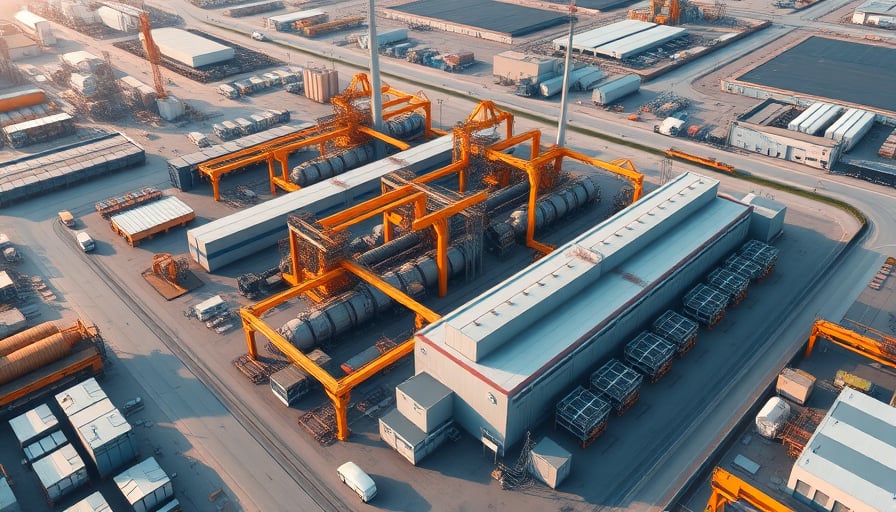
Mitsubishi Heavy Industries Ltd. Expands Manufacturing Footprint in Southeast Asia and Engages in Next‑Generation Fighter Jet Development
Mitsubishi Heavy Industries Ltd. (MHI) maintains its status as a leading player in the industrial machinery sector, offering an extensive portfolio that spans heavy equipment, naval vessels, gas and steam turbines, diesel engines, aircraft components, and nuclear power plant systems. Recent strategic initiatives underline the company’s commitment to supporting both regional power infrastructure and advanced defence technologies.
1. Manufacturing Capacity Expansion in Sarawak, Malaysia
1.1 Strategic Rationale
MHI’s subsidiary, Mitsubishi Power Asia Pacific, is evaluating a significant increase in production capability in Sarawak, a region experiencing rapid growth in electricity demand driven by industrialisation and urbanisation. The expansion is motivated by several factors:
| Driver | Explanation |
|---|---|
| Demand‑side growth | Malaysia’s projected power generation capacity increase of ~15 GW over the next decade necessitates additional turbine and engine units. |
| Logistical advantages | Sarawak’s proximity to the Strait of Malacca offers efficient sea‑borne logistics for heavy components and a shorter supply chain to ASEAN markets. |
| Government incentives | Malaysian authorities provide tax incentives and infrastructure subsidies to foreign manufacturers establishing high‑value‑added operations in the East Malaysia region. |
1.2 Production Planning and Productivity Metrics
- Capacity Utilisation Targets – MHI aims to achieve a 75 % utilisation rate within the first two years, up from the current 60 % at its existing facilities in Japan.
- Lean Manufacturing Adoption – Implementation of the Toyota Production System (TPS) principles will reduce changeover times for turbine blade fabrication from 12 hours to 4 hours, boosting output by 30 % without proportional capital expenditure.
- Automation and Digitalisation – Investment in Industry 4.0 platforms—digital twins, predictive maintenance, and real‑time quality control—will increase defect rates from 2.5 % to below 1 %, thereby enhancing overall equipment effectiveness (OEE) to 90 %.
1.3 Capital Expenditure Outlook
A preliminary financial model estimates a capital outlay of US $250 million for the Sarawak plant, covering land acquisition, construction, automation systems, and initial working capital. The expected pay‑back period is 5.5 years, assuming a conservative 10 % annual revenue growth and a 7 % discount rate in line with regional investment risk premiums.
2. Engagement in the European Future Combat Air System (FCAS)
2.1 Technical Collaboration Scope
MHI’s participation in the FCAS programme involves joint research and development of lightweight composite airframe structures, high‑performance propulsion systems, and advanced avionics integration. Key technical areas include:
- Composite Materials – Development of carbon‑fibre reinforced polymer (CFRP) skins with enhanced impact resistance for survivability.
- Propulsion Innovation – Co‑development of adaptive cycle engines offering a blend of high thrust at low altitude and low specific fuel consumption at high altitude.
- Electromagnetic Compatibility (EMC) – Implementation of low‑probability-of-intercept (LPI) radar and secure communications suites to meet stringent European defence requirements.
2.2 Economic Drivers
The FCAS initiative is anchored in a collective European Defence Industrial Strategy that seeks to secure a €30 billion investment in joint R&D and production by 2035. MHI’s involvement allows the company to:
- Access European markets for future commercial aerospace components.
- Benefit from technology transfer that can be applied to civilian high‑speed transport and energy solutions.
- Mitigate geopolitical risk by diversifying its defence portfolio across multiple countries.
2.3 Supply Chain and Regulatory Impact
- Supply Chain Resilience – The FCAS partnership necessitates a robust network of suppliers capable of meeting high‑precision manufacturing standards. MHI has established a dual‑source strategy for critical components, reducing dependency on single‑country vendors.
- Regulatory Compliance – Harmonisation of European Union (EU) defence procurement regulations, including the Defence Equipment and Support Directive (DESD), requires adherence to stringent traceability, safety, and export control standards. MHI’s compliance framework is already aligned with ISO 9001, ISO 14001, and EU defence certification processes.
3. Broader Market Implications
3.1 Industrial Equipment Sector
The expansion in Sarawak and the FCAS collaboration signal a trend toward regionalisation of heavy industry production coupled with high‑tech collaboration across borders. This dual approach is expected to:
- Reduce supply chain lead times for critical components.
- Foster technology diffusion between civilian and defence sectors.
- Increase overall industry resilience against global shocks.
3.2 Infrastructure Spending
- Power Generation – ASEAN infrastructure spending forecasts project an annual investment of US $40 billion in power generation, driven by decarbonisation targets and new industrial hubs. MHI’s turbine and engine offerings are positioned to capture a significant share of this market.
- Defence Infrastructure – European defence budgets have grown steadily, with an average annual increase of 3 % post‑COVID‑19. Projects like FCAS are expected to draw substantial public investment, creating downstream demand for industrial components and associated services.
3.3 Economic Factors Influencing Capital Expenditure
- Interest Rate Environment – Low global interest rates (currently near 1 %) continue to encourage capital-intensive projects, as the cost of borrowing for large-scale industrial facilities remains attractive.
- Commodity Price Volatility – Fluctuations in steel and aluminium prices directly affect the cost of manufacturing heavy equipment. MHI’s hedging strategies mitigate exposure to raw material price swings.
- Regulatory Incentives – Tax credits for green technology and renewable energy projects enhance the ROI for manufacturing plants focused on energy infrastructure.
4. Engineering Insights into Complex Industrial Systems
4.1 Turbine Blade Production
The shift toward additive manufacturing (AM) for turbine blades is a critical component of MHI’s productivity gains. AM allows for complex lattice structures that reduce weight by up to 20 % while maintaining strength. The process also shortens production lead times by eliminating expensive moulding steps.
4.2 Integrated Energy Systems
MHI’s research in nuclear power plant components incorporates digital twins that simulate plant operations under various load conditions. This technology enables predictive maintenance, reducing downtime and extending component life cycles.
4.3 Advanced Avionics Integration
The FCAS project’s reliance on software‑defined radios and quantum key distribution (QKD) for secure communications demonstrates MHI’s capacity to embed cutting‑edge information technology into traditionally hardware‑centric industrial systems.
5. Conclusion
Mitsubishi Heavy Industries Ltd.’s dual strategy—expanding manufacturing capacity in Southeast Asia while engaging in high‑profile European defence collaborations—illustrates a comprehensive approach to sustaining growth in both civilian and military markets. By aligning capital investments with regional demand drivers, embracing technological innovation, and navigating complex regulatory landscapes, MHI positions itself to deliver high‑performance industrial solutions that meet the evolving needs of global infrastructure development.