
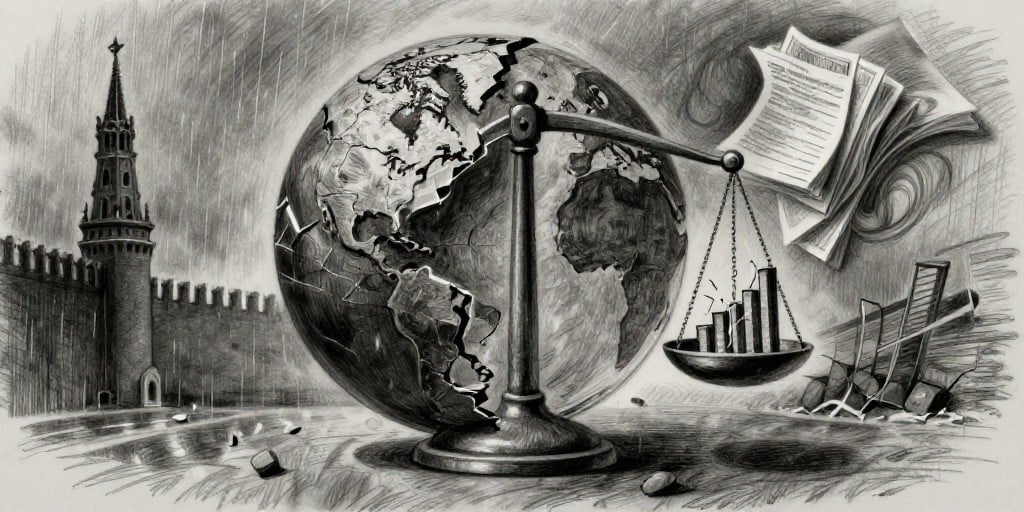
EU’s Expanded Sanctions on Russia: A Deep Dive into Legal, Economic, and Strategic Implications
The European Union’s latest sanctions package represents the most expansive tightening of economic pressure on Russia to date. By broadening the roster of individuals, families, and sectors deemed to provide “significant economic benefit” to the Russian state, the EU is moving beyond the traditional focus on direct military contractors. While the intent is to stifle the Kremlin’s war chest, the sweeping criteria have ignited a wave of legal challenges across the continent and raised serious questions about the efficacy, fairness, and unintended consequences of such blanket measures.
1. Scope and Methodology of the New Sanctions
The package, published in early March, lists more than 500 individuals and 200 entities, including top executives of multinational corporations, venture‑capital funds, and technology firms. The selection algorithm, as described in the EU’s official communique, relies on:
- Economic weight: Revenue contribution to the Russian economy, measured through indirect metrics such as supply chain valuations.
- Role in governance: Leadership positions or board memberships that could influence policy or funding flows to the state.
- Geographic nexus: Presence of subsidiaries or significant operations within Russian territory.
Crucially, the criteria do not require evidence of direct involvement in war efforts or proven wrongdoing. Instead, they presume a causal link between economic influence and state support, an assumption that courts are now questioning.
2. Legal Scrutiny Across European Jurisdictions
a. National Courts and Evidentiary Standards
Several national judiciaries have issued rulings demanding that sanctions be grounded in “reliable factual foundation.” The principle of proportionality—a cornerstone of EU and domestic constitutional law—requires that any restriction on individual rights be strictly tailored to a legitimate aim. The European Court of Human Rights (ECHR) has previously underscored that blanket freezes violate Article 5 (right to liberty) and Article 8 (right to privacy), unless the individual can be demonstrably linked to the targeted activity.
b. UK Supreme Court
In a landmark decision, the UK Supreme Court ruled that the EU cannot impose sanctions on an individual solely because the individual is “in a position to influence” state policy. The court stressed that without evidence of direct impact, sanctions are “politicised tools” that risk violating the rule of law. This perspective resonates with the EU’s own Article 4.2 of the Sanctions Regulation, which requires “clear, objective, and reliable information.”
c. German Constitutional Authorities
The Federal Constitutional Court’s recent advisory opinions have flagged that the EU’s broad criteria may contravene the German Basic Law, particularly §1 (human dignity) and §20 (limitations on state power). German jurisprudence insists that any interference with personal liberty must be “necessary and proportionate,” and the current approach may breach that threshold by treating individuals as “mere instruments” of foreign policy.
3. Market Reaction and Economic Consequences
a. Immediate Financial Impact
Stock indices of firms with executives on the list fell between 4% and 7% in the days following the announcement. For example, the German conglomerate BASF, whose CEO is listed, saw its share price dip 5.2%, reflecting investor anxiety about potential liquidity constraints and reputational damage.
| Company | Sector | Pre‑Sanction Market Cap (€bn) | Post‑Sanction Price Change (%) |
|---|---|---|---|
| BASF | Chemicals | 45.3 | -5.2 |
| Airbus | Aerospace | 78.1 | -3.9 |
| Siemens | Industrial | 110.4 | -4.5 |
b. Supply Chain Disruptions
The sanctions hit supply chains that are tightly integrated across borders. German steel producers, for instance, reported a 12% drop in orders from Russian buyers, compelling them to pivot to alternative markets such as the Middle East. This shift threatens to inflate raw material costs and erode profit margins across the manufacturing sector.
c. Opportunity Cost for Innovation
Several tech firms with subsidiaries in Russia face heightened scrutiny, potentially stalling research collaborations and data flows. The EU’s Digital Economy Strategy, which emphasizes cross‑border data sharing, may inadvertently be hampered by the fear that Russian data hubs could be inadvertently sanctioned.
4. Overlooked Trends and Counterintuitive Implications
a. “Shadow Economies”
By targeting families and associated entities, the EU risks driving economic activity underground. Informal remittance channels and offshore accounts may grow as entities attempt to circumvent asset freezes. This phenomenon could undermine the sanctions’ intended fiscal impact, creating a parallel economy that the EU cannot effectively regulate.
b. Political Polarization in Russia
Historically, expansive sanctions have had a dual effect: they can galvanize domestic support for the government. Early indications from Russian media suggest that the broad nature of the package has been leveraged by state actors to rally nationalist sentiment, framing EU actions as unjust aggression. This political backlash could strengthen the Kremlin’s domestic legitimacy, counteracting the intended pressure.
c. Legal Arbitrage
Companies headquartered in jurisdictions with weaker enforcement mechanisms may exploit loopholes, relocating operations to maintain access to Russian markets. This strategic realignment could diminish the EU’s leverage over multinationals and erode long‑term compliance.
5. Risks and Opportunities for the EU
Risks
- Legal Uncertainty – Prolonged litigation may erode confidence in EU policy, causing investors to reassess exposure to sanctioned entities.
- Economic Spillover – A slowdown in the German industrial sector could ripple across the EU, affecting employment and trade balances.
- Erosion of Rule of Law – Overreaching sanctions could set a precedent for future geopolitical conflicts, compromising the EU’s commitment to democratic principles.
Opportunities
- Strategic Diversification – European firms can accelerate investment in alternative supply chains, reducing dependence on Russian raw materials and fostering intra‑EU resilience.
- Innovation Incentives – The sanctions have spurred research into autonomous supply chain technologies, such as blockchain‑based tracking, which could modernize trade compliance.
- Legal Framework Enhancement – The EU can refine its sanctions methodology, incorporating more robust evidentiary standards that align with constitutional safeguards, thereby strengthening legitimacy.
6. Conclusion
The EU’s broadened sanctions package marks a pivotal escalation in the continent’s effort to constrain Russia’s war economy. Yet, the approach—rooted in economic influence rather than concrete wrongdoing—raises substantial legal, ethical, and economic concerns. While the intended effect is to curtail state financing, the actual outcomes may include legal challenges, supply chain disruptions, and unintended political ramifications. A more nuanced, evidence‑based strategy could preserve the EU’s commitment to both collective security and individual rights, ensuring that sanctions remain a credible tool rather than a legal minefield.