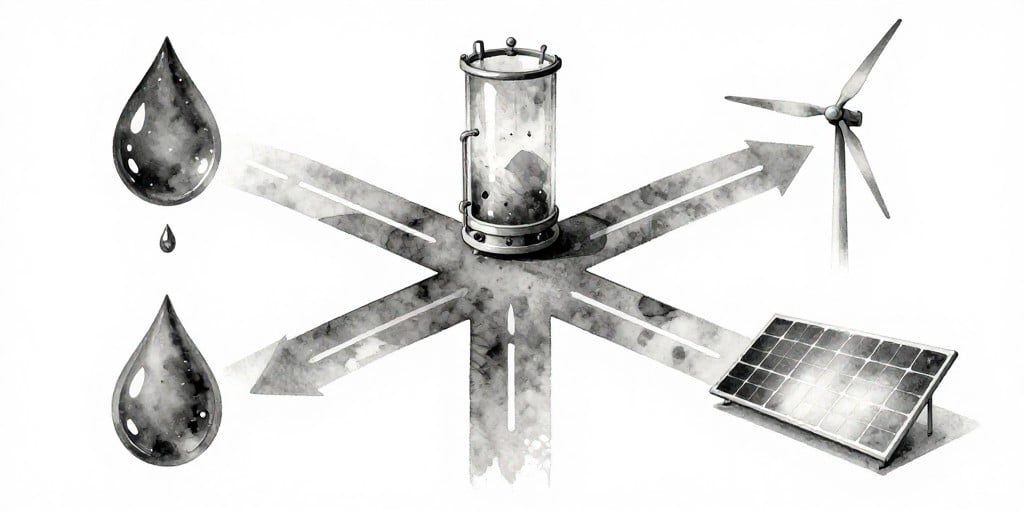
Energy Markets at a Crossroads: Supply‑Demand Fundamentals, Innovation, and Regulation
The Austrian equity market’s modest movement this week provides a useful backdrop for an in‑depth examination of the global energy landscape. While the national index largely held steady, the volatility in oil‑related shares and the broader European context underscore the intricate link between commodity pricing, supply‑demand dynamics, and regulatory policy. In this corporate‑news‑style analysis, we dissect the key forces shaping today’s energy markets and forecast their implications for both traditional and renewable sectors.
1. Supply‑Demand Fundamentals in the Current Energy Environment
1.1 Fossil Fuels
Global oil supply remains constrained by OPEC+ production cuts that were recently extended until the end of 2026. According to the latest International Energy Agency (IEA) data, Brent crude averaged 88 USD/barrel in August, up 3.2 % from the prior month. On the demand side, the International Monetary Fund (IMF) projects a 1.5 % growth in global oil consumption for 2026, reflecting a rebound in transport activity and industrial output in emerging markets.
Gas markets are experiencing a similar tension. European gas volumes fell by 8 % in Q2 2026, primarily due to reduced imports from Russia following geopolitical sanctions. This contraction has pushed Henry Hub gas prices to an average of 7.6 USD/mcf, up 15 % from Q1. The resulting supply tightness is reflected in the upward pressure on natural‑gas‑linked derivatives and has prompted several European utilities to accelerate LNG procurement contracts.
1.2 Renewable Energy
On the supply side, renewable generation capacity is expanding at a rapid clip. Global installed wind capacity increased by 9 % in 2025, while solar PV installations grew by 11 % year‑over‑year. In 2026, the IEA forecasts an additional 400 GW of new renewable capacity, driven largely by policy incentives in China, the EU, and India.
Demand for clean electricity has also intensified. The EU’s “Fit for 55” package sets a 55 % reduction in CO₂ emissions by 2030, pushing member states to replace fossil fuel capacity with renewables. As a result, the price of renewable energy certificates (RECs) in the EU has risen to 20 EUR/REC, up 18 % from last year, further incentivizing new investments.
2. Technological Innovations Driving Market Change
2.1 Energy Production
Battery storage now represents a key technology for integrating variable renewables. The global cost of lithium‑ion batteries has fallen by 45 % since 2020, according to BloombergNEF, making large‑scale storage projects economically viable. Several utilities in Germany and the UK are deploying utility‑scale 400 MW storage farms, which will smooth wind and solar output over several hours.
Hydrogen is gaining traction as both a fuel and an energy storage medium. The European Commission’s hydrogen strategy allocates €9 billion for electrolyzer deployment, targeting 5 GW of electrolyzer capacity by 2030. In the United States, the Biden administration’s $30 billion investment in green hydrogen infrastructure is poised to spur a new pipeline of projects in the Gulf Coast region.
2.2 Energy Storage
Beyond batteries, advanced flow‑cell designs and molten‑salt storage are emerging as cost‑effective alternatives for grid‑scale storage. A recent study from the National Renewable Energy Laboratory (NREL) indicates that redox‑flow batteries can achieve round‑trip efficiencies of 80 % at a unit cost of $0.18/kWh, a significant improvement over traditional lithium‑ion systems.
The deployment of “green hydrogen” via electrolysis is also enabling the creation of synthetic natural gas (SNG), which can be injected into existing gas grids, thus providing a seamless transition path for gas utilities.
3. Regulatory Landscape and Its Implications
3.1 Traditional Energy Sector
The International Energy Agency’s 2025 “World Energy Outlook” highlights the continued relevance of coal in some developing economies, albeit at declining rates. However, the European Union’s “Carbon Border Adjustment Mechanism” (CBAM) is set to impose a carbon fee on imports of high‑carbon goods, raising costs for coal‑dependent power producers. Consequently, several European coal utilities have begun exploring low‑carbon retrofit options, such as carbon capture and storage (CCS), to maintain competitiveness.
3.2 Renewable Energy Incentives
The EU’s Clean Energy Package has introduced a new “Renewable Energy Directive” requiring member states to achieve 42 % of energy consumption from renewables by 2030. In response, Germany’s Energiewende policy has shifted to prioritize offshore wind, offering a feed‑in tariff of 13.5 EUR/MWh for 15‑year contracts, a significant increase from the previous 8.5 EUR/MWh.
In the United States, the Inflation Reduction Act (IRA) includes a 45 % investment tax credit (ITC) for renewable projects, encouraging domestic manufacturing and installation of solar panels and wind turbines. This has spurred a surge in domestic supply chain development, with several large contract awards announced for U.S.‑based solar panel producers.
3.3 Geopolitical Considerations
The ongoing geopolitical tensions in Eastern Europe continue to reshape energy trade flows. Russia’s sanctions and the consequent reduction in gas supplies to Europe have prompted a diversification strategy, including the acceleration of LNG terminals in the U.K. and the U.S. In the Middle East, the Saudi‑Qatar energy partnership has focused on joint development of solar parks, providing a stable source of clean electricity that can be exported to neighboring markets.
4. Commodity Price Analysis and Market Dynamics
Oil: Brent crude’s 3‑month moving average has stabilized at 89 USD/barrel, indicating a short‑term equilibrium between supply cuts and rising demand. However, the volatility index (VIX) for energy futures remains elevated at 12.5 %, reflecting uncertainty surrounding global economic growth and potential supply shocks.
Gas: Henry Hub futures are trading at 7.8 USD/mcf with a 10‑year forward curve that shows a steepening spread, suggesting market expectations of tighter supplies and higher prices in the near term.
Coal: Spot coal prices in the U.K. have increased by 6 % year‑over‑year, driven by higher transport costs and a tightening of environmental regulations. Nevertheless, coal remains a significant source of baseload generation in the U.S., where the National Energy Board reports a 12 % increase in coal consumption in 2025.
5. Balancing Short‑Term Trading and Long‑Term Transition
While short‑term trading strategies are heavily influenced by commodity price swings, long‑term investors are increasingly looking at ESG metrics and policy trajectories. Corporate bonds issued by renewable energy firms have seen record demand, with spreads narrowing to 30 bp above Treasuries. Conversely, bonds from coal‑heavy utilities face a rising discount rate, reflecting heightened risk perceptions.
The Austrian market’s oil‑related shares, for instance, demonstrated a modest rise amid global oil price volatility. Analysts note that such companies can leverage their dividend attractiveness and low valuation metrics to retain investor confidence, even as the broader market lags behind.
6. Outlook
Energy Transition: The convergence of declining renewable technology costs, supportive policy frameworks, and investor appetite for clean‑energy assets will likely accelerate the transition. Renewable generation is projected to reach 70 % of global electricity demand by 2035, according to the IEA.
Fossil Fuels: While demand for oil and gas remains robust in the short term, regulatory pressure and the potential for stricter carbon pricing will gradually erode profitability margins for traditional energy producers.
Investment Strategy: A balanced portfolio that incorporates renewable infrastructure, storage solutions, and strategically positioned fossil fuel assets with low carbon intensity will likely outperform in the evolving landscape.
In summary, the Austrian equity market’s steady performance masks a dynamic underlying energy market. The interplay of supply‑demand fundamentals, technological progress, and regulatory evolution will determine the trajectory of both traditional and renewable energy sectors over the coming years. Investors and corporate leaders alike must navigate this complex environment with a keen awareness of both immediate market signals and the long‑term imperatives of the global energy transition.