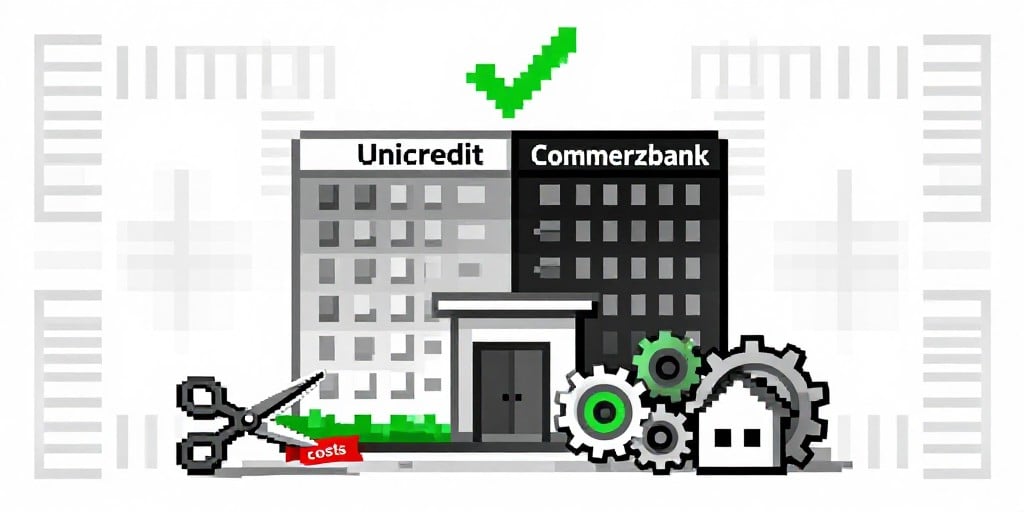
Regulatory Endorsement of Unicredit’s Expanding Stake in Commerzbank: Market Implications
On 15 October, the European Central Bank (ECB) officially cleared the path for Italian banking group Unicredit to increase its ownership of Frankfurt‑based Commerzbank beyond the 30 percent threshold that has long constrained cross‑border consolidation in the euro‑area banking sector. The ECB’s ruling allows Unicredit to convert the shares it acquired through a recent swap offer into its own equity, thereby enabling the Italian lender to raise its voting rights to nearly 50 percent in the coming months.
Quantitative Impact on Share Ownership
- Unicredit’s stake: Prior to the ECB decision, Unicredit held 30 percent of Commerzbank’s voting rights. After conversion of the swap‑acquired shares, its stake is projected to increase to ≈ 48 percent.
- German government’s share: The Federal Republic of Germany retains a ≈ 13 percent stake in Commerzbank, ensuring that the institution remains predominantly German‑owned.
- Share conversion volume: The swap transaction involved ≈ 1.5 billion euros worth of shares, representing the bulk of Unicredit’s additional equity contribution.
Regulatory Context and Strategic Rationale
The ECB’s approval underscores the central bank’s broader policy that cross‑border mergers, when they meet prudential standards, can reinforce the single market and improve the resilience of the banking sector. Unicredit’s pursuit of a larger position in Commerzbank is a long‑term strategy, developed over roughly two years, aimed at achieving:
- Cost synergies: Estimates suggest potential cost savings of €2–3 billion annually through the elimination of overlapping functions and consolidation of back‑office operations.
- Operational integration: A streamlined organizational structure could reduce the workforce by tens of thousands of employees, a figure that has attracted scrutiny from labor representatives and regulators alike.
- Strategic positioning: Unicredit seeks to broaden its footprint in the German market, especially in middle‑market lending, while preserving Commerzbank’s status as a publicly listed company and its core business model.
Market Reception and Investor Sentiment
Investors in both the German and Italian markets reacted positively to the ECB ruling:
- Commerzbank shares spiked 4.3 % in pre‑market trading on 15 October, reflecting optimism about a more favorable ownership structure.
- Unicredit shares gained 2.8 % following the announcement, as market participants priced in the anticipated synergies.
- Analysts highlighted that the decision reduces regulatory uncertainty and accelerates the timeline for full integration, potentially delivering value to shareholders within 12–18 months.
Competitive and Stability Implications
- Competition: The consolidation will likely increase market concentration in the German banking sector. However, the ECB’s stance that such mergers can strengthen the single market suggests that competition policy authorities will scrutinize the deal to ensure no significant anti‑competitive effects arise.
- Capital Allocation: Unicredit’s enhanced stake enables more efficient deployment of capital across the combined entity, potentially improving returns on equity for both institutions.
- Sector Stability: By bringing a larger, well‑capitalised European institution into the fold, the merger is expected to bolster the resilience of Commerzbank’s balance sheet, particularly in the face of emerging macro‑economic pressures such as rising interest rates and regulatory capital tightening.
Actionable Insights for Investors and Financial Professionals
- Portfolio Diversification: Investors holding positions in either bank may consider adjusting exposure to align with the post‑merger risk profile, as the combined entity will likely exhibit lower cost volatility but higher concentration risk.
- Yield Assessment: With anticipated cost reductions, dividend payouts could improve. Analysts should monitor Unicredit’s capital allocation plans to gauge potential lift in dividend yields.
- Regulatory Monitoring: Remaining regulatory approvals are expected to be finalized by year‑end. Market participants should track the ECB’s and national supervisory authorities’ timelines closely, as any delays could influence share pricing.
- Risk Management: Financial professionals should reassess credit and market risk models to incorporate the enlarged balance sheet of the merged entity, particularly in stress scenarios involving interest‑rate shocks or asset‑quality deterioration.
In conclusion, the ECB’s endorsement of Unicredit’s expanded stake in Commerzbank marks a pivotal moment in euro‑area banking consolidation. The merger promises significant operational synergies, improved capital efficiency, and a strengthened position within the single market, while also raising critical questions about competition and employment. Investors and industry participants will need to monitor the integration process and regulatory developments closely to capitalize on the opportunities and manage the risks that accompany this landmark transaction.