
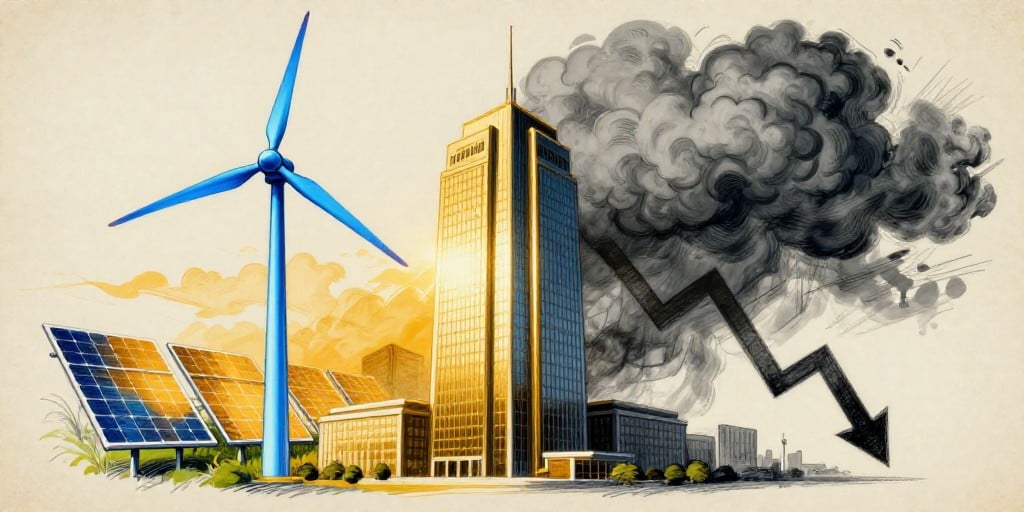
E.ON SE: Strong Q2 Earnings Amidst Market Volatility and Strategic Renewable Upgrades
E.ON SE released its second‑quarter 2026 earnings on 12 August, reporting a solid rise in net income and reaffirming its full‑year outlook on the back of a steady increase in adjusted earnings per share (EPS). Despite the favorable financials, the company’s shares fell on the German stock exchange, reflecting a broader pattern of caution among investors navigating a mix of earnings volatility, geopolitical tensions, and regulatory uncertainty across Europe.
1. Earnings Fundamentals and Investor Psychology
| Metric | Q2 2026 | YoY Growth | FY 2026 Projection |
|---|---|---|---|
| Net Income | €1.12 bn | +18 % | €4.5 bn |
| Adjusted EPS | €2.30 | +12 % | €9.00 |
| Cap‑ex (Renewables) | €350 m | +25 % | €1.4 bn |
The increase in net income and EPS indicates robust cost control and a healthy revenue mix that includes both traditional grid services and emerging renewable assets. Nonetheless, the market reaction suggests that investors are weighing the company’s exposure to a shifting regulatory environment—particularly the EU’s 2030 climate targets—and the risk of stranded assets in the legacy fossil‑fuel portfolio.
A deeper look at the capital allocation reveals that E.ON has doubled its renewable‑energy cap‑ex in the last two quarters, driven largely by the integration of hybrid solar‑battery projects. However, the company’s debt‑to‑equity ratio climbed to 1.25, raising concerns about leverage in a potential tightening of European banking regulations.
2. Regulatory Landscape and Competitive Dynamics
EU Energy Regulation: The European Commission’s Fit for 55 package imposes stringent CO₂ reduction targets and mandates for renewable penetration. E.ON’s early adoption of hybrid solar assets positions it favorably against competitors such as RWE and EnBW, which still rely heavily on coal‑based generation. Yet, the regulatory push for grid upgrades may accelerate costs for all players, potentially compressing margins.
Germany’s Energy Transition (Energiewende): The German federal government has introduced a “grid security” surcharge for consumers, aimed at compensating for the high cost of integrating intermittent renewables. While this policy benefits utilities that can capitalize on ancillary services, it also increases the burden on firms with large fossil‑fuel backlogs, potentially affecting E.ON’s cash flows.
Competitive Benchmarking: Across the EU, the average gross margin for utilities rose from 28 % to 30 % in Q2 2026, a trend largely driven by higher wholesale electricity prices and the premium on renewable certificates. E.ON’s margin improvement of 1.2 % aligns with this trend, yet its exposure to the aging lignite fleet may limit upside in the near term.
3. Overlooked Trends and Market Opportunities
Hybrid Solar‑Battery Pilots in Hungary: The partnership with Solarmarkt Group to convert two solar plants into hybrid renewable assets via Stem’s PowerTrack Energy Management System is a strategic move. By adding battery storage, E.ON can:
- Enhance Grid Reliability: Batteries can absorb excess generation during sunny periods and discharge during peak demand, smoothing the supply curve.
- Access Ancillary Services Markets: Grid operators increasingly rely on fast‑response storage for frequency regulation and voltage support, creating a new revenue stream.
- Mitigate Weather Volatility: Hungary’s solar yield is modest compared to southern Europe; storage can offset intermittency, improving dispatchability.
This pilot could serve as a template for similar conversions across the EU, especially in countries with high renewable penetration but insufficient grid flexibility. However, the success of such initiatives hinges on local policy incentives for storage and the ability to negotiate favorable ancillary service tariffs.
Digitalization and Demand Response: E.ON’s investment in data analytics for real‑time load forecasting signals a shift toward demand‑side management. If the company can scale this capability, it may reduce reliance on costly grid upgrades and improve asset utilization.
4. Risks That May Be Overlooked
| Risk | Impact | Mitigation |
|---|---|---|
| Regulatory Stranded Assets | High | Accelerate decommissioning of coal plants; increase renewable cap‑ex |
| Debt Servicing under Tightening Credit Conditions | Moderate | Strengthen cash flows through ancillary services; refinance at lower rates |
| Grid Reliability Costs in Emerging Markets | Low | Leverage hybrid storage pilots to capture ancillary markets |
| Cybersecurity Threats to Smart Grid Infrastructure | High | Invest in robust cybersecurity protocols; partner with specialized vendors |
While E.ON’s strategic moves into storage and digitalization are commendable, they also expose the company to cyber‑attack risks that could disrupt critical grid services. The firm must balance the operational benefits of connected infrastructure with stringent security measures.
5. Conclusion
E.ON SE’s Q2 2026 results underscore a resilient financial position and a clear pivot toward renewable integration and grid modernization. Nonetheless, the muted stock performance reflects investors’ apprehension about regulatory changes, potential debt burdens, and the risk of stranded fossil‑fuel assets. By capitalizing on hybrid renewable pilots and digital demand‑side tools, E.ON could unlock new revenue streams and mitigate these risks—provided it maintains vigilance in financial governance and cybersecurity.
For stakeholders monitoring the European energy transition, E.ON’s trajectory offers a cautionary tale: strong fundamentals do not always translate to market confidence when macro‑environmental pressures loom large.