
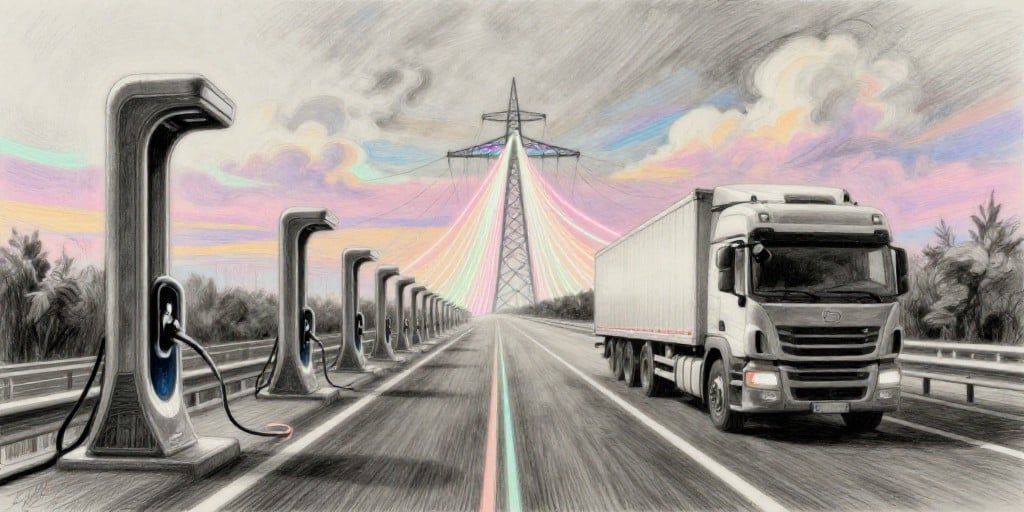
E.ON SE Expands High‑Power Truck‑Charging Network Across Germany
E.ON SE is accelerating the deployment of electric truck‑charging infrastructure by partnering with the motorway service provider Tank & Rast. The collaboration will see the installation of nearly two hundred high‑power stations—each rated in the megawatt range—across 24 service sites, complemented by lower‑power CCS units designed for overnight or longer stops. The first station is slated to become operational in 2027, with the full rollout scheduled to include grid connections, transformers, IT systems, and a reservation platform.
Grid Integration Requirements for High‑Power Stations
The megawatt‑rated chargers demand significant feeder upgrades and substations to accommodate the peak load. Engineers must design phase‑balancing schemes, install voltage‑regulation equipment, and integrate dynamic load‑shifting controls. Given the intermittent nature of renewable generation, power‑quality measures such as harmonic filtering and phase‑angle control are essential to mitigate the impact on sensitive grid equipment. The integration of energy‑storage units—often in the form of battery banks or flywheel systems—at each station can smooth the load profile, providing ancillary services such as frequency regulation and voltage support.
The lower‑power CCS stations, while less demanding, still require robust network connections to ensure reliability during extended stopovers. A modular transformer architecture, paired with smart metering, allows for incremental capacity scaling as demand grows. Both station types must be embedded within the wider distribution network, necessitating coordination with local transmission operators to avoid congestion and maintain system stability.
Renewable Energy Integration Challenges
Germany’s power grid is rapidly incorporating solar and wind resources. The simultaneous operation of a dense network of electric freight chargers introduces new constraints. Peak charging periods often coincide with low wind generation, amplifying the need for dispatchable resources or storage solutions. Grid operators must employ sophisticated forecasting tools to predict renewable output and align it with projected charging loads.
Furthermore, the high‑capacity chargers can act as “smart loads” that participate in demand‑response programs. By dynamically shifting charging times based on real‑time price signals or grid congestion, utilities can reduce the need for costly peaking plants and enhance the overall flexibility of the system.
Regulatory Frameworks and Rate Structures
The rollout of a large-scale freight‑charging network intersects with Germany’s regulatory environment governing electricity tariffs, renewable feed‑in, and grid usage. The Elektrogesetz (ElektroG) and the Energieeinsparungsgesetz (EnEG) provide the statutory framework for grid access and renewable integration. Under the Tarifnetzordnung (TNO), E.ON will negotiate grid usage fees that reflect the marginal cost of network augmentation, while adhering to the Netzentgeltgesetz (NEG) which regulates the remuneration of grid operators.
Rate structures for heavy‑duty vehicle charging are evolving. The traditional flat‑rate model is increasingly replaced by time‑of‑use tariffs or real‑time pricing, designed to align consumer costs with wholesale market signals. E.ON’s reservation platform will likely incorporate dynamic pricing to encourage off‑peak charging, thus easing grid stress during critical periods. Regulatory bodies such as the Bundesnetzagentur (Federal Network Agency) are actively reviewing tariff structures to support the electrification of freight transport while safeguarding consumer affordability.
Economic Impacts of Utility Modernization
Modernizing the grid to accommodate high‑capacity truck charging requires substantial capital investment. The costs encompass transformer upgrades, feeder hardening, advanced protection systems, and the deployment of intelligent control infrastructure. These investments are expected to be partially offset by new revenue streams generated through charging fees, ancillary service markets, and potential participation in capacity markets.
From an economic standpoint, the transition from vehicle electrification to infrastructure development shifts the cost burden from manufacturers to utilities. Utilities must therefore manage a delicate balance: investing in grid upgrades while maintaining regulatory compliance and consumer rate acceptability. In the long term, the widespread adoption of electric freight transport will generate significant savings on fuel costs and reduce emissions, providing measurable benefits to the broader economy.
Competitive Landscape and Market Dynamics
E.ON’s focus on infrastructure aligns with a broader industry trend. Daimler Truck’s TruckCharge brand is constructing a semi‑public network of over 3,000 fast‑charging points, while a joint venture among Daimler Truck, Traton, and Volvo aims to establish 1,700 high‑power stations by 2027. These initiatives highlight the acute shortage of freight‑vehicle chargers relative to the projected demand required to meet European CO₂ targets.
By prioritizing grid infrastructure, E.ON positions itself as a foundational player, providing the backbone for future electrification efforts. This strategic shift emphasizes that vehicle technology advances must be matched by robust, reliable power delivery systems capable of sustaining high‑power loads without compromising grid stability.
Conclusion
E.ON SE’s expansion of high‑power truck‑charging stations represents a critical step toward a sustainable, low‑emission freight sector in Germany. The project exemplifies the technical, regulatory, and economic challenges inherent in modernizing power systems for emerging high‑power applications. Through thoughtful grid integration, dynamic pricing, and strategic partnerships, utilities can foster an environment where renewable energy, advanced charging infrastructure, and economic viability coexist, driving the energy transition forward while safeguarding consumer costs and grid reliability.