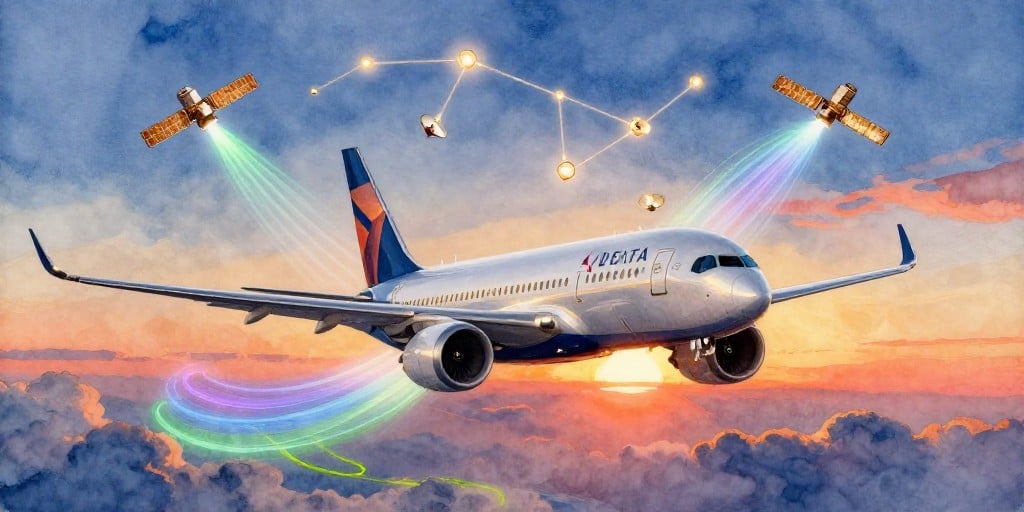
Delta Air Lines Inc. Announces Third‑Quarter 2026 Results and Strategic Expansion of In‑Flight Connectivity
Delta Air Lines Inc. released its third‑quarter financial results for 2026 on Friday, announcing a decisive step toward enhancing its in‑flight connectivity offering. The announcement follows a broader industry discourse on wireless services aboard aircraft and draws particular attention to Delta’s partnership with Amazon’s Leo satellite network.
Financial Performance
The carrier reported a steady revenue stream, with earnings per share and operating margin remaining within the range projected in the company’s earlier guidance. Load factor improved modestly, indicating that demand for Delta’s services continued to recover as travel restrictions eased. However, the quarter also revealed the impact of escalating fuel and maintenance costs, which applied pressure on operating margins. Delta’s guidance for the forthcoming quarter anticipates a slight narrowing of margins, a trend that mirrors the broader airline sector’s experience amid rising operating expenses.
Connectivity Strategy
Delta’s chief executive officer emphasized the company’s commitment to improving passenger experience through more reliable and cost‑effective Wi‑Fi solutions. By integrating Amazon’s Leo satellite platform, Delta aims to deliver enhanced bandwidth while reducing the cost per gigabyte relative to other satellite or ground‑based options. This development is positioned as a strategic response to increasing passenger expectations for seamless in‑flight entertainment and connectivity.
The partnership with Amazon is seen as a critical differentiator in a market where competitors such as United Airlines and American Airlines are advancing their own satellite‑based systems. Analysts note that the move signals Delta’s intent to maintain a competitive edge while adhering to stringent safety and operational standards.
Safety Focus
Delta reaffirmed its dedication to safety, citing a recent incident involving an Airbus A330 that diverted to Porto following a smoke detection in the cabin. The company highlighted the necessity of rigorous safety protocols, particularly as service upgrades, such as expanded connectivity, are implemented. Delta’s safety record remains a cornerstone of its operational philosophy, and the incident serves as a reminder of the importance of maintaining high standards amid evolving technology deployments.
Industry Context
The airline industry’s shift toward satellite‑based connectivity reflects broader economic and technological trends. As consumers increasingly demand constant connectivity, carriers are compelled to invest in infrastructure that delivers higher data rates at lower costs. The partnership between Delta and Amazon underscores the convergence of aviation and aerospace technology sectors, illustrating how alliances across industries can create synergies that benefit both operators and passengers.
Moreover, the strategic emphasis on connectivity aligns with macro‑economic factors such as fluctuating fuel prices and tightening regulatory environments. By securing a lower‑cost satellite solution, Delta seeks to mitigate some of the financial volatility that has beset the sector, while simultaneously enhancing its value proposition to passengers.
Outlook
Delta’s third‑quarter results demonstrate a resilient financial footing amid external pressures, while its collaboration with Amazon’s Leo network marks a significant strategic move toward sustaining competitive positioning. Industry observers will closely monitor how this partnership influences customer satisfaction metrics, operational efficiency, and ultimately, the carrier’s market share in an increasingly technology‑driven airline landscape.