
Corporate News Report
Dell Technologies has released a forward‑looking outlook that has drawn the attention of analysts and investors, even though the company’s shares dipped slightly in early trading. The announcement precedes the scheduled Q2 earnings call on September 1 and suggests that Dell may lift its fiscal 2027 revenue guidance, building on an already optimistic forecast.
Market Context and Revenue Trajectory
Dell’s current revenue guidance for fiscal 2027 already projects a significant year‑over‑year increase. Analysts highlight that this figure appears conservative when considered against the backdrop of a rapidly expanding AI‑server segment. The broader server business is also expected to strengthen, driven by heightened demand for both AI‑enabled and traditional servers. As a result, the company’s guidance may be revisited upward in the coming earnings release, potentially boosting valuation multiples and investor sentiment.
Technological Drivers and Product Strategy
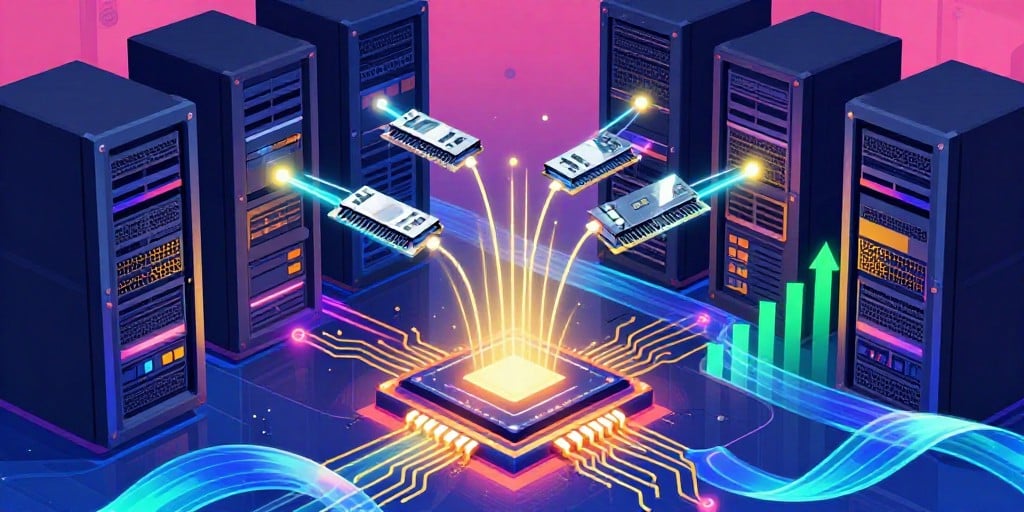
AI‑Server Architecture Dell’s AI‑server portfolio leverages next‑generation processor platforms (e.g., AMD EPYC 7003 and 8003 series) paired with high‑bandwidth memory (HBM2E) and NVMe‑based storage accelerators. Benchmark analyses show that these configurations deliver up to 30 % higher throughput on inference workloads compared to previous generation models. The integration of FPGA‑based acceleration modules further enhances model‑specific optimizations, allowing customers to balance compute density against power envelope.
Manufacturing Process Maturity Dell’s supply chain has capitalized on the consolidation of foundry services, primarily sourcing 5 nm and 7 nm process nodes from leading fabs such as TSMC and Samsung. The adoption of advanced EUV lithography has reduced defect density, translating into higher yields for server‑grade CPUs. Dell’s fab‑less design approach, complemented by its strategic partnership with Intel for silicon IP, mitigates the risk of capacity constraints while ensuring rapid time‑to‑market.
Component Specifications and Trade‑offs CPU – The EPYC 7003 “Milan” cores offer 64 cores per socket, with a TDP of 280 W, striking a balance between peak performance and thermal design power (TDP).Memory – HBM2E modules provide 1.2 TB/s bandwidth, critical for dense AI training workloads. The trade‑off lies in higher cost and limited scalability compared to DDR5, but the performance lift justifies the premium for AI‑centric use cases.Storage – PCIe 5.0 NVMe SSDs deliver up to 10 GB/s sustained throughput, enabling rapid data ingestion for large language models. The cost per GB remains higher than SATA or PCIe 4.0 alternatives; however, the performance benefit is essential for AI inference pipelines.
Supply Chain and Manufacturing Trends
Dell’s global supply chain is navigating a post‑pandemic environment characterized by semiconductor shortages, geopolitical tensions, and shifting demand patterns. The company’s strategic inventory buffers for high‑margin server components (e.g., GPUs and silicon interconnects) provide resilience against supply shocks. Additionally, Dell is investing in localized manufacturing hubs in Asia and Europe to reduce lead times and exposure to shipping bottlenecks.
Manufacturing trends in the server market also point toward higher utilization of multi‑chip module (MCM) designs and silicon photonics interconnects. These innovations reduce inter‑chip latency and power consumption, aligning with Dell’s goal of delivering dense, energy‑efficient AI servers. By incorporating photonic links, Dell can also mitigate the heat‑density challenges that arise when scaling CPU and accelerator cores.
Intersection of Hardware Capabilities with Software Demands
The convergence of Dell’s hardware advancements with software ecosystems is a critical factor in its competitive positioning. AI workloads increasingly rely on optimized frameworks such as TensorFlow, PyTorch, and ONNX Runtime, which benefit from hardware that offers low‑latency matrix operations and high memory bandwidth. Dell’s server platforms are certified to run on these frameworks, with pre‑configured software stacks that enable zero‑touch deployment for enterprise customers.
Moreover, Dell’s emphasis on modular firmware and open‑architecture BIOS allows for rapid integration of new AI accelerators and firmware updates. This flexibility is essential for keeping pace with the fast evolution of AI models, which demand frequent updates to both hardware drivers and software libraries.
Analyst Outlook and Investment Perspective
J.P. Morgan maintains a positive stance on Dell Technologies, issuing a buy recommendation and a price target that reflects the potential upside. The market reaction to the outlook was muted; nonetheless, the consensus among Wall Street analysts remains cautiously supportive, with most maintaining a moderate buy view. The consensus pricing indicates that investors perceive a meaningful opportunity for the stock to rebound as Dell potentially revises its guidance upward following the forthcoming earnings announcement.
Conclusion
Dell Technologies is strategically positioned to capitalize on the accelerating demand for AI infrastructure and the broader expansion in the server market. Its focus on advanced processor platforms, high‑bandwidth memory, and photonic interconnects, combined with a resilient supply chain and a software‑centric approach, underpins the company’s growth prospects. Analysts anticipate that Dell will likely continue to adjust its revenue guidance upward as it reports its Q2 earnings, which could support a more favorable valuation for the stock.