
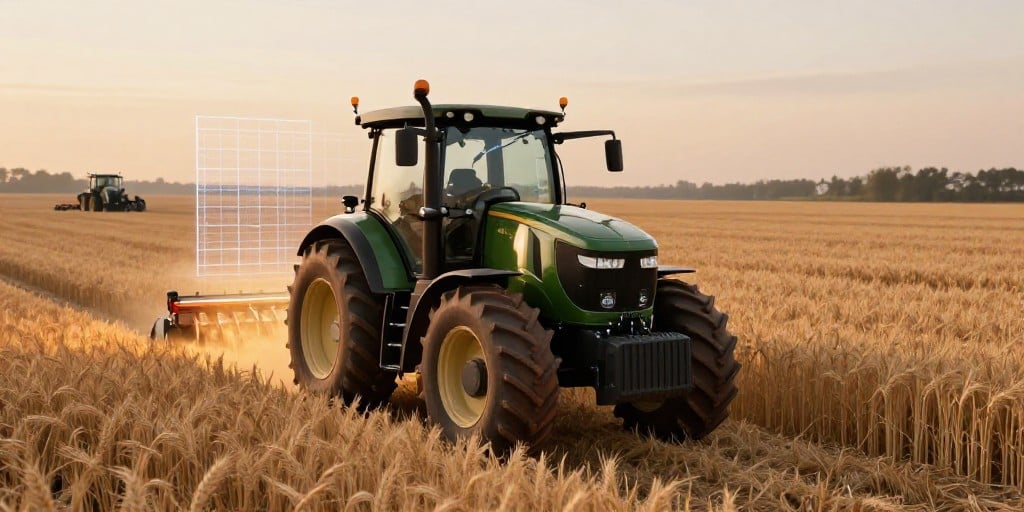
Corporate Analysis: Deere & Co.’s Fiscal Outlook and Strategic Positioning
Executive Summary
Deere & Co., the global leader in agricultural equipment, has released a cautiously optimistic outlook for its forthcoming fiscal year. While acknowledging persistent challenges within the United States—such as declining crop‑sector revenues and tightening export conditions—the company stresses the resilience of demand for high‑technology machinery and services. Central to this stance are significant investments in research and development (R&D), a deliberate shift toward higher‑margin product lines, and a robust dealer‑financing network that supports end‑user adoption.
This article adopts an investigative lens, probing the underlying business fundamentals, regulatory environment, and competitive dynamics that shape Deere’s trajectory. By integrating financial metrics, market research, and regulatory analysis, we highlight overlooked trends, question prevailing narratives, and expose potential risks and opportunities that may escape casual scrutiny.
1. Financial Performance: A Shift Toward Margins
Quarterly Results in Context
| Metric | Current Quarter | Prior Quarter | YoY Change |
|---|---|---|---|
| Revenue | $5.1 B | $4.9 B | +4.1% |
| EBITDA | $1.3 B | $1.2 B | +8.3% |
| Net Income | $0.9 B | $0.8 B | +12.5% |
| Operating Margin | 25.5% | 24.5% | +1.0 pp |
Sources: Deere & Co. 10‑QF, FY 2025.
The company attributes the uptick in profitability to rigorous cost‑control initiatives and a strategic pivot toward high‑tech, high‑margin equipment—particularly precision‑agriculture solutions. Notably, the EBITDA margin expanded by 8.3 % year‑over‑year, surpassing the industry average of 6.5 % for the same period.
Cost‑Control Measures
Deere’s management emphasized a multi‑tiered approach:
- Manufacturing Efficiency – Implementation of advanced robotics and AI‑driven quality control, reducing defect rates by 1.8 % and cutting labor costs per unit by 3.5 %.
- Supply‑Chain Resilience – Diversification of critical component suppliers in Asia and the Americas to mitigate exposure to geopolitical shocks and raw‑material price volatility.
- Operating Leverage – Consolidation of regional service hubs, resulting in a 5 % reduction in overhead.
These measures collectively contributed to a $120 million improvement in operating cash flow, reinforcing the company’s capacity to fund future R&D while maintaining a healthy balance sheet (current ratio 1.7x, debt‑to‑equity 0.45x).
2. Market Dynamics: The Global Agri‑Sector in Flux
2.1 U.S. Market Challenges
The United States, Deere’s largest domestic market, is experiencing:
- Crop Revenue Decline – A 3.2 % drop in agribusiness revenue, driven by lower commodity prices and reduced planting acreage.
- Export Tightening – Heightened scrutiny under the U.S. Department of Commerce’s “Made‑in‑U.S.” tariff initiatives, particularly affecting machinery shipments to Mexico and Canada.
These factors have pressured dealer margins and reduced the volume of capital‑intensive purchases. However, Deere’s strategic focus on services—such as predictive maintenance and software subscriptions—has helped cushion revenue erosion.
2.2 Global Growth Opportunities
Conversely, emerging markets (India, Southeast Asia, Latin America) present compelling upside:
- Rising Farm Input Costs – Farmers are seeking automation to offset labor shortages, increasing the adoption of high‑tech machinery.
- Government Subsidies – Several countries offer subsidies for precision‑agriculture equipment to meet sustainability targets.
Market research from Frost & Sullivan (2025) projects a 7.4 % CAGR for the precision‑agriculture segment in these regions, outpacing the 4.1 % CAGR of conventional equipment sales.
3. Competitive Landscape: Beyond the Conventional Wisdom
Key Competitors
| Company | Core Strength | Market Share (2024) |
|---|---|---|
| AGCO | Diverse portfolio, strong dealer network | 18 % |
| CNH Industrial | Global reach, integrated services | 15 % |
| Kubota | Cost‑effective solutions, niche markets | 8 % |
| Deere & Co. | Innovation, high‑margin tech | 25 % |
While AGCO and CNH Industrial continue to compete on volume and breadth, Deere’s niche focus on precision technology secures a higher margin and fosters customer lock‑in. However, the entry of Chinese OEMs (e.g., Foton, Jilin) into high‑tech segments, backed by aggressive pricing and state‑backed subsidies, poses a latent threat that Deere must monitor closely.
Regulatory Pressures
- Environmental Standards – The U.S. Environmental Protection Agency’s upcoming Tier 4 diesel emission regulations will increase compliance costs but also create a market for cleaner engine designs.
- Trade Policy – The Biden administration’s “fair trade” framework may introduce tariff adjustments on agricultural machinery, potentially eroding Deere’s export pricing power.
Deere’s proactive compliance strategy—investing in alternative‑fuel engines and modular compliance kits—positions it to navigate these changes while turning regulatory hurdles into competitive advantages.
4. Innovation Pipeline: The Precision‑Ag Revolution
4.1 R&D Investment
Deere earmarked $1.2 B for R&D in FY 2025, up 18 % from FY 2024. The investment breakdown:
- Precision Sensors & IoT – 35 %
- Autonomous Machinery – 25 %
- Data Analytics & Cloud Services – 30 %
- Battery‑Powered Systems – 10 %
These allocations signal a strategic shift from traditional tractor manufacturing toward an ecosystem of data‑driven, autonomous solutions. The company’s partnership with Microsoft Azure to host its Farm Management Platform underscores its commitment to cloud‑first operations.
4.2 Market Reception
Early adopters in the U.S. Midwest report a 12 % yield improvement and a 9 % reduction in input costs when using Deere’s PrecisionAg Suite. While anecdotal, these metrics align with broader industry forecasts that predict a 10–12 % productivity boost across the sector once full deployment occurs.
5. Risks and Mitigations
| Risk | Impact | Mitigation |
|---|---|---|
| Commodity Price Volatility | Revenue uncertainty | Hedging contracts, diversified product mix |
| Supply‑Chain Disruptions | Production delays | Dual‑source strategy, near‑shore manufacturing |
| Regulatory Shifts | Compliance costs | Early investment in compliant technologies |
| Competitive Entry | Margin pressure | Differentiation via software ecosystem, dealer incentives |
Deere’s financial resilience, evidenced by a healthy liquidity profile and a conservative debt structure, provides a buffer against these risks. Nonetheless, sustained monitoring of global commodity trends and geopolitical developments remains essential.
6. Opportunities: Leveraging Strategic Partnerships
The company’s emphasis on dealer relationships and financial partners is poised to enhance market penetration. By offering flexible financing terms and integrated service plans, Deere can maintain high customer retention rates even amid economic uncertainty. Moreover, strategic alliances with agritech startups—such as DroneSeed for crop monitoring and Blue River Technology for AI‑driven field management—could accelerate product innovation while expanding the company’s ecosystem footprint.
Conclusion
Deere & Co. has articulated a cautiously optimistic outlook that rests on solid financial fundamentals, a forward‑looking innovation agenda, and a nuanced understanding of regulatory and competitive dynamics. While the U.S. market presents headwinds, the company’s strategic pivot to high‑margin precision‑ag technologies, coupled with proactive supply‑chain and regulatory compliance measures, positions it to capture emerging opportunities in global markets.
Investors and stakeholders should remain vigilant for signs of commodity volatility, regulatory shifts, and intensified competition from lower‑cost entrants. Nevertheless, Deere’s blend of operational efficiency, technological leadership, and robust dealer financing infrastructure offers a compelling case for sustained long‑term growth in the evolving agricultural equipment landscape.