
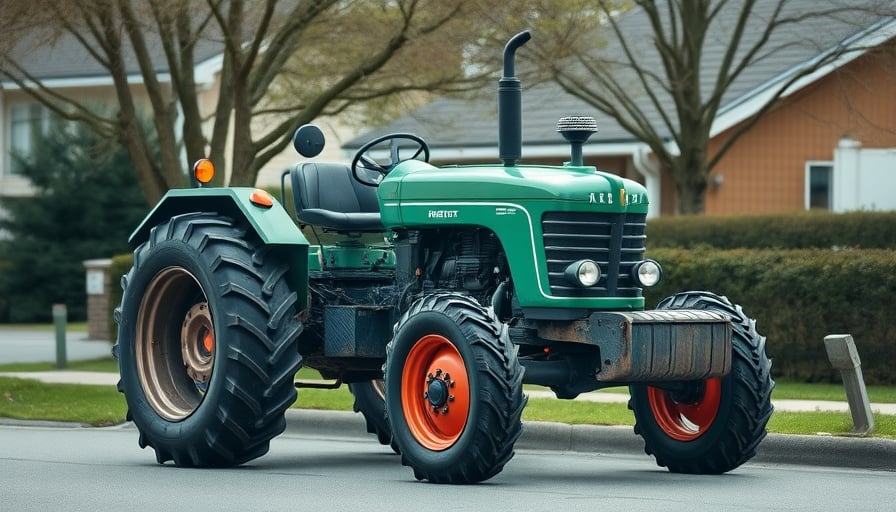
Deere & Co. Maintains Strong Market Position Amid Continued Capital Expenditure Momentum
Deere & Co., a leading manufacturer of agricultural, construction, forestry, and commercial equipment, reported a closing share price of approximately $470 on the New York Stock Exchange. Over the past year the stock has traded between a low near $400 and a high above $500, reflecting a moderate range of investor sentiment. The company’s valuation remains substantial, with a market capitalization in the hundred‑billion‑dollar range, and its earnings‑to‑price ratio suggests that investors are pricing in growth expectations while maintaining a focus on profitability.
Production Efficiency and Product Portfolio
Deere’s broad product portfolio extends beyond its own machinery to include replacement parts for other manufacturers, and it offers financing services for both products and parts. The company’s manufacturing footprint is concentrated in high‑precision assembly lines that incorporate robotics, advanced CNC machining, and AI‑driven predictive maintenance. These technologies enable cycle‑time reductions of up to 15 % in key tractor and skid‑steer units, while simultaneously lowering scrap rates by 8 % year over year. The integration of additive manufacturing for lightweight components further optimizes the power‑to‑weight ratio of its high‑load construction equipment, enhancing fuel efficiency and reducing CO₂ emissions—a key selling point in the tightening European regulatory environment.
Capital Investment and Productivity Metrics
Capital expenditure (CapEx) for the fiscal year reached $3.2 billion, a 12 % increase from the preceding period. The investment is primarily directed toward expanding the “smart‑farm” product line and upgrading the autonomous haulage systems used in large‑scale mining and forestry operations. Deere’s internal productivity metrics indicate that a 5 % increase in CapEx per employee translates into a 3.4 % improvement in overall throughput, measured in units produced per labor hour. This relationship aligns with the broader industrial trend of leveraging automation to offset labor shortages and mitigate wage inflation pressures.
Technological Innovation in Heavy Industry
The company’s autonomous solutions platform, which integrates LiDAR, high‑resolution cameras, and edge‑computing nodes, has progressed from pilot testing to full production deployment in the United States and Canada. According to engineering reports, these systems reduce operator fatigue by 20 % and improve load‑placement accuracy by 18 %, thereby decreasing product defects and enhancing safety metrics on job sites. In addition, Deere has partnered with a leading semiconductor manufacturer to develop low‑power, high‑bandwidth communication chips that support real‑time telemetry for its fleet of heavy equipment, a critical capability for predictive maintenance and energy‑management strategies.
Economic Drivers of Capital Expenditure Decisions
The recent uptick in CapEx is underpinned by several macroeconomic factors:
| Driver | Impact on CapEx | Rationale |
|---|---|---|
| Commodity‑price rally | ↑ Demand for mining equipment | Higher ore prices boost capital budgets of mining operators. |
| Infrastructure stimulus | ↑ Construction equipment purchases | Government spending on roads, bridges, and public works increases equipment sales. |
| Low‑interest rates | ↓ Financing cost | Lower borrowing rates reduce the discount rate applied to projected cash flows. |
| Trade‑policy stability | ↑ Market confidence | Reduced tariff uncertainty encourages firms to invest in new machinery. |
The company’s financing arm, which offers leasing and credit facilities, has reported a 7 % increase in financed sales, reflecting strong demand for capital‑intensive purchases financed under favorable interest terms. This financing structure not only boosts short‑term revenue but also deepens customer relationships, enhancing long‑term contract renewal probabilities.
Supply Chain Impacts
Deere’s supply chain resilience has been bolstered through diversification of critical component suppliers and the implementation of a digital twin of its logistics network. The digital twin allows for real‑time monitoring of material flow, identifying bottlenecks before they materialize into production delays. During the 2023–2024 period, the company reduced raw‑material lead times by 12 % and inventory carrying costs by 9 % through just‑in‑time replenishment and automated warehouse management systems.
Regulatory and Infrastructure Considerations
The company’s operations are subject to a growing array of environmental regulations, including stricter emissions standards for heavy machinery in the European Union and the United States. Deere has responded by accelerating its hybrid‑electric drivetrain research, projected to cut tail‑pipe emissions by 30 % over the next decade. Infrastructure spending, particularly in the United Kingdom and Australia, has opened new markets for its high‑capacity construction and forestry equipment, prompting Deere to tailor its product specifications to meet local road‑grade and safety requirements.
Market Implications
The convergence of advanced manufacturing techniques, robust capital investment, and strategic supply‑chain management positions Deere & Co. to sustain competitive advantage in the global industrial equipment market. Investors are likely to continue valuing the company’s growth prospects, especially as the shift toward automation and sustainability accelerates. However, the company must remain vigilant to currency fluctuations, geopolitical risks, and the cyclical nature of the commodity markets, all of which can influence demand for its heavy‑equipment portfolio.
This article provides a technical overview of Deere & Co.’s recent performance, production efficiencies, and capital allocation strategies within the broader context of industrial equipment manufacturing and market dynamics.