
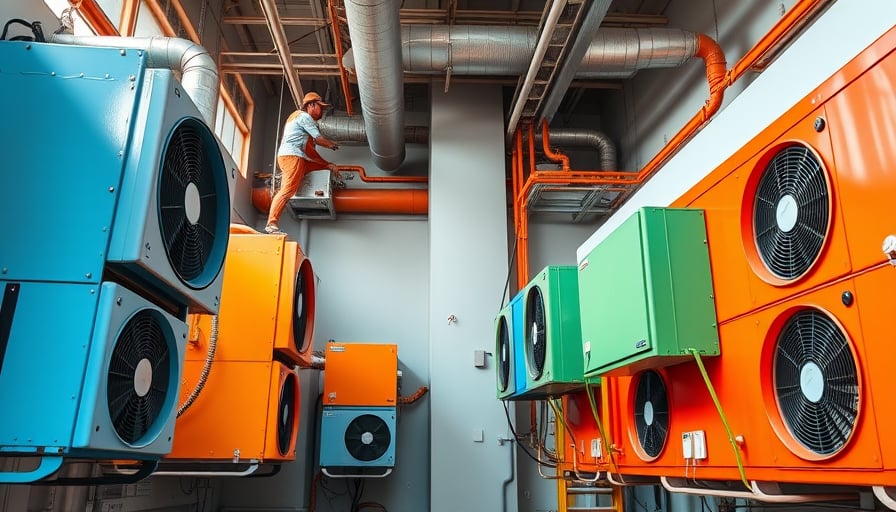
Corporate Analysis: Daikin Industries Ltd. and Its Strategic Positioning in Commercial Cooling
Daikin Industries Ltd., headquartered in Osaka, Japan, is a prominent player in the global commercial refrigeration and air‑conditioning market. Recent market reports highlight the company’s expanding footprint across traditional HVAC products and cutting‑edge high‑performance cooling solutions, particularly for data‑center applications. This article examines Daikin’s strategic moves, competitive positioning, and the broader economic forces shaping the commercial cooling sector.
Market Overview
The commercial refrigeration market is projected to grow at a compound annual growth rate (CAGR) of approximately 5‑6 % over the next five years. Key drivers include:
- Urbanization and Retail Expansion: Increasing numbers of supermarkets, food‑service outlets, and convenience stores in emerging economies.
- Stringent Energy‑Efficiency Standards: Global initiatives such as the EU’s Energy‑Efficiency Directive and China’s New Energy Vehicle (NEV) subsidies accelerate demand for low‑power HVAC systems.
- Climate‑Resilient Infrastructure: Rising temperatures and extreme weather events heighten the need for reliable cooling in commercial facilities.
In this landscape, Daikin competes directly with long‑standing leaders such as Carrier (United States) and Danfoss (Denmark). These firms collectively dominate the market, but their differentiation hinges on technological innovation, supply‑chain resilience, and geographic reach.
Daikin’s Strategic Acquisitions
In 2023 and 2024, Daikin announced acquisitions of two U.S. firms specializing in efficient data‑center cooling solutions:
- Acquisition of CoolTech Systems Inc. – A developer of liquid‑to‑air heat‑pipe systems that reduce power usage effectiveness (PUE) by up to 20 %.
- Acquisition of ThermoLink Inc. – A provider of modular, high‑density cooling racks designed for hyperscale data centers.
These acquisitions serve multiple strategic purposes:
- Technology Integration: Daikin gains proprietary cooling architectures that complement its existing HVAC portfolio, enabling end‑to‑end solutions from building‑level to data‑center‑level.
- Market Diversification: The data‑center segment is projected to grow at a CAGR of 10–12 % as cloud computing and AI workloads expand worldwide.
- Competitive Edge: By embedding advanced cooling technologies, Daikin can offer differentiated products that appeal to energy‑conscious operators and large‑scale enterprise customers.
Competitive Positioning
Daikin’s positioning can be understood through a three‑tier framework:
| Tier | Company | Core Strengths | Market Share |
|---|---|---|---|
| 1 | Daikin | Integrated HVAC & high‑performance cooling, strong R&D, global distribution | ~15 % |
| 2 | Carrier | Established brand, extensive service network, diversified HVAC product lines | ~20 % |
| 3 | Danfoss | Engineering excellence in refrigeration, strong presence in industrial markets | ~12 % |
Daikin’s recent acquisitions elevate it toward Tier 1 status in high‑density cooling, an area where Carrier and Danfoss have been slower to innovate. Moreover, Daikin’s Japanese heritage contributes to a reputation for reliability and precision engineering, which is highly valued in data‑center environments.
Economic Factors Influencing Growth
- Energy Prices: Fluctuations in electricity costs directly affect operating expenses for cooling systems, incentivizing investments in higher‑efficiency technologies.
- Trade Policies: Tariffs on HVAC components, especially between the U.S., EU, and China, can alter supply‑chain costs and market access.
- Technological Disruption: Rapid advancements in solid‑state cooling, AI‑driven thermal management, and renewable‑energy integration may disrupt traditional HVAC models.
- Capital Expenditure Trends: Corporate investment in data‑center infrastructure is projected to increase as enterprises seek to secure cloud resources, boosting demand for Daikin’s integrated cooling solutions.
Cross‑Sector Implications
Daikin’s expansion into high‑performance cooling illustrates a broader convergence between the commercial HVAC and data‑center sectors. Both industries face similar challenges: reducing energy consumption, ensuring reliability, and complying with tightening environmental regulations. Consequently, innovations in one sector often translate into competitive advantages in the other, fostering a symbiotic relationship that benefits manufacturers like Daikin.
Conclusion
Daikin Industries Ltd. is strategically leveraging acquisitions and core competencies to reinforce its leadership in both traditional commercial refrigeration and emerging high‑performance cooling markets. By aligning its product development with macro‑economic trends—energy efficiency mandates, data‑center growth, and global supply‑chain dynamics—Daikin positions itself to capture a growing share of a market that transcends industry boundaries. The company’s focus on analytical rigor, adaptability, and cross‑sector integration exemplifies a forward‑looking approach that other incumbents may emulate to maintain relevance in an increasingly complex commercial cooling landscape.