
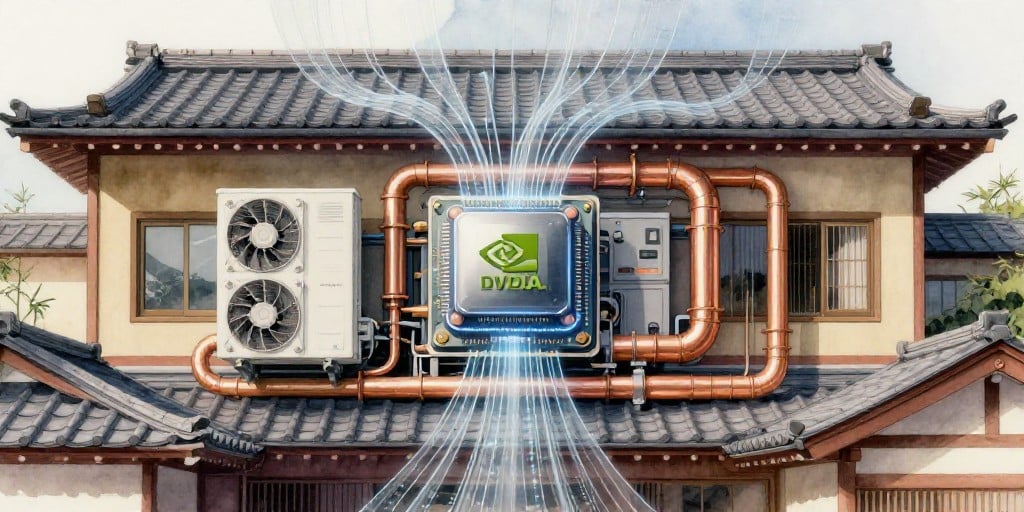
Corporate News – Daikin Industries Ltd. Joins Noetra Consortium to Advance AI‑Enabled Manufacturing
Daikin Industries Ltd., a prominent Japanese manufacturer of HVAC systems and industrial machinery, has formally joined the Noetra consortium—an expansive partnership that now includes global leaders such as NEC, Sony, SoftBank, and Honda. The consortium’s primary objective is to develop a domestically sourced multimodal foundation model that will underpin a wide spectrum of AI‑enabled robots and physical AI applications. Daikin’s participation is a clear indicator of its long‑term strategy to embed advanced artificial intelligence throughout its manufacturing and product development pipelines.
Capital Investment and Infrastructure Outlook
The consortium has attracted substantial capital from a diversified pool of investors spanning technology, automotive, telecommunications, and industrial sectors. In alignment with this investment influx, Noetra has established a dedicated research and development (R&D) arm that leverages expertise from both academia and industry. A pivotal component of the initiative is a partnership with NVIDIA to build a high‑performance computing (HPC) infrastructure. This infrastructure will feature a large‑scale GPU installation, essential for accelerating the training of the multimodal foundation model. Construction of the HPC facility is slated to commence in early 2027, with full operational capability expected by mid‑2028.
From a capital expenditure perspective, the projected investment in GPU clusters, cooling systems, and data center networking represents a significant outlay that aligns with global trends in industrial AI R&D. The Japanese government’s push to bolster domestic AI capabilities, coupled with the industry’s pursuit of higher productivity metrics, is expected to sustain a robust pipeline of such infrastructure projects over the next decade.
Manufacturing Processes and Productivity Gains
Daikin’s integration of the foundation model into its production lines is anticipated to yield measurable productivity improvements. The model’s multimodal capabilities—combining visual, auditory, and sensor data—enable real‑time anomaly detection, predictive maintenance, and adaptive quality control. By incorporating AI‑driven robotics, Daikin can automate complex assembly tasks, reduce cycle times, and minimize scrap rates. Early pilots in partner facilities have indicated potential productivity gains of 12–18 % in throughput and a 5–7 % reduction in downtime.
From an engineering standpoint, the foundation model will interface with existing programmable logic controllers (PLCs) and distributed control systems (DCS) through standardized industrial communication protocols such as OPC UA and Ethernet/IP. This seamless integration minimizes retrofitting costs and preserves legacy investments, which is critical for companies with extensive manufacturing footprints.
Technological Innovation in Heavy Industry
The Noetra consortium’s focus on a multimodal foundation model is particularly relevant to heavy industry, where physical robots operate in unstructured environments. The AI system’s ability to perceive and interact with complex physical contexts—such as navigating cluttered factory floors or handling variable part geometries—addresses longstanding challenges in automation. Moreover, the model’s architecture is designed to scale across multiple domains, from smart assembly cells to autonomous mobile units, thereby unlocking cross‑functional synergies.
NVIDIA’s contribution of GPU infrastructure not only supports model training but also facilitates edge inference through NVIDIA’s Jetson and DGX platforms. This dual emphasis on high‑performance training and lightweight inference ensures that AI benefits can be realized throughout the manufacturing stack, from central servers to field‑deployed robots.
Economic Drivers of Capital Expenditure
The decision to invest heavily in AI infrastructure reflects several macro‑economic drivers. First, Japan’s aging workforce and the need for higher output per worker create a compelling case for automation and AI. Second, global supply chain disruptions—exacerbated by geopolitical tensions and pandemic‑related shutdowns—have highlighted the vulnerability of traditional manufacturing models. By embedding AI, companies can achieve greater resilience and flexibility.
Additionally, recent regulatory shifts in the European Union and the United States—such as stricter data privacy laws and standards for autonomous machinery—necessitate the adoption of robust, compliant AI systems. The Noetra consortium’s collaborative approach, which includes rigorous testing and certification pathways, positions its members to meet these evolving regulatory requirements.
Supply Chain and Infrastructure Impact
The consortium’s investment strategy is expected to have a cascading effect on the broader industrial supply chain. Suppliers of GPU hardware, cooling solutions, and high‑bandwidth networking equipment are likely to experience increased demand. At the same time, the deployment of AI‑enhanced manufacturing lines may reduce the need for certain intermediary components, thereby reshaping component utilization patterns.
Infrastructure spending, particularly in the data center domain, is projected to rise sharply. The Noetra HPC facility will require advanced cooling technologies—such as liquid immersion cooling—to manage heat loads from dense GPU arrays. This shift will drive innovation in data center design, energy efficiency, and sustainability metrics, aligning with Japan’s broader sustainability commitments.
Market Implications
Daikin’s entry into the Noetra consortium signals a broader trend of traditional industrial players aligning with high‑tech firms to accelerate AI adoption. This convergence is likely to intensify competitive pressure, prompting other manufacturers to invest in similar partnerships or develop in‑house AI capabilities. Market analysts predict that companies that successfully integrate AI will achieve a 20–30 % higher return on capital compared to peers that lag in digital transformation.
Moreover, the consortium’s roadmap—targeting advanced AI capabilities for mid‑2028—positions its members to capitalize on upcoming industry demands, such as smart factories, Industry 4.0 compliance, and the emerging field of physical‑world AI applications. The ability to produce AI systems that can reliably interact with physical environments is expected to become a key differentiator in markets ranging from automotive to consumer electronics.
Conclusion
Daikin Industries Ltd.’s participation in the Noetra consortium underscores a strategic commitment to leveraging AI for manufacturing excellence. By aligning with leading technology and industrial firms, Daikin is poised to benefit from shared R&D, significant capital investment, and a robust AI infrastructure that collectively enhance productivity, reduce operational risk, and foster sustainable growth. As the consortium progresses toward operational deployment, industry stakeholders will closely monitor its impact on production metrics, supply chain dynamics, and regulatory compliance—factors that will ultimately shape the trajectory of Japan’s industrial innovation landscape.