
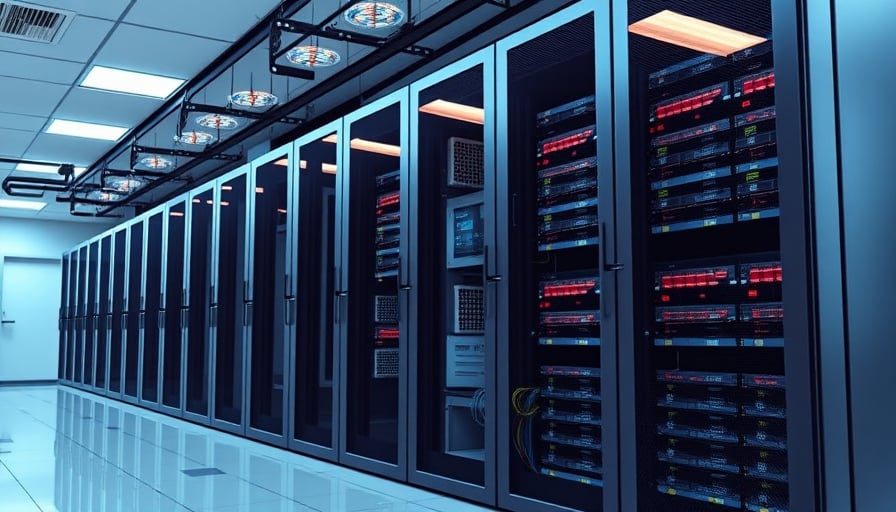
Daikin Industries Expands U.S. R&D Footprint in Data‑Centre Cooling
Daikin Industries Ltd. (ticker: DAIKIN), a global leader in HVAC and refrigeration systems, has announced a strategic investment to enhance its research and development capabilities in the United States. The company plans to allocate approximately $163 million to construct a new facility dedicated to the development of cooling solutions for data centres. Simultaneously, Daikin will earmark a comparable sum for a high‑performance test laboratory in Minneapolis, Minnesota, aimed at accelerating innovation in HVAC technologies for both traditional and hyperscale data‑centre applications.
Investment Details
- New U.S. Facility – The proposed plant will focus on designing and testing next‑generation cooling systems that meet the stringent power‑density and reliability requirements of modern data‑centres. The facility is expected to house advanced simulation equipment, prototype fabrication units, and a dedicated testing corridor to evaluate thermal performance under realistic load conditions.
- Minneapolis Test Laboratory – The high‑performance laboratory will provide a controlled environment for benchmarking HVAC units against industry standards. It will enable Daikin to validate energy‑efficiency metrics, noise levels, and environmental impact before commercial deployment.
Both investments are scheduled to commence in the second quarter of 2026, with full operational capability projected by late 2027.
Strategic Rationale
1. Rising Data‑Centre Demand
The global data‑centre market is projected to grow at a compound annual growth rate (CAGR) of 8–10 % through 2030, driven by cloud computing, artificial intelligence, and the Internet‑of‑Things. Hyperscale operators, such as Amazon Web Services and Microsoft Azure, require cooling solutions that can deliver high performance while minimizing power usage effectiveness (PUE). Daikin’s investment aligns with this trend, positioning the company as a preferred supplier of energy‑efficient cooling technologies.
2. Shift Toward Sustainable Energy
Regulatory pressure and corporate sustainability initiatives are pushing data‑centre operators to reduce carbon footprints. Daikin’s focus on sustainable HVAC designs, including variable refrigerant flow (VRF) systems and liquid‑cooling integration, supports clients’ decarbonization targets. The new U.S. facility will enable rapid prototyping of low‑global‑warming‑potential (GWP) refrigerants, thereby accelerating compliance with forthcoming environmental standards.
3. Competitive Positioning
Daikin faces competition from established HVAC manufacturers such as Honeywell International, Johnson Controls, and Carrier Corporation, as well as emerging startups offering modular cooling solutions. By investing in dedicated R&D infrastructure, Daikin can differentiate itself through:
- Product Innovation – Faster time‑to‑market for novel cooling concepts, including direct‑liquid immersion and hybrid air‑liquid systems.
- Performance Metrics – Ability to certify superior PUE reductions and lower operating costs for hyperscale clients.
- Service Ecosystem – Enhanced post‑sale support, predictive maintenance tools, and customized energy‑management software.
Economic Factors and Market Drivers
- Capital Expenditure (CapEx) Dynamics – Data‑centre operators are allocating significant CapEx toward cooling infrastructure, which accounts for 30–40 % of total data‑centre energy costs. This creates a robust demand environment for advanced cooling solutions.
- Energy Price Volatility – Rising electricity prices in key data‑centre hubs (e.g., East Coast U.S.) heighten the importance of energy‑efficient HVAC systems, offering Daikin a compelling value proposition.
- Geopolitical and Supply‑Chain Considerations – Localizing R&D and manufacturing in the U.S. mitigates risks associated with global supply‑chain disruptions, especially for critical components like compressors and electronic controls.
Cross‑Sector Implications
The technologies under development at Daikin’s new facilities have broader applicability beyond data‑centres:
- Commercial Real‑Estate – Energy‑efficient HVAC solutions can be deployed in high‑rise office buildings, reducing operating costs for landlords and tenants.
- Manufacturing – Precise temperature control is essential for semiconductor fabrication, pharmaceuticals, and food processing; Daikin’s research can lead to customized cooling modules for these sectors.
- Renewable Energy Integration – Cooling systems that can operate efficiently during peak renewable generation periods contribute to grid stability and the broader transition to clean energy.
Conclusion
Daikin Industries’ $163 million investment in a U.S. cooling research hub and a Minneapolis test laboratory reflects a calculated response to evolving market demands and sustainability imperatives. By bolstering its R&D capabilities, Daikin is poised to reinforce its competitive stance in the rapidly expanding data‑centre cooling arena while simultaneously creating synergies across related industrial sectors. The strategic focus on innovation, energy efficiency, and localized production positions the company to capitalize on long‑term economic trends that favour resilient, low‑carbon infrastructure solutions.