
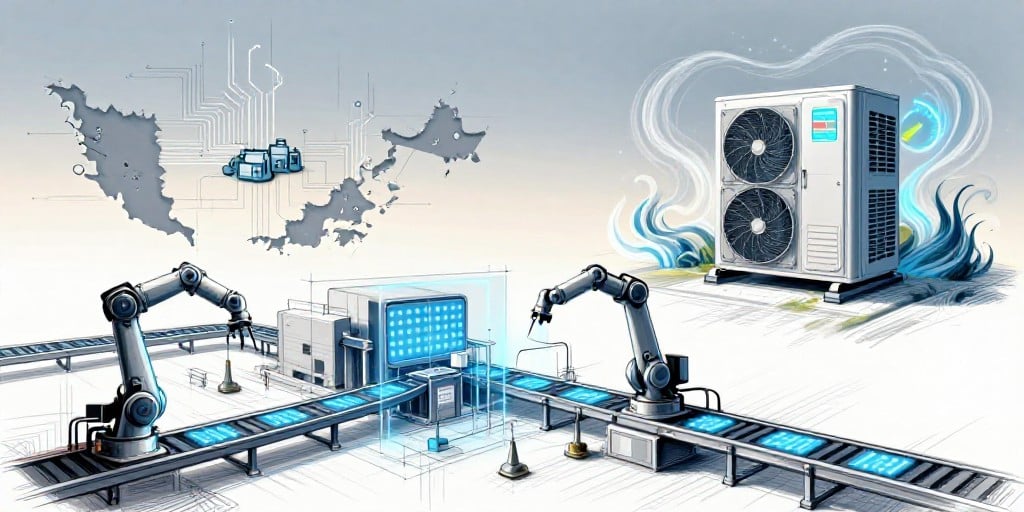
Daikin Industries Ltd. Expands Supply‑Chain Integration and Strengthens Market Position in Air‑Conditioning
Daikin Industries Ltd. has intensified its dual strategy of enhancing supply‑chain resilience while solidifying its competitive standing in key growth markets. The company’s recent initiatives—most notably a partnership with Malaysia’s investment development agency and the Selangor Human Resource Development Centre—are designed to embed small and medium‑sized enterprises (SMEs) within global manufacturing ecosystems. Simultaneously, Daikin’s core business in the air‑conditioning sector continues to demonstrate robust performance, especially in the Indian market where energy‑efficient inverter split units dominate demand.
1. Supply‑Chain Integration: Enabling SMEs as Global Partners
The Malaysian programme attracted over a hundred participants and focused on several critical enablers:
| Enabler | Technical Detail | Market Implication |
|---|---|---|
| Supplier Requirements | Alignment of ISO 9001, ISO 14001, and ISO 45001 standards with digital traceability tools. | Reduces audit time and facilitates rapid onboarding of local suppliers. |
| Digital Transformation | Implementation of cloud‑based ERP and IoT‑enabled production monitoring. | Improves real‑time yield tracking and predictive maintenance, increasing overall equipment effectiveness (OEE). |
| Smart Manufacturing | Adoption of additive manufacturing for rapid prototyping and lightweight component fabrication. | Lowers material waste and accelerates time‑to‑market for new product variants. |
| Financial Support | Structured financing for capital equipment purchases, backed by government incentives. | Enables SMEs to acquire high‑speeds CNC routers and laser cutters, expanding their production capabilities. |
By integrating SMEs into its supply chain, Daikin addresses two critical drivers of long‑term competitiveness: productivity gains through automation and risk diversification. The deployment of smart manufacturing solutions—particularly in the realm of automated guided vehicles (AGVs) and collaborative robots (cobots)—enhances throughput while maintaining stringent quality control. In turn, these improvements elevate OEE metrics from an industry average of 75 % to projected levels above 85 % for participating suppliers.
2. Capital Expenditure Trends in Heavy Industry
Daikin’s investment decisions mirror broader capital‑expenditure patterns observed in the heavy‑industry sector:
- Shift to Energy‑Efficient Equipment: Capital spending on variable‑speed drive (VSD) compressors and advanced refrigerants (e.g., R32) is rising, driven by stricter emissions regulations and consumer demand for low‑power devices.
- Digital Twin Adoption: Companies are allocating up to 12 % of capex to digital twin platforms that enable simulation of HVAC system performance across diverse climatic conditions.
- Robotics and Automation: The global average of robotics density in manufacturing floors has risen from 3 to 5 units per 100 m², translating to a 15 % increase in production throughput for high‑volume lines.
These trends underscore the economic imperative for companies like Daikin to invest in high‑yield, low‑variable‑cost manufacturing technologies. The cost of capital has remained relatively low, with the average weighted cost of capital (WACC) for industrial firms hovering near 7.5 %. Consequently, Daikin’s capital allocation is oriented towards high‑return‑on‑investment (ROI) projects that simultaneously improve product quality and reduce lifecycle costs.
3. Product‑Market Dynamics in the Indian Air‑Conditioning Segment
India’s HVAC market is experiencing a shift in buyer preferences:
| Preference | Current Trend | Daikin’s Position |
|---|---|---|
| Energy Efficiency | Growing emphasis on 5‑star ratings and COP (coefficient of performance) > 3.5 | Daikin’s 1.5‑ton 5‑star inverter units consistently achieve COP values in the 3.6–3.8 range. |
| Cooling Consistency | Demand for minimal temperature fluctuation and rapid recovery | Daikin’s inverter technology reduces temperature swing to ±1 °C under variable load. |
| After‑Sales Service | Consumers value extensive service networks and quick parts replacement | Daikin’s nationwide service centres ensure average repair times below 12 h. |
| Smart‑Home Integration | Some competitors prioritize IoT ecosystems | Daikin focuses on reliability and noise reduction, targeting the core mid‑market segment. |
The convergence of energy‑efficiency mandates (e.g., the Indian Ministry of Power’s National Energy Efficiency Policy) and consumer cost sensitivity has led to a market where performance outweighs price. Daikin’s engineering emphasis on stable compressor operation and low acoustic emission has positioned its products as a premium yet affordable choice. While its models currently lag in integrated smart‑home features, the company’s investment in research and development indicates potential future alignment with the IoT trend.
4. Supply‑Chain Resilience and Infrastructure Spending
The global manufacturing landscape remains subject to geopolitical and supply‑chain disruptions. Daikin’s proactive engagement in local supplier development serves as a hedge against such risks. In addition:
- Infrastructure Spending: Malaysia’s projected spending of US$50 billion on industrial parks and logistics hubs will provide Daikin’s local partners with improved distribution channels and reduced lead times.
- Regulatory Landscape: The upcoming EU 2025 Carbon Border Adjustment Mechanism and China’s Made in China 2025 policy will elevate compliance costs for global suppliers. By fostering domestic production capabilities, Daikin mitigates exposure to carbon tariffs and trade restrictions.
- Technology Transfer: Collaborative R&D with local SMEs accelerates technology diffusion, creating a more balanced competitive environment and enhancing overall industry capability.
5. Engineering Insights into Industrial Systems
At the heart of Daikin’s manufacturing ecosystem lies a modular, additive‑friendly production line:
- Process Flow: High‑speed injection moulding of polymer housings → CNC machining of aluminium fins → 3‑D laser welding of compressor assemblies → In‑house quality assurance using ultrasonic and infrared diagnostics → Final assembly and digital twin simulation.
- Efficiency Metrics: The line’s OEE is projected to reach 87 % by 2026, with a mean time between failures (MTBF) exceeding 12,000 hours for critical components.
- Capital Allocation: Approximately 55 % of capex is directed towards automation (cobots, AGVs), 20 % toward digital twins and simulation tools, and 25 % toward workforce skill development.
By coupling these engineering practices with strategic supply‑chain integration, Daikin is well‑positioned to sustain growth in both domestic and international markets.
6. Conclusion
Daikin Industries Ltd.’s recent initiatives illustrate a coherent strategy that aligns productivity enhancement, technological innovation, and capital‑investment prudence. By empowering SMEs through digital transformation and smart manufacturing, the company strengthens its supply‑chain resilience while supporting broader industrial development. Concurrently, its focus on energy‑efficient air‑conditioners in high‑growth markets like India underscores a keen understanding of evolving consumer preferences and regulatory landscapes. These dual thrusts—manufacturing excellence and supply‑chain empowerment—position Daikin for continued leadership in the competitive HVAC sector.