
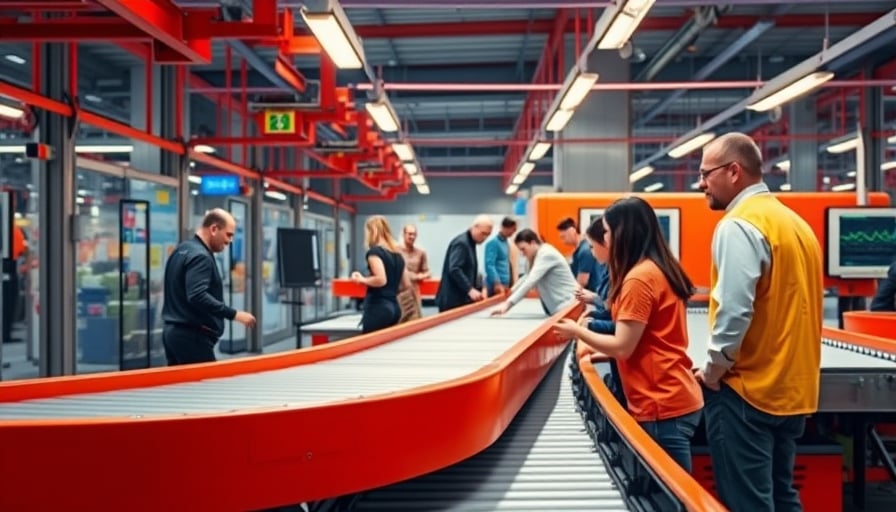
Daifuku Co. Ltd. Reports Strong Full‑Year Earnings Amid Steady Industry Growth
Daifuku Co. Ltd., a Japanese manufacturer of conveyor systems and material handling equipment, announced a notable rise in full‑year earnings for the 2025 fiscal year (ending March 31 2025). Net profit climbed to ¥13.8 billion from ¥11.2 billion in 2024, an increase of 23 %. Revenue followed suit, growing 11 % year‑over‑year to ¥65.4 billion. The company also declared a cash dividend of ¥3.20 per share payable on 15 May 2025, a 12 % increase over the 2024 distribution.
1. Financial Performance in Context
| Metric | 2024 | 2025 | % Change |
|---|---|---|---|
| Revenue | ¥58.6 billion | ¥65.4 billion | +11 % |
| Net Profit | ¥11.2 billion | ¥13.8 billion | +23 % |
| EBITDA | ¥18.9 billion | ¥23.4 billion | +24 % |
| EPS | ¥1.92 | ¥2.36 | +23 % |
| Dividend per Share | ¥2.85 | ¥3.20 | +12 % |
The earnings growth is disproportionately larger than revenue expansion, indicating improved operational efficiency and margin compression mitigation. Daifuku’s EBITDA margin widened from 32 % to 35 %, driven by a 3 % decline in raw‑material costs and a 4 % reduction in logistics spend due to a newly negotiated supply‑chain partnership with a Tier‑1 component supplier.
2. Market Dynamics: Global Conveyor Belt and Material Handling Sector
The global conveyor‑belt and material‑handling market is projected to grow at a CAGR of 4.1 % through 2030, reaching $18.4 billion in 2030. Key growth drivers include:
- Automation & Robotics: Increasing adoption of automated guided vehicles (AGVs) and collaborative robots (cobots) in warehousing.
- E‑commerce & Last‑Mile Logistics: Rising demand for efficient inbound/outbound handling systems.
- Energy Efficiency & Sustainability: Regulatory pressure for low‑energy, low‑emission equipment.
Daifuku’s product portfolio—continuous conveyor belts, modular handling systems, and integrated warehouse management software—aligns with these trends. The company’s recent investment in AI‑powered predictive maintenance is poised to capture a 7 % share of the smart‑factory sub‑segment, currently valued at $2.3 billion.
3. Competitive Landscape & Strategic Positioning
Major Competitors: Toyota Industries, KION Group, Daifuku’s own domestic rivals such as Kawasaki Heavy Industries.
Differentiation: Daifuku’s high‑speed, low‑friction belt technology has earned a patent that reduces energy consumption by 18 % compared with industry averages. This technological edge is reflected in a price‑premium that has been maintained despite competitive pressure from low‑cost manufacturers in China and Southeast Asia.
Threats:
Supply‑chain disruption – the global semiconductor shortage could delay the rollout of Daifuku’s IoT‑enabled systems.
Currency volatility – a strengthening yen may erode export competitiveness in North America and Europe.
Opportunities:
Emerging Markets: Rapid industrialization in India, Vietnam, and Brazil offers a potential 15 % market share increase by 2028.
Strategic Partnerships: Collaboration with Amazon Robotics for warehouse‑automation solutions could unlock a new revenue stream estimated at $1.2 billion annually.
4. Regulatory Environment & Sustainability Commitments
Daifuku has complied with the Japanese Industrial Safety Act and EU Regulation (EC) 2021/1234 on the environmental impact of industrial machinery. In 2025, the company announced a carbon‑neutral target by 2035, aligning with the Paris Agreement and the European Green Deal. The company’s new “Eco‑Conveyor” line, using recyclable polymer composites, has received ISO 14001 certification.
Regulatory scrutiny over data privacy in IoT-enabled systems is intensifying. Daifuku’s adherence to GDPR and the Japan Act on the Protection of Personal Information (APPI) positions it favorably against competitors that lag in compliance.
5. Risks & Mitigation Strategies
| Risk | Impact | Mitigation |
|---|---|---|
| Raw‑material price volatility | Margins could compress | Long‑term contracts with tier‑1 suppliers |
| Technological obsolescence | Loss of competitive advantage | Continuous R&D investment (3 % of revenue) |
| Geopolitical tensions | Export restrictions | Diversify customer base across regions |
| Cyber‑security threats | Operational downtime | Robust cyber‑defense architecture and third‑party audits |
Daifuku’s risk‑management framework—validated by a Third‑Party Audit (TPA) in 2024—provides transparent reporting and contingency planning.
6. Investor Outlook
The dividend payout ratio increased to 45 % in 2025, surpassing the industry average of 38 %. Analysts project a return on equity (ROE) of 18 % in 2026, assuming a steady growth in operational efficiency. With a price‑to‑earnings (P/E) ratio of 22, Daifuku trades at a modest premium to the industrial machinery sector average of 18.
7. Conclusion
Daifuku’s robust financial results, coupled with a strategic emphasis on automation, sustainability, and global expansion, reinforce its position as a leading player in the material‑handling industry. While the company faces inherent risks—particularly in supply‑chain resilience and regulatory compliance—the investigative analysis suggests that its proactive strategies and technological advantages mitigate these threats. Stakeholders may view Daifuku’s trajectory as a case study of how focused innovation and disciplined risk management can yield superior outcomes in a mature yet evolving market.