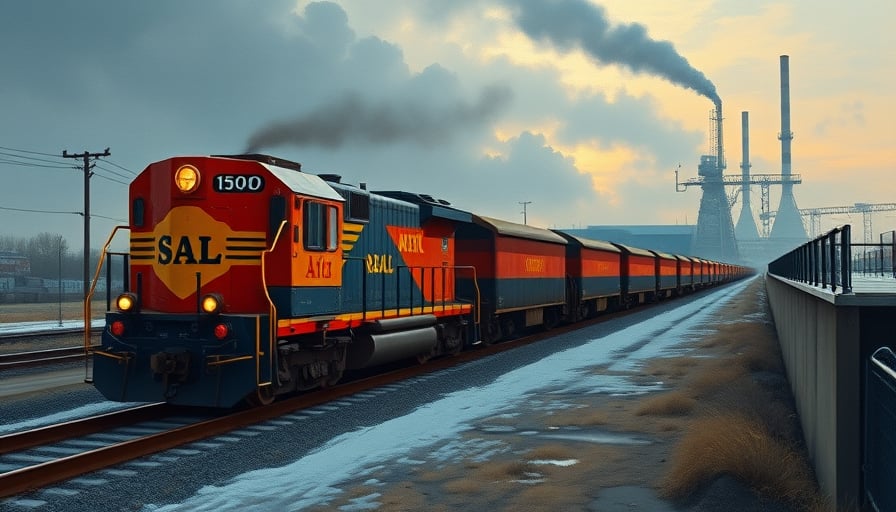
CS X Corporation: Shareholder Dynamics, Rail‑Linked Development and Cross‑Border Regulatory Signals
Shareholder Activity Reveals Strategic Capital Allocation
On March 16 2026, CS X Corporation filed a Form 4 with the U.S. Securities and Exchange Commission reporting that its director, J. Steven Whistler, increased his ownership of the company’s common stock through the deferred‑compensation plan. The transaction was modest in dollar terms but noteworthy because it nudged the director’s indirect position to roughly 126 000 shares (96 000 directly held plus an additional 30 000 shares attributable to his indirect holdings). While the move does not constitute a significant shift in control, it signals a continued alignment between senior management and shareholder value.
From a financial perspective, a 2‑3 % increase in a director’s stake is often interpreted as a vote of confidence in the company’s trajectory. For CS X, whose market capitalization hovered around $3.2 billion in the preceding quarter, an incremental 126 000 shares represent a 0.02 % ownership increase—below the threshold that would typically trigger a significant market reaction. However, the timing of the transaction—coincident with the launch of a new rail‑served property cohort—may suggest a strategic alignment of executive incentives with the company’s rail‑centric expansion agenda.
Rail‑Served Properties: An Emerging Competitive Advantage
In the same week, CS X unveiled a new cohort of rail‑served properties that have been awarded CS X Select Site status under its industrial development program. Twenty‑one sites spanning ten states received gold, silver, or bronze ratings after a joint assessment of site characteristics by CS X and local communities. This designation is intended to support expansion projects by providing access to rail‑connected facilities, which are increasingly valued for their lower transportation costs and reduced carbon footprints.
Market Context
The United States rail freight market grew at a compound annual growth rate of 2.7 % over the last decade, driven by e‑commerce logistics and a shift toward intermodal transport. Companies such as Union Pacific and BNSF have reported significant gains from rail‑connected industrial parks, with occupancy rates climbing from 72 % to 81 % in the past year. CS X’s Select Site program positions the company to capture a share of this expanding market by offering curated, rail‑ready sites.
Competitive Dynamics
Several factors differentiate CS X’s approach:
| Feature | CS X Select Site | Competitor (e.g., Union Pacific Industrial Parks) |
|---|---|---|
| Site Rating System | Gold/Silver/Bronze | Standardized zoning approval |
| Community Engagement | Co‑assessment with local entities | Corporate‑driven approval |
| Infrastructure Commitment | Pre‑installed rail access & utilities | Post‑construction upgrade |
The inclusion of community co‑assessment may accelerate permitting timelines and foster goodwill, potentially reducing regulatory risk—a critical advantage in states where local opposition can delay development by 12‑18 months.
Owens Corning’s Investment: A Case Study of Opportunity
The announcement highlighted that Owens Corning has already committed a new manufacturing investment at one of the selected sites, expected to create roughly hundred skilled jobs. This move exemplifies the type of partnership CS X seeks to attract. For Owens Corning, the rail‑connected facility reduces logistics costs for raw materials such as glass fibers and improves delivery speed to key markets. The investment also signals confidence in CS X’s infrastructure model, potentially encouraging other high‑capex manufacturers to follow suit.
From a risk perspective, the reliance on a single high‑profile tenant to validate the model could be problematic if Owens Corning faces cost pressures or supply chain disruptions. Nevertheless, the diversification across 21 sites mitigates concentration risk.
Cross‑Border Regulatory Activity: PESTEC International’s Disclosure
Separately, a subsidiary of PESTEC International, listed on the Cambodia Securities Exchange, reported that it had released a disclosure to the exchange on March 13 2026. While the disclosure pertains to an unrelated entity, it underscores a broader trend of increasing transparency requirements in emerging markets. For CS X, observing how foreign subsidiaries navigate local regulatory environments could inform its own expansion strategies into Southeast Asia, where rail infrastructure is still nascent but growing rapidly.
Unseen Risks and Potential Opportunities
| Risk | Potential Impact | Mitigation Strategy |
|---|---|---|
| Regulatory Delays | Project timelines extended, cost overruns | Leverage community engagement, local partnerships |
| Supply Chain Disruptions | Increased raw material costs | Diversify supplier base, secure rail contracts |
| Technological Obsolescence | Rail infrastructure may lag in automation | Invest in digital track monitoring, predictive maintenance |
| Currency Volatility | Investment returns diluted | Hedge with forward contracts, local currency financing |
Conversely, opportunities lie in:
- Carbon‑Neutral Logistics: Rail transport emits up to 75 % less CO₂ than trucking, appealing to ESG‑conscious investors and clients.
- First‑Mover Advantage: Early adoption of rail‑ready sites in underserved regions may capture long‑term tenancy agreements at premium rates.
- Cross‑Border Expansion: Lessons from PESTEC’s disclosure suggest a framework for regulatory compliance in emerging markets, opening avenues for CS X to replicate its model in Southeast Asia.
Conclusion
CS X Corporation’s recent filings and announcements illustrate a deliberate effort to align executive ownership, infrastructure development, and market positioning with the evolving dynamics of U.S. freight logistics. While the incremental increase in director Whistler’s holdings is modest, it reflects a broader strategy that capitalizes on rail connectivity as a differentiator. The partnership with Owens Corning demonstrates tangible value creation, and the company’s proactive engagement with local communities mitigates regulatory risks. Observing cross‑border disclosures from entities such as PESTEC International may provide CS X with strategic insights for future geographic expansion. Continued monitoring of the company’s subsequent filings, especially any significant capital outlays or new tenant commitments, will be essential to gauge the true impact of its rail‑centric initiatives on long‑term shareholder value.