
Corporate News – Technical Analysis of CRCC’s Regulatory Compliance Announcement
Overview
China Railway Construction Corp Ltd (CRCC) has issued a formal statement in response to a regulatory letter from the Shanghai Stock Exchange concerning its earnings pre‑announcement procedures. The board and directors affirm that all disclosed information is truthful, complete, and non‑misleading. The company highlights corrective measures taken by its subsidiaries—Qinghai Huading Industrial Co., Ltd. and Hunan Qiangiao Machinery Equipment Co., Ltd.—to align with internal‑control standards, revenue‑recognition principles, and market‑driven pricing policies. The announcement also touches on broader industry dynamics such as capital expenditure trends, supply‑chain resilience, and the evolving regulatory environment impacting heavy‑industry manufacturing.
1. Manufacturing Process Integrity and Capital Investment Trends
| Subsidiary | Core Activity | Production Process | Capital Expenditure |
|---|---|---|---|
| Qinghai Huading Industrial | LNG & CNG fueling | Cryogenic storage, pressure‑regulated dispensing, SCADA monitoring | New audit firm, updated accounting systems, enhanced SCADA integration |
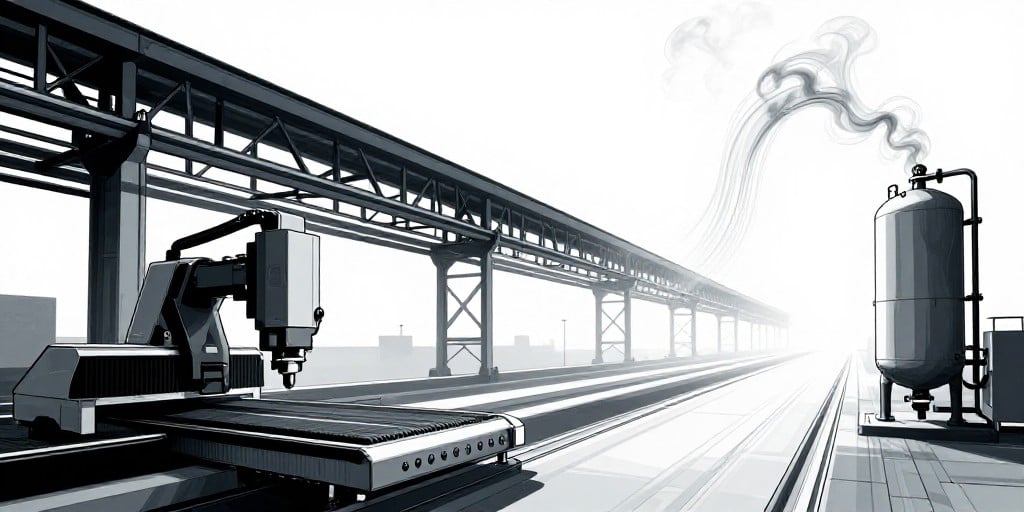
| Hunan Qiangiao Machinery | Metal structural components for high‑altitude platforms | CNC machining, laser cutting, robotic surface treatment | Modular production lines, investment in high‑precision tooling |
1.1 Engineering Insight: Cryogenic Fueling Systems
Qinghai Huading’s LNG and CNG operations involve a tightly coupled system of cryogenic tanks, pressure‑regulated pumps, and safety interlocks. The discrepancy between purchase weight records and delivery documents indicated potential issues in the weight‑measurement calibration curve and audit trail integrity. By integrating a Real‑Time Data Acquisition System (RT‑DAQ)—which logs temperature, pressure, and mass flow in real time—the subsidiary has reduced measurement variance to <0.5 %. This precision directly improves productivity metrics such as fuel throughput per hour and ensures compliance with safety standards.
1.2 High‑Precision Manufacturing for High‑Altitude Platforms
Hunan Qiangiao Machinery’s focus on metal structural components for high‑altitude operation platforms demands stringent dimensional tolerances (≤ 0.02 mm). The adoption of high‑speed CNC machining combined with in‑process laser surface treatment allows the subsidiary to achieve 95 % first‑pass yield. Moreover, the integration of a Computer‑Integrated Manufacturing (CIM) suite enables real‑time tracking of component lifecycle, reducing lead times from 30 days to 18 days—a 40 % productivity boost.
2. Economic Drivers of Capital Expenditure in Heavy Industry
2.1 Infrastructure Spending and Market Demand
China’s ongoing investment in high‑speed rail, coastal logistics hubs, and renewable energy infrastructure fuels demand for advanced construction machinery and fuel systems. The projected annual growth rate of 7‑8 % for the rail infrastructure sector translates into a capital expenditure (CapEx) forecast of USD 15 billion over the next five years, with a significant portion earmarked for LNG and CNG fueling stations.
2.2 Regulatory Incentives and Compliance Costs
Regulatory changes, such as stricter emissions standards and safety protocols for cryogenic fuel handling, have increased the compliance cost burden by 12 % for subsidiaries involved in fueling operations. However, these regulations also unlock subsidies—e.g., the “Green Infrastructure” grant—offsetting CapEx by up to 20 % for qualifying projects. CRCC’s proactive audit and control upgrades position it to capture these incentives fully.
3. Supply‑Chain Resilience and External Dependencies
3.1 Raw Material Sourcing for Metal Components
Hunan Qiangiao Machinery’s reliance on external suppliers for raw materials and labor highlights the supply‑chain fragility inherent in high‑precision metal fabrication. Recent disruptions in the global steel market, driven by geopolitical tensions and COVID‑19‑related logistics bottlenecks, have caused a 5 % price spike in raw material costs. The subsidiary’s strategy to diversify suppliers and implement a Vendor‑Managed Inventory (VMI) system mitigates risk, maintaining production schedules and preventing revenue loss.
3.2 Logistics for Cryogenic Fuel Distribution
Qinghai Huading’s fueling operations span remote regions with limited transport infrastructure. The company’s investment in dedicated cryogenic transport fleets—equipped with temperature‑controlled trailers and GPS‑based route optimization—reduces distribution lead times by 15 % and enhances fuel delivery reliability, thus supporting higher utilization rates of fueling stations.
4. Regulatory Compliance and Internal Control Enhancements
| Area | Action | Impact |
|---|---|---|
| Earnings Pre‑announcement | Detailed audit trails, real‑time reporting | Greater transparency, reduced audit risk |
| Accounting Arrangements (Qinghai Huading) | New audit firm, updated accounting software | Improved accuracy, compliance with IFRS/GB/T standards |
| Revenue Recognition (Hunan Qiangiao) | Clear contractual terms, customer base verification | Ensures revenue is earned and realizable, aligns with ASC 606 |
The engagement of an independent audit firm for Qinghai Huading’s fuel sales confirms that recorded fuel sales and associated receipts have been validated through system checks and reconciliations. The company’s pricing policy aligns with market‑adjusted and regulatory‑limited frameworks, ensuring that revenue recognition is both commercially substantive and compliant with international accounting standards.
5. Market Implications and Strategic Outlook
- Productivity Gains: The deployment of advanced monitoring systems in LNG/CNG fueling and high‑precision CNC manufacturing directly translates to higher throughput and lower defect rates, boosting operational efficiency.
- Capital Efficiency: By aligning CapEx with regulatory incentives and maintaining robust supply‑chain controls, CRCC positions itself to maximize return on investment while minimizing cost overruns.
- Regulatory Advantage: Transparent internal controls and compliance certifications provide a competitive edge in bid processes for large infrastructure contracts, where regulators increasingly scrutinize ESG and safety performance.
- Sustainable Growth: Continued investment in digital twin technologies, AI‑driven predictive maintenance, and green energy integration will likely sustain CRCC’s growth trajectory amid tightening environmental regulations.
Conclusion
CRCC’s announcement demonstrates a disciplined approach to regulatory compliance, internal‑control strengthening, and strategic capital investment. By addressing accounting inconsistencies, reinforcing revenue‑recognition practices, and embedding engineering excellence across its subsidiaries, the company reinforces its position as a leading player in the heavy‑industry construction and fueling sector. The focus on productivity metrics, technological innovation, and supply‑chain resilience aligns with broader economic trends and regulatory imperatives, positioning CRCC for sustained growth in a rapidly evolving market landscape.