
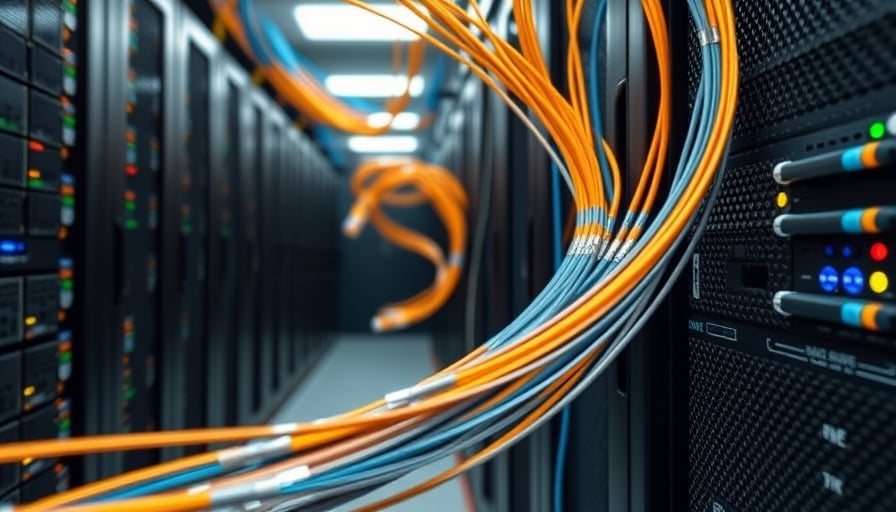
Corning Inc. Surges as AI‑Driven Demand for Optical Infrastructure Grows
Corning Inc. has captured renewed investor interest after its shares reached a new all‑time high at the end of February. The rally prompted a wave of analyst revisions, with several upgrading their price targets to reflect heightened expectations for demand in the data‑center sector, especially for fiber‑optic cables that underpin the expanding artificial‑intelligence (AI) infrastructure. While consensus on the company’s precise valuation remains unsettled, the consensus underscores Corning’s position as a pivotal supplier of optical and photonic components for telecommunications and information‑display markets. The stock’s recent performance has been the strongest among peers in the S&P 500 during the week, contributing to a notable year‑to‑date gain.
Technological Momentum Behind the Rally
The surge in Corning’s valuation can be traced to two interlocking technological trends:
AI‑Enabled Workloads and Bandwidth Demands Modern AI models—particularly large language models and generative adversarial networks—require terabit‑scale data movement between GPUs, storage arrays, and cloud servers. Fiber‑optic cables with low latency and high spectral efficiency have become critical enablers. Corning’s advanced Optical Amplifier and Photonic Integrated Circuit lines are designed to support wavelengths beyond 1 µm, allowing for more data channels per fiber. As data‑center operators shift from copper to optical interconnects, the company’s product portfolio aligns with this migration.
Edge Computing and 5G Expansion The rollout of 5G networks and the proliferation of edge data centers demand robust optical backhaul to connect remote base stations and compute nodes. Corning’s High‑Capacity Fiber solutions, including the SMF‑C and MMF‑C variants, are engineered to maintain signal integrity over long distances and high traffic loads. This capability positions the firm as a natural partner for telecom operators and infrastructure providers.
Case Studies: Corning in Action
Amazon Web Services (AWS) Edge Nodes AWS has announced the deployment of 5G‑enabled edge computing nodes in select U.S. regions. Preliminary reports indicate that the company is sourcing Corning’s Ultra‑High‑Bandwidth Fiber to link its edge data centers with central cloud facilities. The choice underscores Corning’s reputation for delivering low‑loss, high‑capacity cabling that can withstand the environmental stresses of outdoor deployments.
NVIDIA’s GPU‑Accelerated Data Centers NVIDIA’s recent collaboration with a major cloud provider involved the installation of a 100 Gbps inter‑connect fabric across a new data‑center campus. Corning’s Optical Interconnect solutions were cited as a key factor in meeting the stringent latency budgets required for real‑time inference workloads.
These examples illustrate how Corning’s technologies are embedded in the backbone of next‑generation computing infrastructure, making the company a critical, though often invisible, participant in the AI economy.
Investment Implications: Valuation vs. Growth
Analysts remain divided on whether the current valuation accurately reflects long‑term growth prospects. Some argue that the price‑to‑earnings multiple now sits above the S&P 500 average, suggesting that the market may be pricing in a near‑term rally rather than a sustained structural shift. Others contend that the company’s gross margin expansion—driven by high‑margin photonic components—justifies a premium.
A key question is the elasticity of demand for high‑performance optical cables. If AI workloads plateau or shift toward alternative interconnect technologies (e.g., silicon photonics on chip), Corning could see a deceleration in sales growth. Conversely, a continued acceleration in data‑center expansion, especially in emerging economies, could sustain the current trajectory.
Risks and Benefits: Societal and Security Considerations
| Aspect | Potential Benefit | Potential Risk |
|---|---|---|
| Privacy | Enhanced data transfer speeds enable faster compliance with real‑time data‑processing regulations (e.g., GDPR, CCPA). | Faster data movement could facilitate large‑scale surveillance if used by governments or malicious actors. |
| Security | Fiber optics are inherently less susceptible to electromagnetic interference, reducing the risk of signal tampering. | Physical security of fiber routes becomes paramount; compromised cabling could expose sensitive AI models to adversaries. |
| Environmental Impact | Fiber cables have a lower energy footprint over their lifespan compared to copper, supporting greener data‑center operations. | Manufacturing of rare‑earth components used in optical amplifiers can have significant ecological footprints if not properly managed. |
The dual nature of these impacts underscores the need for robust governance frameworks governing the deployment and stewardship of optical infrastructure. Corporate policies, industry standards, and regulatory oversight must evolve in tandem with technology to ensure that the benefits outweigh the risks.
Market Context and Peer Comparison
Corning’s outperformance relative to peers in the S&P 500 is noteworthy. While many traditional semiconductor and networking companies have experienced volatility due to supply‑chain disruptions, Corning’s share price has remained resilient—attributable to its diversified customer base across telecom, data‑center, and display sectors. The company’s ability to maintain a high Return on Invested Capital (ROIC) further strengthens its appeal to value‑seeking investors.
However, analysts caution that the broader market environment, characterized by high inflation expectations and potential rate hikes, could compress valuation multiples across the sector. Corning’s exposure to the cyclical nature of capital expenditure in telecom infrastructure may also make it sensitive to macroeconomic downturns.
Looking Ahead: Strategic Initiatives
Corning is actively investing in silicon photonics and quantum‑enabled communications as part of its long‑term R&D agenda. Early prototypes demonstrate the feasibility of integrating photonic transceivers directly onto silicon chips, which could dramatically reduce latency and power consumption for edge AI workloads. Additionally, the company’s collaboration with university research labs on entanglement‑based secure communication signals a strategic pivot toward next‑generation security solutions.
These initiatives hint at a future where Corning’s optical technology not only supports existing AI infrastructure but also shapes the protocols and standards that govern secure, high‑speed data transmission.
Conclusion
Corning Inc.’s recent share rally reflects a confluence of factors: the explosive growth of AI workloads, the migration to fiber‑optic interconnects in data centers, and the company’s proven track record in delivering high‑performance optical components. While analysts differ on valuation, the consensus acknowledges that Corning occupies a strategic position at the intersection of telecommunications and emerging AI infrastructure.
Investors should weigh the company’s robust gross margins and diversified customer base against the potential cyclical risks and the evolving landscape of optical technologies. Simultaneously, policymakers and industry stakeholders must address the privacy, security, and environmental implications that accompany the widespread adoption of high‑capacity optical networks. Only by balancing technical advancement with responsible governance can the full societal benefits of Corning’s innovations be realized.