
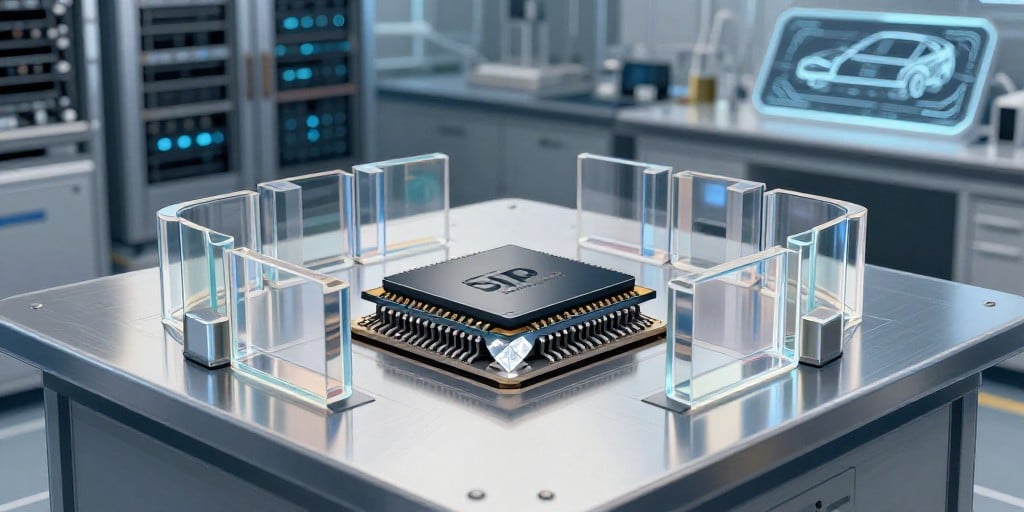
Continental AG Advances Packaging and Materials Strategy Amid Semiconductor Shift
Continental AG has intensified its focus on advanced packaging and materials as the semiconductor industry pivots from front‑end fabrication to back‑end integration. The company’s expertise in wafer‑level and system‑in‑package (SiP) solutions is expected to position it favorably to serve high‑performance computing, automotive electronics, and artificial‑intelligence data‑center markets—sectors that demand dense interconnects and efficient heat management.
Alignment with Market Demands
The demand for compact, high‑density interconnects is accelerating in both high‑performance computing and automotive electronics, where power budgets are tightening and performance ceilings are rising. Continental’s SiP technology, which enables the integration of multiple chips on a single substrate, directly addresses these constraints by reducing inter‑chip distances and streamlining signal routing. Moreover, the company’s focus on thermal management—particularly through the exploration of diamond‑based heat sinks—aligns with broader industry efforts to mitigate heat dissipation challenges in high‑power, next‑generation GPUs and data‑center processors.
Emerging Cooling Technologies
Diamond is recognized as an exceptional thermal conductor, with a thermal conductivity exceeding that of conventional silicon and copper. Continental’s reported exploration of diamond‑based heat sinks reflects a strategic move to incorporate materials with superior thermal properties and low coefficients of thermal expansion. By reducing thermal stress in advanced process nodes, such materials can enhance reliability and yield—a critical consideration as foundries push toward ever smaller geometries.
Synergy with Semiconductor Equipment Upgrades
The semiconductor equipment sector is entering a gradual upward cycle driven by substantial logic and memory expansion plans. Large foundries and memory manufacturers are investing heavily in new lithography and etching tools, creating a sustained demand for high‑quality packaging services. Continental’s capability to integrate its packaging solutions with these upstream equipment investments positions it to capture a share of this expanding market. The company’s existing partnerships with leading fab facilities further bolster its ability to align packaging designs with the latest process nodes.
Competitive Positioning and Economic Drivers
Continental’s strategy leverages fundamental business principles—innovation, supply‑chain integration, and scalability—to maintain a competitive edge. Its focus on advanced materials and packaging techniques not only meets the immediate needs of high‑performance and AI workloads but also supports broader industry goals of reducing power consumption and enhancing system reliability. By aligning its portfolio with the macro‑economic trend of increasing semiconductor capital expenditure, Continental is well‑positioned to benefit from the continued growth in logic, memory, and automotive electronics markets.
Conclusion
Continental AG’s recent developments underscore a clear recognition of shifting semiconductor ecosystem dynamics. By concentrating on advanced packaging, exploring high‑performance cooling solutions, and aligning with the upstream equipment cycle, the company is set to capture growing demand across multiple high‑growth sectors. Its strategy reflects a broader industry trend toward materials and packaging innovations that facilitate higher performance and lower power consumption, ensuring Continental remains a relevant and influential player in the evolving semiconductor landscape.