
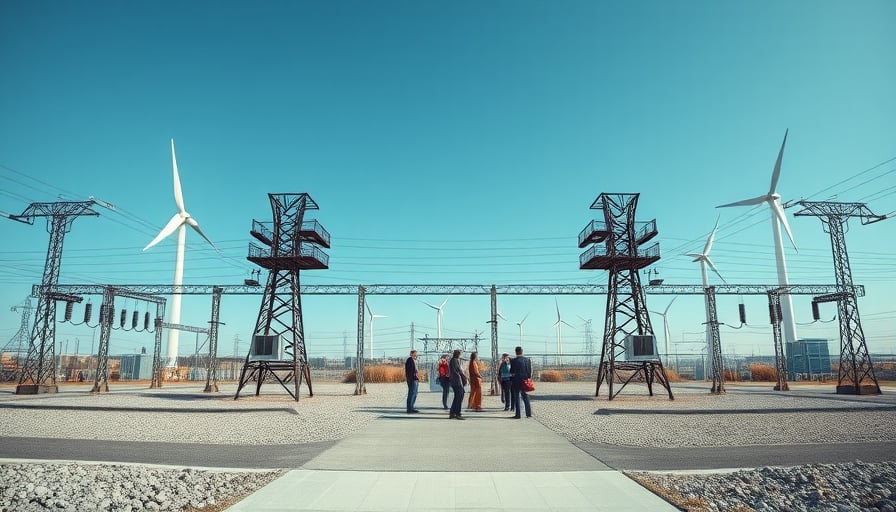
Corporate Update: Consolidated Edison Inc. Maintains Focus on Core Electric Services Amid Stable Outlook
Consolidated Edison Inc. (NYSE: ED), a leading multi‑utility provider serving New York, portions of New Jersey, and Pennsylvania, has reiterated its commitment to the electric services sector while continuing to supply wholesale electricity to external customers. Recent filings and statements on the company’s website confirm that its financial performance remains within the expected parameters for a large utility, and that there are no emerging regulatory or market developments likely to materially influence its investment strategy in the near term.
Business Segments and Geographic Footprint
- Electric Services: The bulk of ED’s revenue originates from residential, commercial, and industrial electric customers across the Tri-State area. The company’s extensive distribution network, comprising approximately 3,000 miles of high‑voltage transmission lines and over 11,000 miles of low‑voltage distribution lines, supports the delivery of power to roughly 1.3 million customers.
- Wholesale Supply: ED continues to operate a wholesale platform, enabling the procurement and sale of electricity to other utilities and large‑scale industrial users. This segment provides a secondary revenue stream and offers hedging opportunities against retail price volatility.
Grid Stability and Renewable Integration
While the company’s immediate financial outlook is stable, several technical imperatives are shaping its medium‑term strategy:
- Grid Stability
- Frequency Regulation: With increasing penetration of intermittent renewables, ED must maintain precise frequency control. The utility has deployed a mix of synchronous condensers and inverter‑based resources to provide synthetic inertia.
- Voltage Support: The integration of distributed energy resources (DERs) necessitates advanced voltage‑regulation equipment, such as static var compensators (SVCs) and on‑load tap changers (OLTCs), to mitigate voltage flicker and ensure power quality.
- Renewable Energy Integration
- Wind and Solar Dispatchability: ED’s existing wind farms and photovoltaic installations exhibit variable output that requires sophisticated forecasting models. The utility is investing in probabilistic forecasting tools and real‑time data analytics to optimize dispatch schedules.
- Storage Deployment: Battery energy storage systems (BESS) are being positioned at critical substations to absorb excess generation during peak solar production and deliver capacity during high‑demand periods, thereby enhancing grid resilience.
- Infrastructure Investment Requirements
- Transmission Upgrades: To accommodate renewable imports, ED plans to reinforce and expand its 345 kV transmission corridor, including the installation of high‑capacity circuit breakers and advanced protection relays.
- Smart Grid Implementation: A comprehensive rollout of phasor measurement units (PMUs) and adaptive protection schemes will improve situational awareness and enable rapid fault isolation.
Regulatory Framework and Rate Structures
ED operates under the purview of multiple regulatory bodies, notably the New York Public Service Commission (NYPSC), the New Jersey Board of Public Utilities (BPU), and the Pennsylvania Public Utility Commission (PUC). Key regulatory considerations include:
- Rate Design: The utility adheres to a cost‑of‑service (COS) rate methodology, ensuring that tariffs reflect the fair allocation of capital and operating costs while promoting investment in reliability and renewables.
- Renewable Portfolio Standards (RPS): In New York, the RPS mandates 50 % renewable penetration by 2030, influencing ED’s procurement strategy and investment in renewable generation capacity.
- Net Energy Metering (NEM): The NEM framework facilitates the integration of distributed solar, impacting the utility’s distribution revenue base and prompting discussions on rate recoupment mechanisms.
Economic Impact of Utility Modernization
Utility modernization carries significant economic implications for both the company and its consumers:
- Capital Expenditure (CapEx) Allocation: ED’s projected CapEx over the next five years exceeds $5 billion, directed primarily toward transmission reinforcement, DER integration, and grid digitalization.
- Ratepayer Impact: While CapEx increases may translate into modest rate adjustments, the long‑term benefits—enhanced reliability, lower outage costs, and reduced exposure to fuel price volatility—are projected to offset immediate cost increases.
- Job Creation: Infrastructure upgrades are expected to generate thousands of skilled construction and engineering jobs, contributing to regional economic development.
Technical Insights into Power System Dynamics
- Inertia Management: Loss of synchronous generators reduces system inertia, increasing the rate of change of frequency (ROCOF). ED’s adoption of inverter‑based resources with synthetic inertia mitigates rapid frequency excursions.
- Transient Stability: High‑voltage faults can destabilize the system if not cleared within a few cycles. Upgraded protection relays and faster fault‑clearing schemes enhance transient stability margins.
- Power Flow Control: Dynamic power flow management, employing flexible AC transmission systems (FACTS), enables the utility to optimize voltage profiles and reduce losses, thereby improving overall system efficiency.
Conclusion
Consolidated Edison Inc. maintains a stable financial position while strategically positioning itself to meet the technical and regulatory demands of the evolving electric grid. Through targeted investments in transmission, renewable integration, and grid digitalization, the company aims to uphold reliability standards, comply with emerging RPS mandates, and manage rate impacts for its diverse customer base. The utility’s continued focus on core electric services, coupled with prudent wholesale participation, underscores its resilience in a dynamic regulatory and technological landscape.