
Corporate News Report
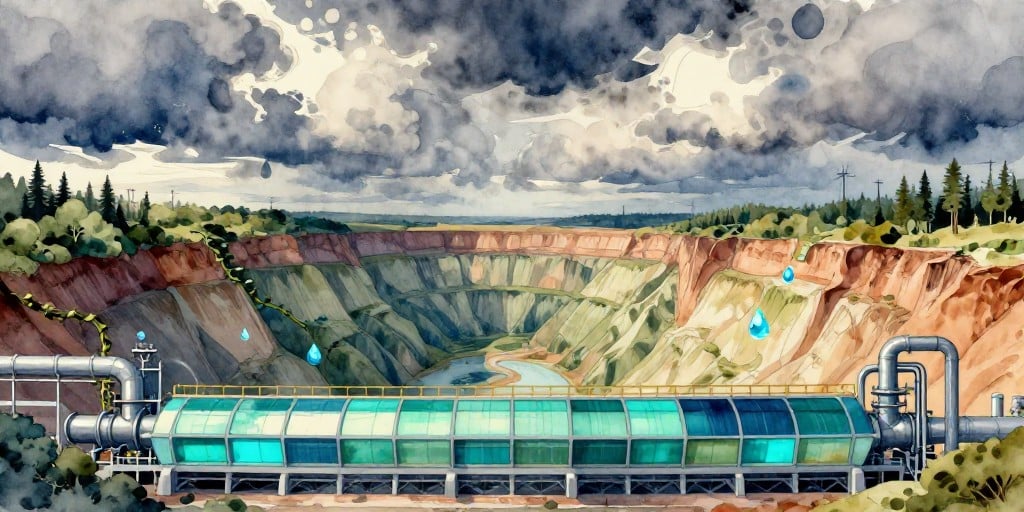
Canadian Natural Resources Ltd (CNQ) announced a contractual agreement with a subsidiary of a prominent Australian mining conglomerate to supply, fabricate, and commission a tailings dewatering plant at the Rasp Mine, located in Broken Hill, New South Wales. The facility will employ the supplier’s proprietary rapid‑dewatering technology, engineered to transform wet tailings into a stable, stackable filter cake while simultaneously recovering process water for reuse in the mill.
Scope and Technical Details
The agreement encompasses the full value chain—from engineering and procurement to manufacturing, supply, and on‑site installation—of a single‑train dewatering installation. The plant is designed to accommodate the mine’s planned production increase to 750,000 tonnes per annum. By transitioning from conventional wet‑tailings storage to a filtered‑tailings regime, the project is intended to deliver lower capital outlays and reduced operating expenditure relative to legacy solutions. The technology has undergone extensive field testing on the Rasp tailings, and performance metrics indicate a substantial reduction in both capital and operating costs.
Financial Implications
In the immediate term, the contract is projected to generate construction revenue for the supplier. Upon execution of a subsequent polymer supply and licensing agreement, the partnership could evolve into a long‑term recurring revenue stream. For the mining partner, the investment aligns with its broader strategic objectives of expanding processing capacity and enhancing mine closure outcomes.
Regulatory and Investor Context
The deployment of the rapid‑dewatering plant aligns with increasingly stringent regulatory frameworks and investor expectations surrounding tailings management. The shift to a filtered‑tailings approach is consistent with evolving global industry standards that prioritize environmental stewardship, risk mitigation, and operational efficiency.
Industry Positioning
The supplier positions itself as a global leader in environmentally sustainable solutions for the mining sector. This engagement reinforces its competitive positioning by demonstrating the scalability of its technology across diverse geographies and ore types. For the mining partner, the collaboration underscores a commitment to integrating cutting‑edge technologies that reduce environmental impact while maintaining economic viability.
Cross‑Sector Insights
The emphasis on water recovery, cost efficiency, and regulatory compliance mirrors trends observed in adjacent sectors such as mining automation, digital asset management, and circular economy initiatives. The ability to convert a traditionally waste product into a reusable resource exemplifies a broader shift toward value extraction from by‑products—a concept increasingly applied in petrochemical processing, mining, and even waste-to-energy programs.
Conclusion
This contractual development illustrates how strategic technology adoption can simultaneously address operational scalability, cost optimization, and compliance imperatives. By integrating a proven rapid‑dewatering system into the Rasp Mine’s expanded production framework, both parties are poised to capitalize on immediate construction revenue and the potential for enduring, recurring income, thereby reinforcing their positions within a rapidly evolving resource extraction landscape.