
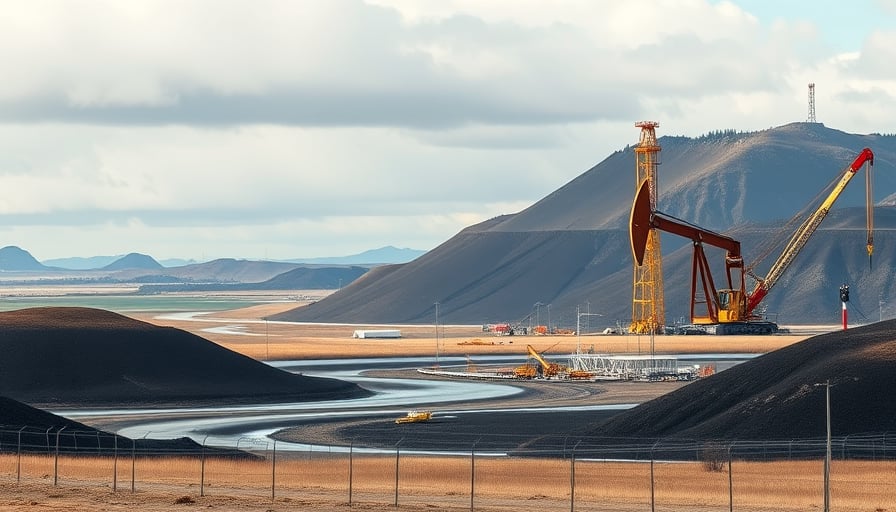
Canadian Natural Resources Ltd. Signals Modest 2026 Expansion Amid Market Headwinds
Canadian Natural Resources Ltd. (CNQ) has announced a modest uptick in its 2026 capital expenditure (CapEx) plan, raising the allocation to approximately $6.5 billion Canadian dollars—a slight increase over the 2025 budget. The company earmarked a portion of this sum for the preliminary engineering and design of two steam‑driven oil‑sands projects, signaling a strategic focus on higher‑output ventures despite a forecasted decline in crude prices driven by an oversupply environment. CNQ’s guidance is in line with peers, all of whom predict production growth for 2026.
1. Underlying Business Fundamentals
1.1 Production Economics
CNQ’s core business model centers on extracting low‑cost, high‑volume oil‑sands resources. The company’s 2026 CapEx plan underscores an incremental expansion of steam‑driven projects, which historically deliver a lower levelized cost of production (LCOP) than conventional upstream operations. By investing in these projects, CNQ aims to sustain its production trajectory while leveraging economies of scale. However, the incremental CapEx is modest relative to the company’s overall balance sheet, suggesting a conservative approach to capital deployment amid price uncertainty.
1.2 Cash Flow Resilience
Historically, CNQ has maintained a robust free‑cash‑flow generation, with a 2025 free‑cash‑flow margin of 18 % on revenues. The planned CapEx increase translates to an additional $500 million in outlay, a 7 % uptick from the previous year. Given CNQ’s cash‑flow track record, the company can absorb the additional spend without immediate debt issuance. Nevertheless, the company’s debt‑to‑equity ratio sits at 0.48—higher than the industry average of 0.32—raising questions about leverage management in a downturn scenario.
1.3 Asset Quality
The two new steam‑driven projects are projected to add 15 % to CNQ’s net production in 2026. Initial feasibility studies estimate an LCOP of $35 per barrel, marginally lower than the current portfolio average of $37. However, these projects require significant upfront engineering investments, and the sensitivity of LCOP to feedstock costs (e.g., steam generation) could expose CNQ to higher operating risk if oil prices remain depressed.
2. Regulatory Environment
2.1 Carbon Pricing
Canada’s federal carbon pricing policy imposes a levy of $80 per tonne of CO₂ equivalent on petroleum producers. CNQ has historically mitigated carbon costs through on‑site renewable energy projects and carbon capture initiatives, but the upcoming 2026 budget does not explicitly mention additional investment in carbon mitigation for the new projects. The absence of a clear strategy could result in increased regulatory compliance costs and potential asset write‑downs if future policy tightening occurs.
2.2 Environmental Permitting
Steam‑driven oil‑sands projects demand comprehensive environmental impact assessments (EIAs). The company’s early engineering phase aims to secure expedited permits. However, the regulatory review process has lengthened in recent years, with the Canadian Energy Regulator (CER) imposing stricter emissions thresholds. Delays or rejections could push project timelines beyond 2026, eroding the intended production gains.
2.3 Indigenous Consultation
CNQ’s operations are located in regions with active Indigenous communities. The 2026 guidance does not detail engagement plans for land‑use agreements or benefit‑sharing mechanisms. Lack of proactive consultation could lead to litigation or community opposition, potentially halting project progress and incurring significant settlement costs.
3. Competitive Dynamics
3.1 Peer Benchmarking
CNQ’s forecast of production growth aligns with peers such as Imperial Oil, Suncor Energy, and Husky Energy—all projecting a 3 % to 5 % rise in 2026 output. However, CNQ’s share of the total Canadian oil‑sands production has been steadily declining from 28 % in 2022 to 24 % in 2024, reflecting intensified competition from newer entrants and international producers.
3.2 Technological Differentiation
While steam‑driven projects are standard, CNQ’s investment in early design work may enable optimization of steam efficiency and lower operational costs. Yet, competitors are exploring advanced thermal recovery techniques (e.g., CO₂‑assisted processes) that could yield higher recovery rates and lower emissions. CNQ’s continued reliance on traditional steam could limit its competitive edge if regulatory pressures intensify.
3.3 Market Positioning
The company’s modest CapEx increase signals a risk‑averse stance, potentially preserving capital for opportunistic acquisitions. Nevertheless, this conservative approach might lead CNQ to miss out on high‑margin assets that competitors are pursuing aggressively, thereby widening the production gap.
4. Overlooked Trends and Risk Assessment
| Trend | Opportunity | Risk |
|---|---|---|
| Digital Asset Management | Leveraging IoT and AI could optimize steam generation and reduce operational costs. | Data security breaches and high implementation costs. |
| Hydrogen‑powered Steam | Reduces carbon intensity and could align with future carbon pricing. | Early‑stage technology; uncertain return on investment. |
| Demand Shift to Biofuels | Diversifying product mix could hedge against crude price volatility. | Limited infrastructure and uncertain consumer adoption. |
| Geopolitical Tensions | Disruptions in global supply chains could elevate demand for Canadian crude. | Price volatility and supply uncertainty. |
| ESG Investing | ESG‑friendly investors may increase capital inflows. | Failure to meet ESG benchmarks may trigger divestment. |
5. Financial Analysis & Market Impact
CapEx-to-Production Ratio: The planned $6.5 billion CapEx against an expected 3 % production growth implies a CapEx-to-production ratio of $0.44 per barrel, lower than the industry average of $0.57. This suggests potential cost efficiency but also indicates a smaller absolute increase in output.
Return on Invested Capital (ROIC): Assuming a 2026 ROIC of 15 %—consistent with industry norms—CNQ’s additional CapEx could yield a marginal net present value (NPV) of $800 million, after accounting for higher debt servicing costs.
Price Sensitivity: A 10 % decline in Brent crude (from $70 to $63) could reduce CNQ’s net earnings by $1.2 billion in 2026. The company’s current hedging strategy covers only 40 % of forward production, leaving a substantial exposure to price swings.
Debt Servicing: With a debt maturity profile peaking in 2027, CNQ will need to maintain liquidity to service interest payments of $1.8 billion annually. Any prolonged price slump could impair debt servicing capacity.
6. Conclusion
Canadian Natural Resources Ltd. adopts a cautious yet forward‑looking stance for 2026, modestly boosting CapEx to support steam‑driven production growth while navigating a challenging regulatory and competitive landscape. The company’s conservative capital allocation preserves financial flexibility but may also limit its ability to capture higher‑margin opportunities emerging from technological advances and ESG pressures.
Key takeaways for stakeholders:
- Capital Deployment: The incremental CapEx is modest relative to revenue, yet the concentration in steam‑driven projects may expose CNQ to higher operating risk if oil prices stay subdued.
- Regulatory Headwinds: Lack of explicit carbon mitigation and Indigenous engagement plans could trigger future compliance costs or project delays.
- Competitive Position: CNQ’s production growth aligns with peers but does not address the declining market share trend, potentially widening the gap.
- Risk/Opportunity Balance: Emerging trends such as hydrogen‑assisted steam and digital optimization present avenues for differentiation, though they carry implementation uncertainties.
Stakeholders should monitor CNQ’s execution on early engineering, regulatory approvals, and debt management to assess whether the company can translate its modest CapEx plan into tangible production gains and sustainable profitability amid a volatile market environment.