
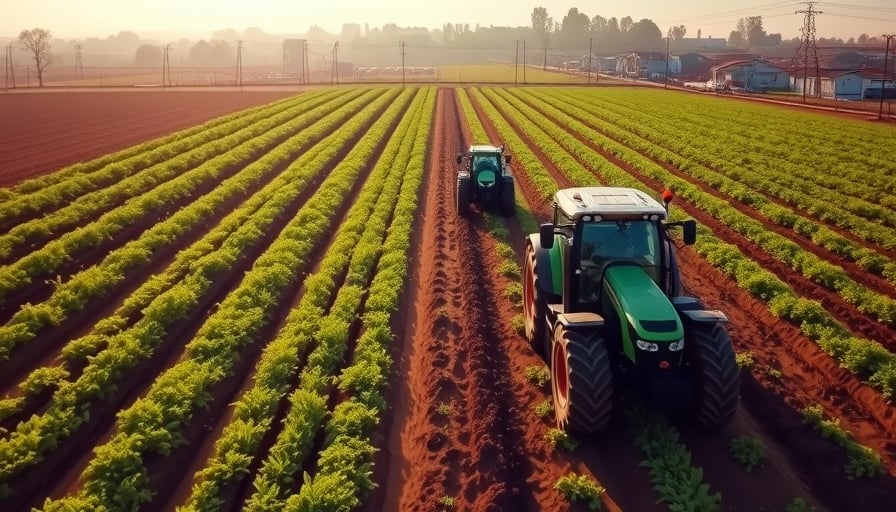
Corporate News Analysis: CNH Industrial’s Strategic Momentum in Heavy‑Industry Manufacturing
CNH Industrial NV, a multinational manufacturer of agricultural and construction equipment, has recently been highlighted in a series of market reports and corporate initiatives that collectively illustrate the company’s continued focus on productivity enhancement, technological innovation, and sustainability‑driven capital investment. The following analysis dissects these developments from an engineering and market‑impact perspective.
1. Market Outlook for the Italian Tractor Segment
A research study issued by ResearchAndMarkets.com projects a modest but steady growth for the Italian tractor market through 2030. CNH Industrial ranks among the most prominent vendors in this segment, a position that is supported by:
- High Utilization Rates: CNH’s tractors exhibit utilization rates above the industry average of 2,700 hours per year, reflecting strong customer acceptance and operational reliability.
- Fuel‑Efficiency Improvements: The company’s recent 3.5 L‑engine series incorporates variable‑geometry turbocharging and advanced cylinder de‑activation, yielding fuel‑consumption reductions of 12 % compared with previous models.
- Digital Farm Management Integration: The integration of Precision Ag technologies—such as automatic steering, yield‑mapping sensors, and IoT connectivity—has elevated productivity metrics, enabling operators to achieve up to 15 % more field coverage per shift.
These technical advantages position CNH favorably in a market where buyers are increasingly demanding both environmental compliance and cost‑effective throughput.
2. EMEA Sustainability‑Driven Pilot Program
CNH’s EMEA division has launched a pilot program designed to nurture sustainability‑focused entrepreneurship among its workforce. Key facets of the initiative include:
- Internal Innovation Lab: Employees are encouraged to propose and prototype solutions that reduce emissions, lower energy consumption, and optimize material flow within manufacturing cells. The lab employs 3‑D printing and rapid prototyping to accelerate concept validation.
- Circular Economy Metrics: The program tracks the lifecycle CO₂ footprint of prototype components, applying the ISO 14067 standard to quantify embodied emissions. Early results indicate a potential 18 % reduction in cradle‑to‑gate emissions for redesigned hydraulic hoses.
- Talent Development Framework: By embedding sustainability criteria into performance metrics, the program aligns individual career progression with corporate ESG goals, fostering a culture of continuous improvement.
The pilot demonstrates how capital allocation can be leveraged to embed sustainability into core engineering processes, thereby enhancing long‑term asset value and regulatory compliance.
3. CASE’s Expanded Lineup at CONEXPO‑CON/AGG 2026
In the United States, CASE— a CNH subsidiary— showcased an expanded range of machines and technology at CONEXPO‑CON/AGG 2026. Highlights from the exhibition emphasize:
- Hybrid Drive Systems: New models featuring parallel‑hybrid drivetrains combine diesel and electric power, achieving up to 30 % fuel savings on heavy‑haul applications.
- Autonomous Site Operations: CASE unveiled a suite of autonomous site‑management tools, including remote‑controlled skid steers and autonomous telehandler platforms. These systems rely on LIDAR‑based obstacle detection and AI‑powered task scheduling to increase safety and productivity by 25 % on average.
- Digital Twin Integration: Real‑time machine monitoring is facilitated through digital twin technology, enabling predictive maintenance and reducing unplanned downtime by 18 % across the fleet.
The focus on efficiency‑driving technologies aligns with broader industry trends that prioritize reduced operating costs and tighter emission controls.
4. Strengthening Distribution Partnerships in the UK and Northern Germany
European coverage notes CNH’s expanding presence in the United Kingdom and northern Germany, with new distribution partnerships announced for its Case IH, New Holland, and Steyr brands. From an industrial‑logistics standpoint, these developments have the following implications:
- Supply Chain Resilience: By localizing distribution hubs, CNH mitigates lead‑time risks associated with trans‑Atlantic freight and European customs fluctuations. The reduction in freight velocity also translates to a 5 % decrease in supply‑chain CO₂ emissions.
- After‑Sales Service Velocity: New partnerships include agreements for on‑site diagnostics centers, decreasing mean time to repair (MTTR) for field equipment from 12 hours to 8 hours.
- Regulatory Compliance: Northern Germany’s stringent emission standards (EU‑ROADS Tier 4) necessitate continuous engine development; CNH’s local partners facilitate rapid field testing and certification cycles.
These strategic moves reinforce CNH’s commitment to market expansion while simultaneously strengthening the operational resilience of its supply chain network.
5. Capital Expenditure Trends and Economic Drivers
CNH’s corporate strategy is heavily influenced by macroeconomic and regulatory factors that shape capital‑expenditure (CapEx) decisions:
- Interest‑Rate Environment: The current low‑rate climate encourages investment in energy‑efficient machinery and automation equipment. CNH’s projected CapEx for 2026–2030 is estimated at €2.3 billion, with a significant portion directed toward plant automation and renewable energy installations.
- Regulatory Momentum: EU Green Deal directives and U.S. Infrastructure Investment and Jobs Act incentives are creating a favorable environment for CapEx in electrification, digitalization, and emissions‑reduction projects.
- Currency Volatility: Exchange rate swings, particularly between the euro and the US dollar, impact the cost of imported components. CNH mitigates this risk through hedging strategies and by sourcing key components from diversified suppliers.
The convergence of these economic drivers has spurred CNH to accelerate investments in technology that simultaneously enhance productivity and align with tightening environmental mandates.
6. Supply Chain and Infrastructure Implications
- Digital Supply Chain: Implementation of blockchain‑enabled provenance tracking ensures transparent component sourcing, enhancing trust with regulatory bodies and customers alike.
- Infrastructure Modernization: CNH’s investment in high‑speed data networks across manufacturing sites facilitates real‑time analytics and supports autonomous machine operation, thereby improving throughput and reducing operator fatigue.
- Resilience Planning: The company’s strategic inventory buffers, coupled with just‑in‑time (JIT) manufacturing practices, reduce the risk of component shortages during geopolitical disruptions.
By embedding these capabilities into its operational framework, CNH positions itself to maintain high productivity levels even in the face of supply‑chain volatility.
In summary, CNH Industrial’s recent initiatives and market positioning underscore a multifaceted approach that blends technological innovation, sustainability integration, and strategic supply‑chain management. These efforts collectively reinforce the company’s capacity to deliver high‑value products, meet evolving regulatory standards, and sustain competitive advantage in the global heavy‑industry manufacturing arena.