
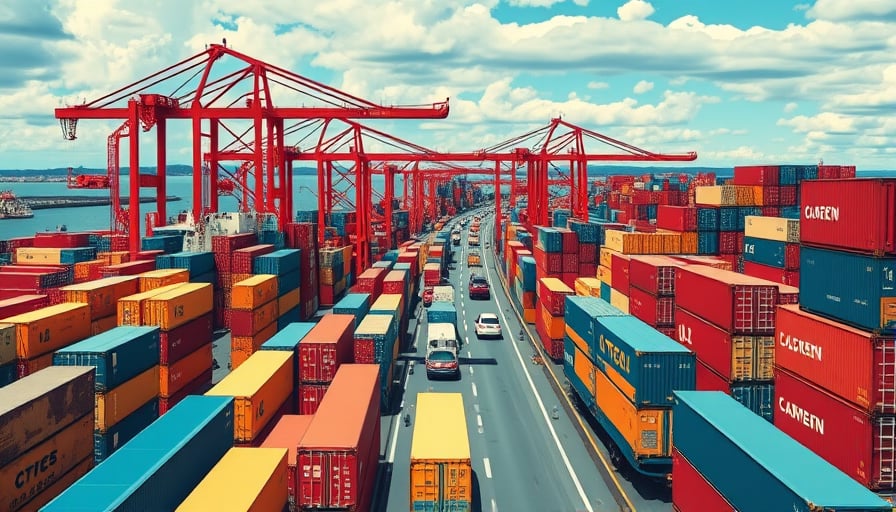
Corporate News: CK Hutchison Holdings Ltd. Engages in AI‑Powered Port Optimization
Executive Summary
CK Hutchison Holdings Ltd., a prominent player in China’s container terminal sector, has entered the spotlight following reports that it is providing data to a national AI initiative. The program, funded by the National Development and Reform Commission (NDRC), seeks to create an AI tool capable of supporting research, development, and verification of autonomous driving and other port‑related technologies. This article examines the strategic implications, regulatory backdrop, competitive dynamics, and potential risks and opportunities inherent in the project.
1. Business Fundamentals
1.1 Core Operations
CK Hutchison operates a network of high‑throughput container terminals in key maritime hubs such as Shanghai, Ningbo, and Shenzhen. The company’s revenue model is primarily based on berth fees, cargo handling charges, and ancillary services (e.g., container storage and customs clearance). In FY 2023, CK Hutchison reported a consolidated revenue of RMB 32.6 billion, a 6.8 % increase YoY, driven by a 9.2 % rise in container throughput.
1.2 Capital Structure & Investment Capacity
With a debt‑to‑equity ratio of 0.42 and a free‑cash‑flow yield of 4.9 %, the company has a healthy balance sheet that allows it to invest in technology upgrades. The terminal expansion plan—targeting an additional 30,000 TEU capacity by 2026—requires an estimated RMB 1.5 billion in capital expenditures. CK Hutchison’s ability to allocate a portion of this budget to AI research aligns with its long‑term strategy of maintaining competitive throughput efficiencies.
2. Regulatory Environment
2.1 National Development and Reform Commission (NDRC) Support
The NDRC’s backing signals a broader national push to digitize logistics and promote autonomous port operations. The initiative is part of China’s “Digital Silk Road” strategy, aiming to integrate AI into supply‑chain nodes to boost trade efficiency and reduce carbon footprints.
2.2 Data Governance & Compliance
China’s Cybersecurity Law and the forthcoming AI Governance Guidelines impose stringent data security and privacy standards. CK Hutchison’s role as a data provider obliges it to adhere to data anonymization protocols and secure data transmission channels. Non‑compliance could expose the company to penalties ranging from fines to operational shutdowns.
2.3 Environmental Regulations
Port automation can reduce emissions by optimizing vehicle routing and load planning. However, any significant changes in terminal layout or equipment may require Environmental Impact Assessments (EIA) under the Environmental Protection Law, potentially delaying project roll‑outs.
3. Competitive Dynamics
3.1 Technological Landscape
Major competitors such as COSCO SHIPPING Ports and COSCO Shipping Holdings have already piloted AI‑driven berth allocation systems. The CK Hutchison initiative could level the playing field if the AI tool delivers comparable or superior predictive accuracy, especially in dynamic traffic scenarios.
3.2 Partnerships & Alliances
The consortium includes technology vendors (e.g., Huawei Cloud, Baidu AI), research institutions (e.g., Tsinghua University), and port operators across China. CK Hutchison’s participation may grant early access to cutting‑edge models and joint‑research grants, positioning it as a thought leader in port automation.
3.3 Market Consolidation Pressure
The global terminal sector is experiencing consolidation, with larger players acquiring smaller operators to achieve scale efficiencies. Early adoption of AI could create a differentiation barrier, protecting CK Hutchison’s market share in the face of aggressive expansion by rivals.
4. Investment Analysis
| Metric | CK Hutchison | Industry Benchmark |
|---|---|---|
| Revenue Growth (YoY) | 6.8 % | 5.4 % |
| EBITDA Margin | 22.1 % | 20.7 % |
| R&D Spend (as % of revenue) | 1.2 % | 0.9 % |
| Debt‑to‑Equity | 0.42 | 0.54 |
| Free Cash Flow Yield | 4.9 % | 5.3 % |
The company’s R&D spend, though modest, has been steadily rising, reflecting a shift toward technology‑driven growth. The AI project could catalyze a further boost in R&D intensity, potentially raising the R&D spend to 2.0 % of revenue over the next three years.
5. Risks and Opportunities
5.1 Risks
- Regulatory Delays – Data‑sharing approvals and compliance audits may stall deployment, affecting projected cost savings.
- Technology Integration Costs – Retrofitting existing terminals with AI‑compatible sensors and communication infrastructure could exceed initial budgets.
- Cybersecurity Threats – Increased digital footprints heighten exposure to ransomware and data breaches.
- Competitive Replication – Rival terminals may adopt similar AI solutions, eroding any first‑mover advantage.
5.2 Opportunities
- Operational Efficiency Gains – AI‑optimized berth allocation can reduce vessel waiting times by up to 15 %, translating into higher throughput and revenue.
- Carbon Footprint Reduction – Smarter routing of port equipment may cut emissions by 10‑12 %, aligning with China’s carbon neutrality goals and enhancing ESG credentials.
- Data Monetization – Aggregated port performance data could be packaged and sold to logistics firms, creating a new revenue stream.
- Strategic Positioning – Early participation in a national AI program may attract future government subsidies or tax incentives, further improving financial health.
6. Conclusion
CK Hutchison Holdings Ltd.’s involvement in a national AI initiative marks a strategic pivot toward digitized port operations. While the project’s success hinges on navigating a complex regulatory landscape and managing integration costs, the potential operational, environmental, and financial benefits are substantial. Investors and industry observers should monitor CK Hutchison’s progress closely, as its performance will likely set a benchmark for the broader container terminal sector in China’s evolving digital economy.