CK Hutchison Holdings Ltd: ADR Dynamics Amidst a Volatile Market Landscape
Introduction
CK Hutchison Holdings Ltd, a diversified conglomerate with interests spanning ports, retail, infrastructure, and telecommunications, has attracted recent analyst attention due to the performance of its American Depositary Receipt (ADR). While the ADR trades at a modest premium relative to the underlying Hong Kong shares, the broader market volatility—particularly within the Hang Seng Index—remains a pivotal factor shaping investor sentiment. This article investigates the underlying business fundamentals, regulatory context, and competitive dynamics that influence the ADR’s pricing, identifying subtle trends and potential risks that may be overlooked by conventional market watchers.
ADR Pricing Mechanics and the Premium Phenomenon
The ADR represents a U.S.-based, tradable proxy of CK Hutchison’s Hong Kong-listed shares. Its price is derived from a fixed number of Hong Kong shares (typically 3–4) and is subject to the same corporate actions (dividends, splits, rights issues) as the underlying security, albeit with a conversion fee and potential tax implications.
Analysts report the ADR trades at a slight premium over the Hong Kong counterpart. This premium can be attributed to:
- Currency Hedging: Investors in the U.S. may prefer ADRs to mitigate direct exposure to Hong Kong dollars (HKD). The premium reflects the cost of hedging or the perceived risk premium associated with currency fluctuations.
- Liquidity Differential: U.S. equity markets offer higher liquidity for ADRs compared to the Hong Kong market, justifying a small markup to compensate market makers for providing continuous bid‑ask spreads.
- Regulatory Transparency: ADRs are subject to U.S. regulatory scrutiny (SEC filings, FINRA oversight), which may enhance investor confidence, warranting a premium over the less regulated Hong Kong listing.
Business Fundamentals: Diversified Portfolio in a Shifting Macro‑Environment
CK Hutchison’s revenue streams are notably heterogeneous. A 2023 earnings report highlighted the following segments:
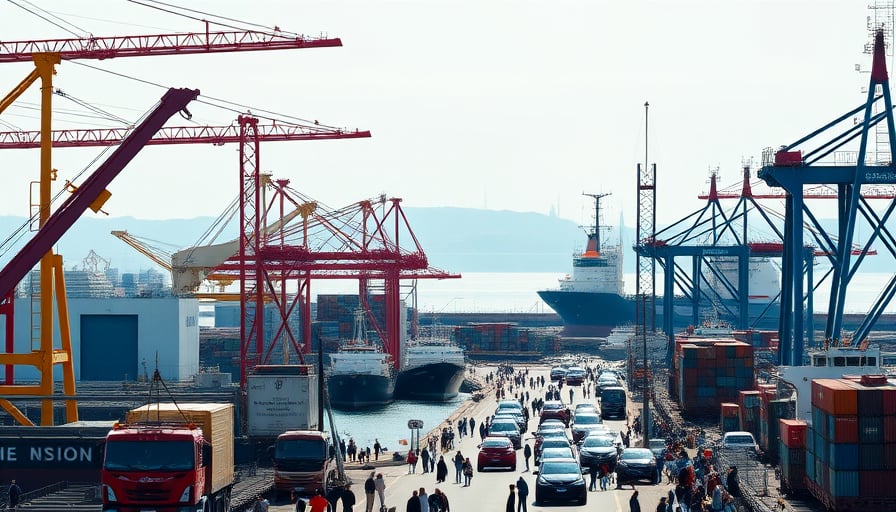
- Ports & Logistics: Operating 25 container terminals worldwide, with a 6.2% YoY increase in throughput, driven by rebound trade volumes post‑COVID‑19.
- Retail: 5,400 retail outlets across Hong Kong, China, and Southeast Asia; sales grew 4.1% amid a modest recovery in consumer spending.
- Telecommunications: Substantial exposure to the Hong Kong 5G rollout; net income increased 8.7% as network expansion reduced churn.
- Infrastructure: Public‑private partnerships in Asia and the UK, with projected cash flows largely fixed over the next decade.
A key strength lies in the circular business model—CK Hutchison’s logistics operations support its retail and telecom infrastructure, creating cross‑segment synergies. However, this integration also introduces inter‑segment risk contagion; a downturn in global trade could compress margin compression across all lines.
Regulatory Environment and Cross‑Border Considerations
CK Hutchison operates under a complex regulatory regime:
- Hong Kong SAR: Securities and Futures Commission (SFC) governs listings, while the Companies Ordinance sets corporate governance standards.
- United Kingdom & Mainland China: Local regulators impose sector‑specific requirements (e.g., UK’s Companies Act for infrastructure, China’s State Administration for Industry and Commerce for retail).
- U.S.: The ADR must comply with SEC disclosure rules (Form 20-F) and the Sarbanes‑Oxley Act, adding a layer of compliance costs.
Recent developments—such as Hong Kong’s tightening of the National Security Law—have raised concerns about political risk affecting corporate operations, particularly for foreign‑owned entities. This geopolitical factor may subtly influence ADR pricing, as U.S. investors weigh sovereign risk against corporate performance.
Competitive Landscape and Market Positioning
CK Hutchison’s principal competitors differ across segments:
- Ports: DP World, Hutchison Ports (via joint ventures), and COSCO Shipping dominate the Asian market. CK Hutchison’s market share of 12% is modest but stable, thanks to strategic alliances and proprietary technology in terminal operations.
- Retail: Competing with SHEIN and Alibaba Group’s Tmall in the fast‑fashion segment, CK Hutchison’s retail arm relies on experiential stores, a differentiator that could capture niche customers.
- Telecommunications: The Hong Kong Telecom sector is oligopolistic; CK Hutchison’s telecom subsidiaries benefit from early adoption of 5G, but face competition from PCCW and SMC.
An often‑overlooked trend is the convergence of logistics and e‑commerce. CK Hutchison’s port operations could integrate more tightly with its retail e‑commerce platforms, offering end‑to‑end supply chain solutions—an opportunity that is underexploited in current disclosures.
Market Dynamics: Hang Seng Index Movements and Implications
The Hang Seng Index, which aggregates Hong Kong’s top 50 companies, experienced a moderate gain at the open of the trading session. CK Hutchison’s inclusion in the index contributed to this upward drift, reflecting investor confidence in the conglomerate’s diversified moat. Nevertheless, the overall volatility—measured by the Hang Seng Volatility Index (HSVA)—remains elevated, driven by macroeconomic uncertainty in China and global interest‑rate tightening.
The ADR’s stability, despite the broader market turbulence, suggests that investors are reassessing CK Hutchison as a defensive play. However, any sharp deterioration in the HKD or an escalation in political risk could quickly erode this defensive stance.
Risk Assessment and Strategic Recommendations
| Risk | Impact | Mitigation | Opportunity |
|---|---|---|---|
| Currency Volatility (HKD/USD) | High | Hedge via forward contracts, ADR structuring | Arbitrage gains from ADR premium adjustments |
| Political Risk (National Security Law) | Moderate | Diversify operations outside Hong Kong | Access to less regulated markets (e.g., Vietnam, Indonesia) |
| Supply Chain Disruption (Port closures) | High | Redundancy in logistics hubs | Expand digital logistics platforms |
| Regulatory Changes (U.S. SEC/UK laws) | Low | Maintain robust compliance | Leverage cross‑border synergies for cost efficiencies |
| Competitive Pressure (Retail & Telecom) | Moderate | Innovate customer experience, invest in 5G | Capture high‑margin services in emerging markets |
Conclusion
The CK Hutchison ADR, while trading at a modest premium, remains tightly coupled to its Hong Kong counterpart. The premium reflects currency, liquidity, and regulatory factors rather than a fundamental mispricing. However, the conglomerate’s diversified portfolio, coupled with an evolving competitive landscape—particularly in logistics and e‑commerce—presents both risks and underleveraged opportunities. Investors should remain vigilant about geopolitical developments and market volatility, while recognizing CK Hutchison’s potential to capitalize on cross‑sector synergies in a post‑pandemic economy.