
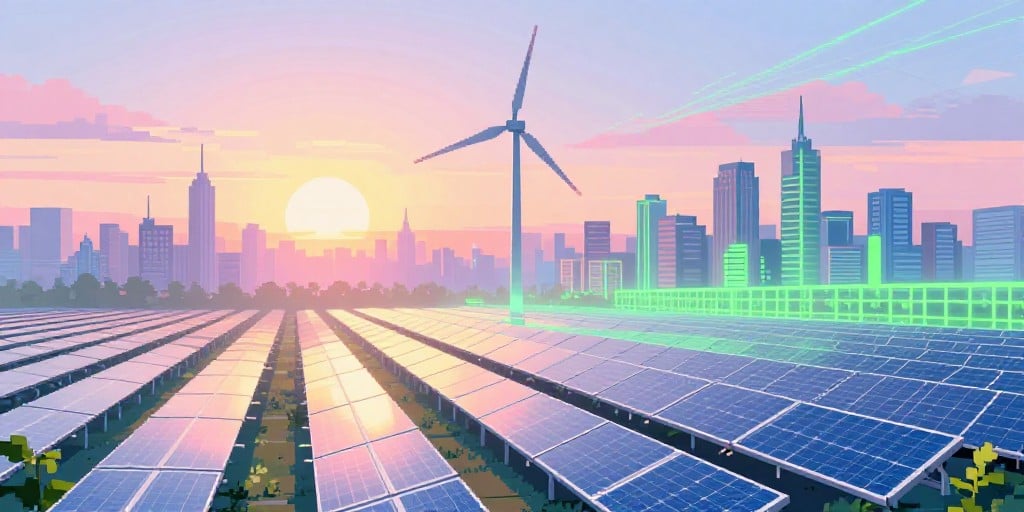
Corporate News: Power Sector Surges Amid Heat‑Wave‑Driven Demand
The day’s market activity exhibited a broad retracement across China’s major indices, yet the power sector emerged as a notable outlier, posting gains that outpaced the overall pullback. Within this sector, a green electricity exchange‑traded fund (ETF) delivered a modest rise, underscoring sustained investor appetite for clean‑energy holdings.
Green Electricity ETF: A Vehicle for Diversified Renewable Exposure
The ETF tracks a green electricity index that blends hydro, wind, solar, and other generation assets, with a particular emphasis on renewable and transition‑era power projects. Its performance today was buoyed by several constituent companies—most prominently a leading water‑power firm and a large energy‑holding group—both of which reported gains exceeding six percent. The ETF’s composition—encompassing hydro, wind, solar, nuclear, and thermal generation—was portrayed as a balanced strategy that captures both the long‑term shift toward cleaner power sources and the immediate benefits of rising demand driven by the current heat wave.
Grid Stability and Renewable Integration Challenges
The heat wave has prompted several provinces to issue high‑temperature alerts, a scenario that historically increases electricity demand. This surge in load stresses the transmission and distribution grid, raising concerns about voltage stability and fault tolerance. Integration of intermittent renewable sources, particularly wind and solar, exacerbates these challenges. Power system operators must employ advanced forecasting tools, dynamic line rating, and flexible generation dispatch to mitigate volatility. Grid operators are also investing in energy storage and demand‑response programs to smooth the net load profile and preserve system inertia.
Infrastructure Investment Requirements
Meeting the dual objectives of grid reliability and renewable penetration requires substantial capital outlays. Estimates suggest that China will need to invest upwards of RMB 2 trillion over the next decade to upgrade transmission corridors, deploy smart grid technologies, and expand distributed energy resources. Key investment areas include:
| Investment Area | Technical Focus | Expected Impact |
|---|---|---|
| High‑Voltage Direct Current (HVDC) links | Long‑distance power transfer with reduced losses | Enhances inter‑regional balancing of wind/solar output |
| Dynamic Line Rating (DLR) | Real‑time capacity monitoring | Increases effective line utilization |
| Wide‑Area Monitoring, Protection, and Control (WAMPAC) | Sub‑second fault detection | Improves fault isolation and system resilience |
| Battery Energy Storage Systems (BESS) | Peak shaving, frequency regulation | Reduces reliance on peaking thermal units |
| Demand‑Response Platforms | Automated load curtailment | Aligns consumption with renewable generation |
Regulatory Frameworks and Rate Structures
China’s regulatory landscape is evolving to accommodate the expanding share of renewables. Recent policy updates emphasize the “green credit” framework, which incentivizes utilities to adopt renewable portfolios and invest in grid modernization. Simultaneously, the State Grid Corporation has piloted time‑of‑use (TOU) pricing in pilot cities, encouraging consumers to shift load away from peak periods.
Rate structures are shifting toward cost‑reflective models that better capture the true value of distributed and renewable generation. The integration of a “grid access fee” for non‑utility generators is also being debated, which could alter revenue streams for both utilities and independent power producers.
Economic Impacts of Utility Modernization
Modernizing the grid has both micro‑ and macro‑economic implications. For utilities, capital expenditures translate into higher cost of service (COS), which may be passed on to end‑users through modest rate hikes. However, long‑term benefits—reduced outage costs, lower transmission losses, and enhanced system reliability—can offset initial price pressures.
From a broader economic perspective, a more resilient grid supports industrial productivity and reduces the risk of blackouts that can derail supply chains. Investment in grid infrastructure also spurs job creation across engineering, construction, and maintenance sectors, contributing to regional economic development.
Engineering Insights: Dynamics of Power System Stability
At the heart of grid stability lies the delicate balance between supply and demand, quantified by the power system’s frequency and voltage profiles. When renewable output fluctuates, the system’s inertia—primarily provided by synchronous generators—diminishes, making frequency regulation more challenging. Modern power electronics, such as inverters for solar and wind, can provide synthetic inertia, but their efficacy depends on control strategies and grid codes.
Moreover, the integration of high levels of renewables increases the proportion of power flow through critical transmission corridors, raising the risk of line overloads. Advanced power flow analysis, utilizing techniques like DC optimal power flow (DC‑OPF) and AC state estimation, is essential for real‑time decision making.
Implications for Energy Transition and Consumer Costs
The convergence of a heat wave‑driven demand spike, diversified renewable portfolios, and a modernizing grid creates a complex environment for stakeholders. While consumers may face modest rate increases, the long‑term benefits of a cleaner, more reliable grid—improved air quality, reduced greenhouse gas emissions, and enhanced system resilience—are likely to outweigh short‑term costs.
Utilities that effectively harness advanced control systems, invest in grid upgrades, and adopt flexible rate structures will be better positioned to navigate the transition toward a predominantly renewable energy mix while maintaining affordability for consumers.
In summary, the power sector’s resilience amid a broader market retracement underscores the strategic importance of grid stability, renewable integration, and infrastructure investment in China’s ongoing energy transformation.