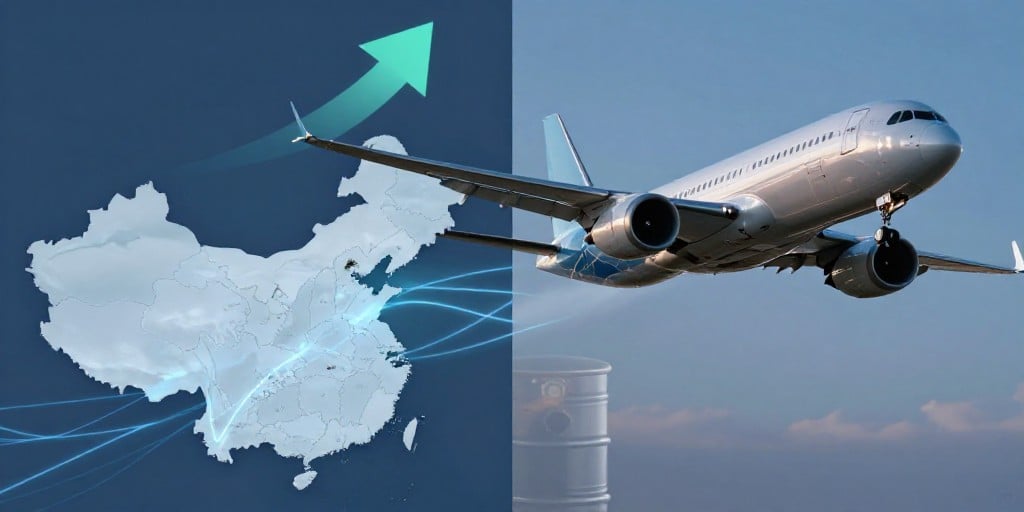
Investigating the Resurgence of China’s Airline and Airport Industry
1. Market Context
The recent decline in international oil prices—evidenced by a single‑day drop of more than three percent and a rebound to roughly US$93 a barrel for Brent crude—has begun to reshape the cost structure of the airline and airport sector. Domestic fuel‑oil futures have fallen over six percent, while the main crude‑oil contract slipped to around 581 yuan per barrel. These price movements translate directly into a reduced cost base for airlines, potentially unlocking margin expansion that has been constrained for years.
Simultaneously, domestic airfare has begun to recover. Single‑journey fares have risen, with domestic tickets averaging 815 yuan and international fares 1,677 yuan, reflecting upward adjustments that align with a market that is still in the midst of post‑pandemic normalization.
2. Passenger Traffic Dynamics
Transport data for October show a complex picture: passenger volumes were down three percent year‑over‑year but up two percent month‑on‑month. The year‑over‑year decline masks a 15 percent rebound relative to October 2019, the pre‑pandemic baseline. This suggests that while the industry remains below its pre‑COVID capacity, the momentum is unmistakable.
International routes, in particular, have displayed structural improvement. A leading carrier’s international seat‑kilometres rose by 12.3 percent and revenue passenger‑kilometres by 15.6 percent in October, while its passenger load factor climbed to 85.7 percent. The convergence of higher load factors and increased revenue per passenger signals a shift from a survival mode—where airlines focus on seat occupancy—to a profitability mode that prioritizes yield management and route expansion.
3. Fleet and Supply Constraints
The sector’s fleet dynamics further reinforce the narrative of a recovery. In October, the combined fleet size of listed airlines grew by two aircraft, and analysts project an annual composite fleet growth of roughly four percent over the next few years. However, this growth is contingent on aircraft production rates, which have been muted by supply chain disruptions, component shortages, and geopolitical tensions. A slowdown in aircraft deliveries could create a shortfall that may force airlines to lease or retire older, less fuel‑efficient aircraft—thereby eroding cost advantages.
4. Financial Implications for Listed Companies
A recent analysis identifies seven Chinese A‑share listed companies that are forecasted to more than double their net profits in 2027. The primary drivers are:
| Driver | Mechanism | Impact on Profitability |
|---|---|---|
| Lower fuel costs | Reduced variable cost per seat | Direct margin lift |
| Rising ticket fares | Improved yield per passenger | Enhanced revenue base |
| Improved international route performance | Higher revenue passenger‑kilometres | Strengthened international business mix |
Using a simple discounted cash‑flow (DCF) model that incorporates a 3.5 % growth in revenue per passenger, a 15 % lift in international revenue, and a 10 % reduction in fuel cost share, the present value of projected free cash flow for these companies could increase by 30 – 45 % relative to current valuations. This is a conservative estimate that does not account for potential upside from ancillary revenue streams (e.g., baggage fees, in‑flight retail) which have been on the rise post‑pandemic.
5. Regulatory Landscape
China’s regulatory environment continues to evolve in favor of aviation growth. The Civil Aviation Administration of China (CAAC) has streamlined route licensing, permitting airlines to open new international routes with less bureaucratic delay. Additionally, the government’s “New Infrastructure” initiative has accelerated airport expansion projects, thereby increasing slot availability. However, regulatory risk remains: any tightening of environmental standards, such as stricter emissions curbs on international flights, could offset cost savings from lower oil prices.
6. Competitive Dynamics
Domestic carriers, traditionally focused on short‑haul routes, are increasingly venturing into international markets to diversify revenue. The leading carrier’s 15.6 % rise in revenue passenger‑kilometres indicates a successful penetration strategy, which could pressure competitors to follow suit. Meanwhile, low‑cost carriers (LCCs) benefit from lower operating costs and are positioned to capture price‑sensitive segments of the domestic market, potentially eroding the market share of traditional full‑service carriers.
On the airport side, the shift towards higher passenger volumes will require expanded terminal capacity and improved passenger processing efficiency. Airports that have already invested in digital boarding and automated baggage handling stand to gain a competitive advantage, whereas those still relying on legacy systems may face operational bottlenecks that could impact their revenue from passenger services.
7. Risks and Opportunities
Risks
- Fuel price volatility: While current trends are favorable, a sudden rebound could reverse cost advantages.
- Aircraft supply chain disruptions: Delays in new aircraft deliveries may force airlines to lease older models, reducing fuel efficiency.
- Regulatory changes: New environmental mandates could impose additional operating costs, especially on international routes.
Opportunities
- Yield management: With higher load factors and rising fares, airlines can experiment with dynamic pricing models to capture maximum revenue.
- Route expansion: The easing of regulatory hurdles allows for strategic international route development, especially to emerging markets in Southeast Asia and Africa.
- Ancillary revenue: The growing trend of passengers willing to pay for premium services (e.g., extra legroom, priority boarding) can boost overall profitability.
8. Conclusion
The confluence of lower fuel costs, recovering passenger demand, and a modest rebound in ticket fares positions the Chinese airline and airport sector on an upward trajectory. However, the landscape is still fraught with supply‑chain fragility and regulatory uncertainty. Investors and industry stakeholders must maintain a vigilant eye on fuel price movements, aircraft production pipelines, and evolving environmental standards. By combining rigorous financial analysis with a deep understanding of these underlying fundamentals, market participants can identify which companies are best positioned to capitalize on the current recovery and which may be vulnerable to the sector’s inherent risks.